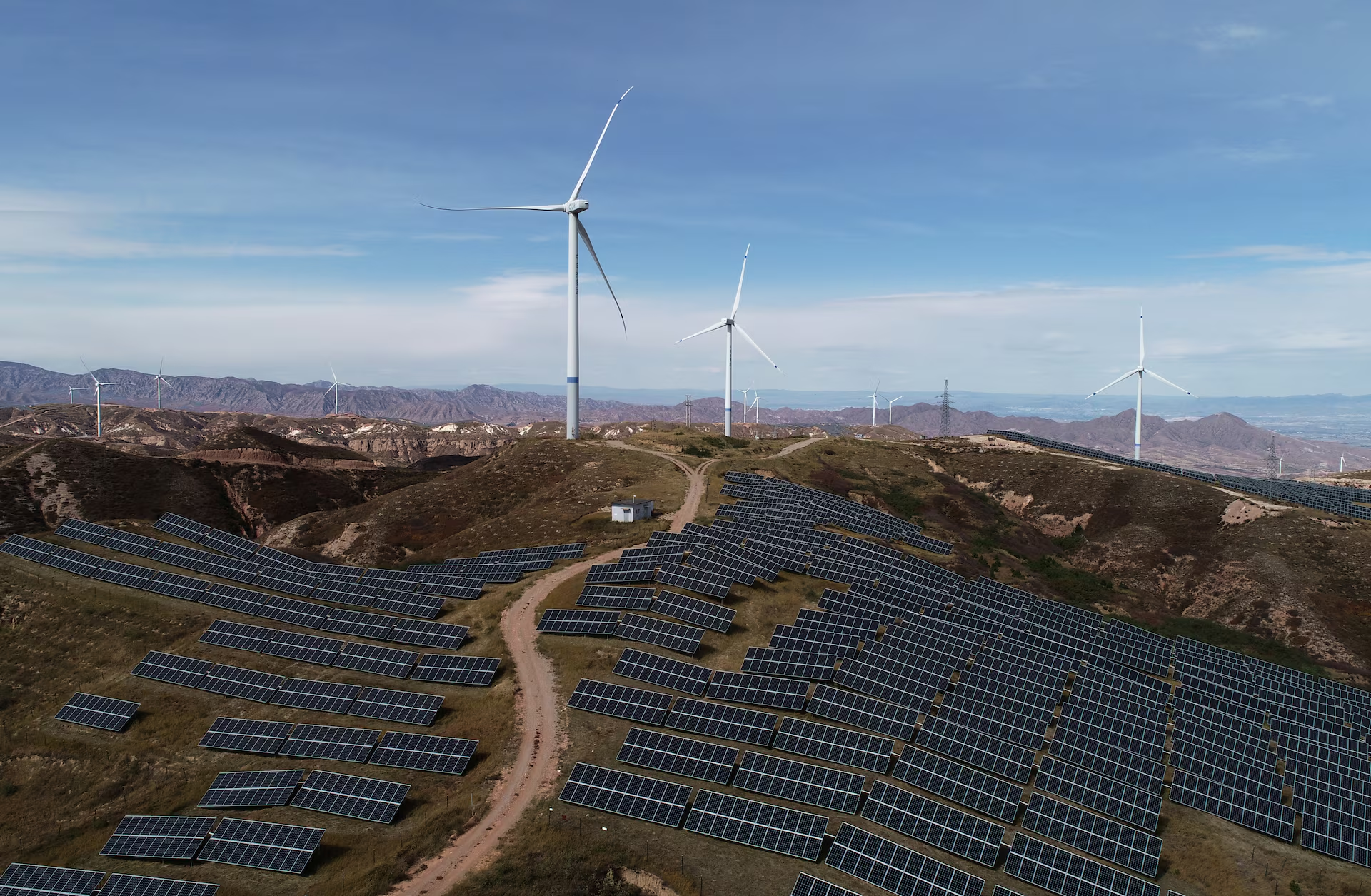
Japan has announced a new package of Japan clean energy investment subsidies worth 210 billion yen ($1.3 billion), aiming to accelerate the use of decarbonised electricity across industry while strengthening regional economies and reducing reliance on imported fossil fuels.
The subsidies, unveiled by a senior official at the Ministry of Economy, Trade and Industry, will be deployed over five years starting in fiscal 2026 and are designed to stimulate demand for renewable power at a time when progress on offshore wind and large-scale solar has slowed.
Demand-side policy enters Japan’s energy transition
Unlike earlier measures focused primarily on power generation, the new scheme targets electricity users. Companies that rely entirely on decarbonised power and contribute to the regions where that power is generated will be eligible for support covering up to half of their capital expenditure. Data centre operators meeting the same criteria will also qualify.
The approach reflects a strategic shift in Japan’s energy policy, recognising that expanding clean power supply must be matched by firm industrial demand if national targets are to be met. Renewable energy currently accounts for about 23 percent of Japan’s electricity mix, while nuclear power contributes roughly 9 percent.
Under government plans, renewables are expected to rise to as much as 50 percent of the electricity mix by fiscal 2040, with nuclear supplying another 20 percent.
Japan clean energy investment subsidies and regional growth
The Japan clean energy investment subsidies form part of the country’s “GX 2040 Vision,” a national framework approved by the Cabinet earlier this year that integrates decarbonisation with industrial competitiveness and regional development.
As part of this framework, the government will establish a “GX Strategy Region” system to foster new industrial clusters in areas with access to decarbonised power sources. Local governments and companies will jointly develop regional plans, with the national government selecting eligible regions and supporting them through subsidies and regulatory reforms. Applications from local governments are expected to open later this fiscal year.
Juntaro Shimizu, Director of the Green Transformation policy group at METI, said: “Companies that rely entirely on decarbonised electricity and contribute to regions where the power is generated will be eligible for subsidies covering up to half of their capital expenditure.”
Energy security shapes the policy calculus
Energy security is a central driver of the new support measures. Resource-poor Japan relies heavily on imported fossil fuels, which account for between 60 and 70 percent of its power generation. That dependence was sharply exposed during the global energy crisis of 2022, reinforcing political momentum behind both clean energy expansion and a return to nuclear power.
Earlier this week, the Niigata prefecture parliament voted to restart the Kashiwazaki-Kariwa nuclear power plant, the country’s largest, more than a decade after the Fukushima disaster triggered the shutdown of Japan’s reactor fleet. Since 2015, Japan has restarted 14 nuclear reactors, with 11 more currently undergoing approval processes.
Balancing ambition and constraints
While Japan’s long-term targets are clear, delivery has faced obstacles. Offshore wind projects — seen as critical to achieving the 2040 renewable energy goal — have been hit by rising costs, while large-scale solar developments have encountered growing local opposition.
By underwriting capital investment for clean-energy users, the government is seeking to anchor demand even as supply-side challenges persist. The policy also signals that Japan’s energy transition will be shaped as much by industrial location and regional planning as by generation capacity alone.
RELATED STORIES:
- Pro Eco Azuero Foundation Receives the 2025 UNESCO–Japan Prize for Education for Sustainable Development
- SDG News Feature: A New Era Under Sanae Takaichi — Implications for Japan’s Agenda
- UNDP, Japan Launch Ambitious Blue Carbon Project to Unlock ASEAN Climate Finance
- Climate Investment Funds Launches Historic $500 Million Bond to Accelerate Low-Carbon Tech
- Biodiversity and nature: Which future will we incentivize
 Follow SDG News on LinkedIn