Denmark’s national election has become a proxy battle for something much larger than domestic politics. What began as a referendum on leadership has evolved into a test case for how advanced economies navigate sovereignty, climate ambition, and public consent in an increasingly volatile global system.
At the center of the election is Prime Minister Mette Frederiksen, whose leadership has been shaped as much by geopolitical pressure over Greenland as by domestic unrest over the country’s green transition.
Greenland and the Return of Hard Power Politics
In recent months, Greenland has reemerged as a geopolitical flashpoint, pulling Denmark into the gravitational pull of great power competition. The Arctic island, rich in critical minerals and strategically positioned, has become a focal point of renewed U.S. interest, forcing Denmark to recalibrate its stance on sovereignty and security.
Frederiksen has leaned into this moment, framing the election as a choice about Denmark’s place in a shifting global order. Her message has been clear: Europe must stand more independently, and Denmark must defend the integrity of the Danish Kingdom, including Greenland.
The strategy appears to have stabilized her political standing after earlier declines tied to domestic dissatisfaction. But it has also underscored a deeper reality: even small, highly stable nations are now operating within a world defined by strategic competition over territory, resources, and influence.
The Green Transition Meets Political Reality
At the same time, Denmark’s identity as one of the world’s most climate-ambitious nations is facing an unexpected challenge from within.
A growing backlash against solar energy infrastructure has become a defining issue in the election, particularly in rural communities. What was once a symbol of progress has, in some regions, turned into a political liability.
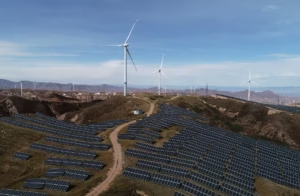
Solar power has expanded rapidly, tripling its share of Denmark’s electricity mix in just a few years. Yet the physical footprint of large-scale solar farms has sparked resistance from residents who argue that farmland is being overtaken, landscapes degraded, and local voices ignored.
The phrase “fields of iron” has entered the political lexicon, capturing a broader sentiment that the green transition is being imposed unevenly, with rural communities bearing the visible costs.
Opposition parties have seized on this tension, transforming climate policy into an electoral battleground. Even traditionally pro-climate actors have softened their positions, signaling a recalibration of how the transition is communicated and implemented.
A Microcosm of a Global Shift
What makes Denmark’s election particularly significant is how clearly it reflects broader global trends.
First, it highlights the return of resource geopolitics. Greenland is not just a territorial question; it is part of a wider scramble for critical minerals essential to clean energy, defense systems, and advanced technologies. Denmark’s experience mirrors similar dynamics unfolding from Africa to the Indo-Pacific, where nations are renegotiating control over strategic assets.
Second, it exposes the political limits of climate ambition. Denmark generates roughly 90% of its electricity from renewables and remains a global leader in decarbonization. Yet even here, the transition is encountering resistance. This suggests that the challenge is no longer technological feasibility, but social license.
Third, it underscores the fragmentation of political consensus. Climate action, once broadly supported, is increasingly contested along geographic and socioeconomic lines. The same pattern is emerging across Europe, where green policies are becoming entangled with broader debates about inequality, identity, and governance.
The Emerging Paradox
Denmark now finds itself navigating a paradox that will define the next decade for many countries.
On one hand, the urgency of climate action and energy independence has never been greater. On the other, the political capital required to implement that transition is becoming harder to sustain.
At the same time, external pressures from allies and competitors alike are forcing governments to prioritize sovereignty, security, and strategic autonomy.
The result is a complex balancing act: accelerating the green transition while maintaining public trust, defending national interests while preserving international alliances.
What This Means for Global Leaders
Denmark’s election offers a preview of the choices facing governments around the world.
The path forward will not be defined solely by policy targets or technological breakthroughs. It will depend on the ability of leaders to align national strategy with local realities, to integrate climate ambition with economic fairness, and to navigate a geopolitical landscape where cooperation and competition increasingly coexist.
In that sense, Denmark is not an outlier. It is an early indicator.
As the world moves deeper into what can only be described as a new geopolitical and economic era, the Danish experience underscores a critical lesson: the success of the green transition will hinge not just on innovation, but on legitimacy.
And legitimacy, as this election makes clear, is now the most contested resource of all.
RELATED STORIES:
- COP30 Opens in Brazil as U.S. Companies Step In to Fill Washington’s Void
- Europe Moves as Washington Talks, NATO Troops Join Denmark in Greenland
- Trump Wants Greenland. NATO Is Now the Story.
- Europe Stands Firm on Sovereignty as Greenland Tensions Escalate
- Denmark Set to Issue World’s First Sovereign Green Bond Under EU Standard
 Follow SDG News on LinkedIn