A funding system built on assessed obligation is absorbing stress from a single capital.
A transfer of roughly $160 million from Washington has marginally reduced more than $4 billion in outstanding U.S. dues to the United Nations, narrowing arrears that now account for more than 95 percent of all unpaid contributions to the regular budget worldwide.
The payment is partial. The imbalance remains structural.
Concentrated exposure
As of early February, the United States owed $2.19 billion to the UN regular budget, alongside $2.4 billion tied to current and past peacekeeping missions and $43.6 million linked to tribunals.
Because assessed contributions anchor the organization’s planning horizon, such concentration of arrears shifts risk from diffuse collective shortfall to asymmetric exposure, compressing financial predictability across core administrative and field operations.
Liquidity becomes conditional.
Under the current administration, Washington has withheld mandatory payments to regular and peacekeeping budgets, reduced voluntary funding to agencies with independent financing structures, and withdrawn from dozens of UN bodies.
The system continues. The margin tightens.
Funding and leverage
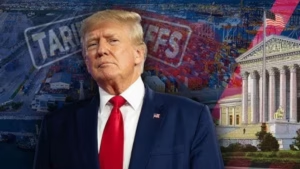
The payment coincided with the first meeting of President Donald Trump’s “Board of Peace,” an initiative recognized by a Security Council resolution through 2027 and initially confined to Gaza, where it was meant to oversee temporary governance.
Trump has since said the board would extend beyond Gaza and address global conflicts more broadly.
The juxtaposition of partial dues settlement with an executive-led governance initiative reframes the relationship between financial obligation and political influence, embedding funding within a broader recalibration of oversight and mandate perimeter.
Obligation and authority intersect.
Countries, including major powers from the Global South and key Western allies, have been reluctant to join the board, and no UN representative attended its first meeting.
Participation narrows.
Viability as discretion
“We’re going to help them money-wise, and we’re going to make sure the United Nations is viable,” Trump said, adding that the organization has “great potential” but has not lived up to it.
Such language positions viability not as an automatic function of treaty-based assessment scales, but as contingent reinforcement subject to executive interpretation.
The United States remains the largest contributor to the UN budget, yet its arrears exceed the combined unpaid amounts of all other member states, concentrating fragility in a single balance sheet.
Continuity now carries discretion.
A system in reset
The UN’s financing architecture assumes predictable inflows across assessed contributions to sustain peacekeeping, tribunals, and core governance functions.
When one member state accounts for nearly all regular-budget arrears while signaling willingness to pay selectively and partially, the funding model shifts from automatic obligation toward episodic settlement, recalibrating leverage within the system itself.
Whether the recent transfer signals normalization of dues or the institutionalization of payment as strategic instrument remains unresolved.
The question is no longer only how much is owed. It is whether obligation will revert to rule or continue to function as leverage within the system it is meant to sustain.
RELATED STORIES:
- How Climate Action is Becoming a Business Opportunity for CEOs
- A $42 Billion Bet: Tanzania’s Gas Gamble and the Future of East Africa’s Energy
- No Time to Idle: CARB’s Grace Period Is Your Ticket to Emissions Reporting Readiness
- U.S. Electricity Demand to Surge 15.8% by 2029: Grid Strategies Report
- A $4 Billion IOU and the Future of the United Nations Under Trump
 Follow SDG News on LinkedIn