As Alphabet seeks one of the largest capital raises in corporate history, governments face growing pressure to secure the energy, talent, and infrastructure needed to compete in the AI economy.
Google’s parent company, Alphabet, announced plans this week to raise $80 billion in new equity capital to finance an unprecedented expansion of artificial intelligence infrastructure, underscoring the immense scale of investment now required to compete in the global AI race. The move includes a $10 billion strategic investment from Berkshire Hathaway, signaling growing confidence from major institutional investors that AI infrastructure will remain one of the defining economic opportunities of the coming decade.
The fundraising effort comes as Alphabet projects capital expenditures of as much as $190 billion in 2026, with spending expected to increase further in 2027. Much of that investment will be directed toward data centers, advanced computing capacity, custom AI chips, and the energy systems required to power them.
For governments around the world, the announcement serves as another reminder that the AI revolution is increasingly becoming an infrastructure race—not merely a software competition.
The New Strategic Asset: Compute
For decades, economic competitiveness was measured through access to labor, natural resources, manufacturing capacity, and financial capital. Today, a new strategic asset has emerged: computational power.
Training and deploying advanced AI systems requires vast networks of data centers, specialized semiconductor chips, reliable energy supplies, and high-speed connectivity. As demand for AI services accelerates, technology companies are investing at levels previously associated with national infrastructure programs.
Google’s cloud business illustrates the scale of that demand. The company reported first-quarter cloud revenues of approximately $20 billion, up 63% year-over-year, while its backlog of contracted cloud services has grown dramatically.
Industry analysts estimate that Microsoft, Alphabet, Amazon, and Meta could collectively spend more than $670 billion on AI-related capital expenditures in 2026 alone, highlighting how rapidly the sector is reshaping global investment patterns.
Energy Becomes the Critical Bottleneck
The announcement also highlights a challenge increasingly confronting governments and technology companies alike: energy availability.
While advances in AI have captured public attention, many experts now view electricity—not computing power—as the primary constraint on future growth. Major technology firms are scrambling to secure long-term energy supplies as they build larger and more powerful data centers.
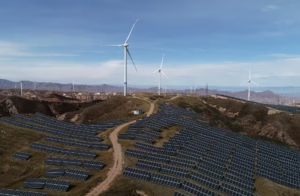
Google has already taken the unusual step of acquiring renewable energy developer Intersect in an effort to secure additional power generation capacity, making it one of the first major technology companies to move directly into energy ownership.
This shift is transforming energy policy into AI policy.
Countries capable of rapidly deploying clean, reliable, and affordable electricity are increasingly positioning themselves as preferred destinations for AI infrastructure investment. Nations unable to expand power generation and grid capacity may find themselves disadvantaged in attracting the next generation of digital industries.
A Growing Competition Among Governments
The race to attract AI infrastructure is no longer confined to Silicon Valley.
Governments across Asia, Europe, the Middle East, and Latin America are introducing incentives to attract data center investments, AI research facilities, semiconductor manufacturing, and cloud infrastructure providers. In many cases, these investments are being viewed as catalysts for broader economic development and digital transformation.
Yet the competition is not without controversy.
Rapid expansion of data centers has raised concerns about land use, water consumption, energy demand, and the equitable distribution of economic benefits. As AI infrastructure becomes increasingly essential to national competitiveness, governments must balance economic opportunity with environmental sustainability and community impact.
The Rise of AI Infrastructure Diplomacy
Alphabet’s announcement reflects a broader trend that is reshaping international relations: the emergence of AI infrastructure diplomacy.
Just as countries once competed to attract manufacturing plants, logistics hubs, and financial centers, they are now competing to become destinations for AI compute capacity. This competition extends beyond private investment and increasingly intersects with national security, industrial policy, energy planning, workforce development, and geopolitical strategy.
The implications are significant.
Nations that successfully attract AI infrastructure may benefit from high-value jobs, technology transfer, research ecosystems, and enhanced economic competitiveness. Those that fail to build the necessary foundations risk becoming consumers of AI technologies rather than participants in their development.
A Defining Test for Governments
Google’s $80 billion fundraising effort is more than a corporate finance story.
It is a signal that the scale of investment required to lead in artificial intelligence is rapidly approaching levels once associated with national infrastructure programs. The companies building the AI economy are no longer asking whether demand will materialize; they are racing to build capacity fast enough to meet it.
For policymakers, the challenge is increasingly clear: ensuring that their countries possess the energy systems, regulatory frameworks, talent pipelines, and investment environments needed to compete in an AI-driven world.
The future of artificial intelligence may be shaped by algorithms, but its success will depend on infrastructure.
RELATED STORIES:
 Follow SDG News on LinkedIn