Ankara summit shifts from spending pledges to concrete capability investments, signaling a new phase in NATO’s military modernization
ANKARA — NATO leaders opened their summit in Ankara by unveiling approximately $50 billion (€43 billion) in new multinational defense procurement contracts, marking one of the alliance’s largest coordinated capability investments in recent years and underscoring a shift from political commitments toward tangible military production.
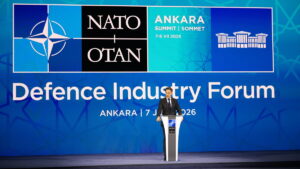
The announcements, led by NATO Secretary General Mark Rutte during the NATO Defense Industry Forum, include major investments in aerial refueling, maritime surveillance, airborne early warning systems, drone technologies, and defense industrial production. The package is designed to accelerate NATO’s readiness while strengthening defense manufacturing capacity across Europe and North America.
The procurement wave comes as alliance members seek to rapidly translate last year’s agreement to significantly increase defense spending into deployable military capabilities amid continued security concerns in Europe.
From Spending Targets to Military Capability
The defense contracts represent one of the clearest demonstrations yet that NATO intends to move beyond commitments on defense budgets toward measurable improvements in operational capability.
Among the flagship announcements are the delivery of the 10th Airbus A330 Multi-Role Tanker Transport (MRTT) aircraft for NATO’s multinational refueling fleet, the procurement of Northrop Grumman Triton unmanned aircraft to strengthen maritime intelligence and surveillance, the joint acquisition of Saab GlobalEye airborne early warning and control aircraft to modernize NATO’s airborne surveillance capabilities, and the launch of the NATO Drone Edge initiative to expand investment in drone and counter-drone technologies while increasing operator training across allied forces.
Speaking at the forum, Rutte emphasized that financial commitments are now being matched with industrial action, telling governments and manufacturers that “the money is there, and more is coming,” while urging both sectors to “do more, faster, together.”
Defense Industry Takes Center Stage
Unlike previous NATO summits that largely focused on political declarations, this year’s opening day placed the defense industrial base at the center of alliance strategy.
The Defence Industry Forum brought together ministers, military officials, investors, and representatives from more than 100 defense companies, reflecting growing recognition that production capacity has become as strategically important as military spending itself. NATO also called on financial institutions to increase investment in the defense sector to help expand manufacturing capacity and accelerate innovation.
The contracts span both European and North American manufacturers, illustrating NATO’s continued emphasis on multinational procurement while encouraging greater interoperability among allied forces.
Strategic Message Amid Global Tensions
The procurement announcements unfolded against a complex geopolitical backdrop, including Russia’s ongoing war in Ukraine, renewed instability in the Middle East, and growing debate over Europe’s long-term security responsibilities.
The summit has also been marked by political tensions surrounding U.S. President Donald Trump, whose comments on Greenland and criticism of some allies drew significant attention. Nevertheless, NATO leaders have sought to project unity around collective defense while emphasizing that strengthening military capabilities remains a shared priority.
For governments across the alliance, the more than $50 billion procurement package demonstrates that NATO’s defense transformation is increasingly being measured not only by national spending targets, but by the speed at which those investments can be converted into operational capability, resilient supply chains, and modern defense technologies.
RELATED STORIES:
 Follow SDG News on LinkedIn