- Climate tech funding dropped 19% in the first half of 2025, with early-stage deals hardest hit.
- The Trump administration’s “One Big Beautiful Bill Act” shifts incentives but leaves some IRA provisions intact.
- Regional players like California are stepping in to fill gaps as federal support recedes.
Investment slowdown under uncertainty
Climate tech investment has cooled in 2025, with funding down 19% compared to last year, according to CTVC. While “mega-deals” above $100 million rose 31%, early-stage rounds fell sharply — seed by 26% and Series A by 12%.
“We found a real slowdown in the first half of the year … people are just not investing in the face of uncertainty,” said Yi Jean, a partner at Clean Energy Ventures.
This downturn has forced startups to prioritize fundamentals. “In today’s climate tech new normal, cash and unit profitability is more important than growth,” said Gabriel Kra, co-founder at Prelude Ventures. “You can’t sell an investor on a vision, you have to prove unit economics and profitability, and how you’re not dependent on tax incentives to reach profitability.”
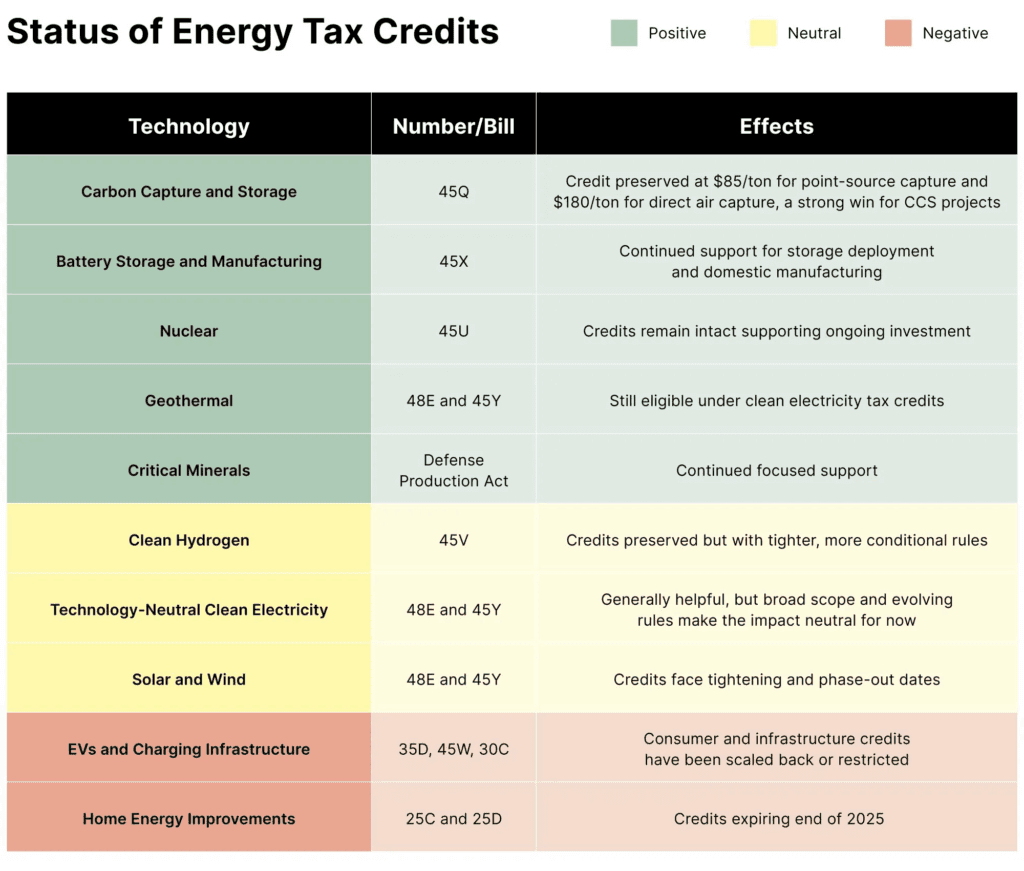
The Trump bill’s mixed impact
The “One Big Beautiful Bill Act” has changed the policy outlook for climate tech but not erased it.
“The sense of disaster has been overhyped,” said Leonardo Banchik, investment director at Voyager. “While the IRA could have been stronger, several important provisions remain intact, which makes a real difference for the sector.”
Some sectors gain, others lose. Tax credits for domestic battery manufacturing remain, while credits for home energy systems are expiring.
How startups are adapting
For Ateios Systems, a startup designing electrodes without toxic chemicals, the bill’s domestic manufacturing provisions are a boost.
“It’s helping our business [from the domestic manufacturing perspective] but it’s not the only thing,” said CEO Rajan Kumar.
Harvest Thermal, which makes smart HVAC systems, faces both challenges and opportunities.
“While the loss of 25D creates headwinds, it has also encouraged us to deepen our partnerships with state and local programs, where we see much of the momentum shifting anyway,” said co-founder and CFO Jane Melia.
California is stepping in, offering up to $25,000 in combined incentives for systems like Harvest’s, while other credits such as 48E for advanced HVAC systems extend through 2033. “Policy shifts like this remind us that incentives come and go, but customer value must remain permanent,” Melia added.
The case for cautious optimism
Despite federal shifts, venture firms see opportunity.
“While we invest in companies with strong fundamentals that don’t depend on policy incentives, having these provisions enshrined in law reduces risk and eliminates countless hours of discussions to build confidence,” said Banchik of Voyager.
Kra of Prelude Ventures echoed that sentiment: “Markets will come roaring back, and companies that meet that moment with unit economics will be poised for growth and tremendous financial success.”
Looking ahead
For now, climate tech is navigating a period of pause and recalibration. Early-stage founders face tougher questions, investors are weighing risk more carefully, and policy incentives are shifting from federal to state and regional levels. But the fundamentals — demand for clean energy, cost declines in technology, and corporate net-zero commitments — remain in place.
As Kra of Prelude Ventures put it, “companies that meet that moment with unit economics will be poised for growth and tremendous financial success.” The wait-and-see mode may dominate today, but the sector’s trajectory still points upward.
Related Content: Tim Mohin: The Climate Impact of the ‘One Big Beautiful Bill’
 Follow SDG News on LinkedIn