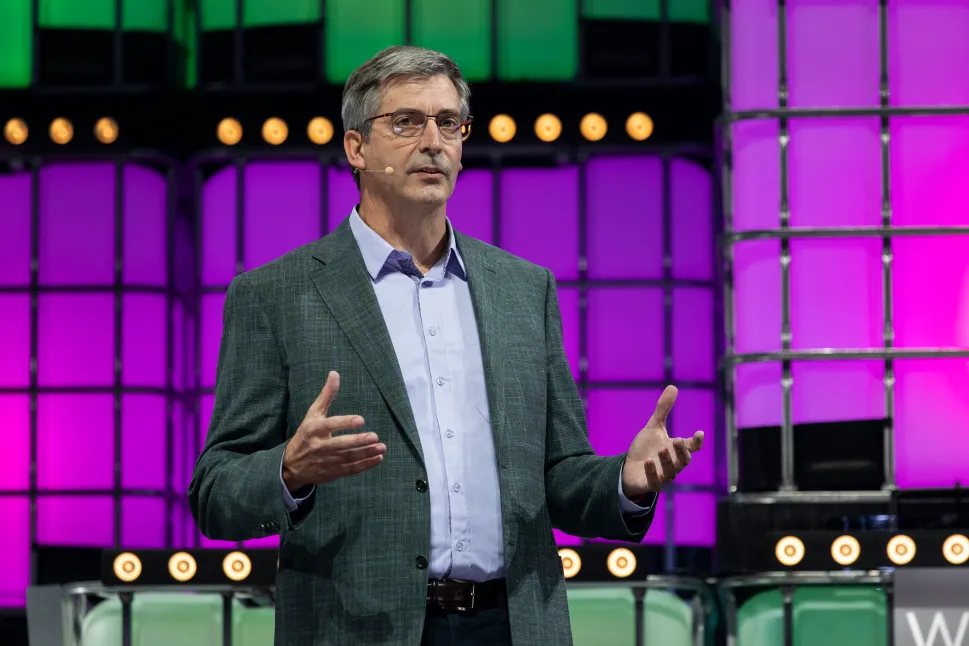
At its annual GTC conference in San Jose, Nvidia CEO Jensen Huang delivered a keynote that underscored a profound shift underway in the global economy: artificial intelligence is no longer an emerging technology. It is becoming the infrastructure layer of modern society.
From next-generation chips to space-based computing, Nvidia’s announcements reveal a company positioning itself not simply as a semiconductor leader, but as the architect of a new industrial era defined by AI at scale.
From Training AI to Running the World
For years, Nvidia dominated the market for training large AI models. At GTC 2026, Huang made clear that the next frontier is inference, the real-time deployment of AI across industries, governments, and daily life.
The company now projects that demand for its AI hardware platforms could reach $1 trillion by 2027, driven by the rapid adoption of AI systems across sectors.
This shift is reflected in Nvidia’s evolving architecture. Its current Blackwell platform, already central to AI training, is now being paired with the next-generation Vera Rubin system, designed to dramatically improve the efficiency and cost of running AI applications at scale.
The message is clear: AI is moving from experimentation to execution, and the companies and governments that can operationalize it will define the next decade.
The Rise of the AI Stack
A central theme of Huang’s keynote was integration. Nvidia is no longer focused on individual chips, but on delivering a fully integrated AI stack that combines hardware, software, and systems architecture.
The Vera Rubin platform represents this shift. It brings together CPUs, GPUs, and software into a unified system optimized for AI agents and large-scale deployment.
This approach reflects a broader reality in the AI economy. Success is no longer about having the best model or the fastest chip. It is about controlling the full pipeline, from data to deployment.
Huang emphasized that this integrated model will power everything from enterprise AI systems to robotics, autonomous vehicles, and national digital infrastructure.
AI Agents and the Next Interface
Beyond hardware, Nvidia is pushing into the software layer with its vision for “agentic AI.”
At the center of this is OpenClaw, an emerging platform that enables the creation of autonomous AI agents capable of performing complex tasks on behalf of users and organizations. Huang described this as a foundational shift in computing, comparable to the rise of operating systems or the internet itself.
To address security concerns, Nvidia also introduced NemoClaw, a secure enterprise version designed to ensure that AI agents operate within controlled environments.
This signals a future where individuals, companies, and governments rely on fleets of AI agents to manage workflows, analyze data, and make decisions in real time.
Extending AI Beyond Earth
In one of the most striking moments of the keynote, Nvidia revealed its ambitions to extend AI infrastructure into space.
The company introduced a Vera Rubin-powered space computing module, designed to enable AI processing in orbit. This marks an early step toward space-based data centers, a concept that could redefine global connectivity and computational capacity.
The implications are far-reaching. As demand for compute continues to surge, space may become a new frontier for digital infrastructure, complementing terrestrial data centers and reducing constraints on energy and land use.
A World Built on Compute
Underlying every announcement was a single, unifying insight: the global economy is being rebuilt around compute.
AI is no longer confined to tech companies. It is becoming embedded in healthcare systems, financial markets, energy grids, defense strategies, and public services. Nvidia’s roadmap reflects a long-term vision of continuous scaling.
The scale of ambition is matched by the scale of demand. Adoption is accelerating so rapidly that it is difficult to imagine a ceiling for customers or use cases.
The Strategic Implications
For governments, Nvidia’s announcements carry strategic weight.
Control over AI infrastructure is increasingly tied to economic competitiveness, national security, and geopolitical influence. Countries that can build or access advanced compute systems will be better positioned to harness AI for growth, resilience, and innovation.
For investors and industry leaders, the message is equally clear. The AI economy is entering a phase of massive capital deployment, where infrastructure, not just applications, will define winners and losers.
The Bottom Line
GTC 2026 was not just a product showcase. It was a statement about the future.
Nvidia is betting that AI will become as foundational as electricity or the internet, powering every sector and every system. Its strategy is to build the infrastructure that makes that future possible.
If Huang is right, the question is no longer whether AI will transform the world. It is who will control the systems that run it.
RELATED STORIES:
- Watt’s Next? Schneider Powers Up AI’s Energy Hunger with Smart Solutions
- Sustainable Funds See 11% Growth in 2023: Key Performers and Insights
- Microsoft Supercharges Sustainability Efforts with Cutting-Edge AI
- India Bets Big on the Backbone of the AI Age
- Big Tech Backs OpenAI’s $110 Billion AI Infrastructure Push
 Follow SDG News on LinkedIn