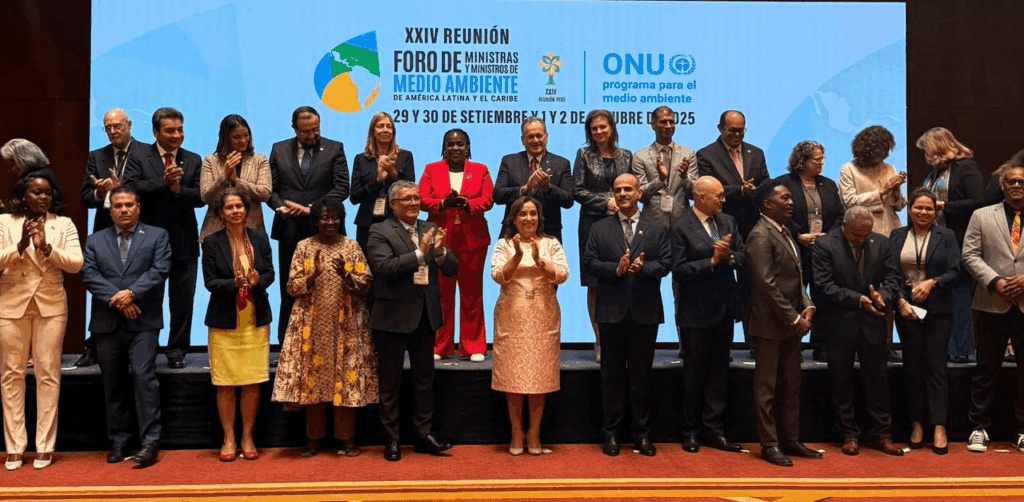
Lima, Peru — The ministers of environment from across Latin America and the Caribbean have chosen Panama’s Minister of Environment, Juan Carlos Navarro, as the new President of the Forum of Ministers of Environment of Latin America and the Caribbean for the 2025–2027 term. The decision, made by consensus during the Forum’s 24th meeting in Lima this week, positions Panama at the center of regional environmental cooperation at a moment when global diplomacy and multilateralism are being redefined.
A Platform for Regional Leadership
The Forum, which convenes 33 countries, is the region’s highest space for dialogue and environmental policymaking. It plays a pivotal role in defining shared priorities and building collective responses to global challenges such as climate change, biodiversity loss, land degradation, and ocean pollution.
Minister Navarro used his acceptance remarks to deliver a pointed call for urgency and unity. “Our region cannot continue losing forests, nor unique species found nowhere else, nor polluting its rivers and oceans,” he said. “Fragmented agendas will not serve our peoples. The only way forward is effective conservation on the ground, backed by integration across our region, to build a just and resilient future.”
Panama’s Dual Approach: Urgent Action and Long-Term Finance
Panama arrives to this presidency with a track record of combining immediate conservation action with forward-looking financial tools. Domestically, the Panama Natural Fund has been established to secure medium- and long-term resources for environmental protection. Internationally, the government has advanced the Nature Pledge, a groundbreaking framework designed to unify global agendas across climate, biodiversity, land, oceans, and plastics into a single, coherent strategy.
This vision has been reinforced through high-profile convenings. In May 2025, Panama joined forces with Global Resilience Partners (GRP) to host the Nature Summit alongside UNFCCC’s inaugural Global Climate Week, establishing a global forum for financing the nature-based economy with leaders from government, business, and philanthropy. Building on that momentum, Minister Navarro announced inside the UN Headquarters during the 80th Session of the General Assembly that Panama and GRP will host invitation-only Nature Summits in Panama City later this year, alongside the UN Biodiversity Convention (CBD) and UN Desertification Convention (UNCCD) intersessionals, further aligning global attention and resources around nature-based solutions.
At a time when multilateralism is under strain, with governments facing multiple, intersecting crises from climate disruption to biodiversity collapse to pollution, Panama’s Nature Pledge may prove to be the innovative policy solution needed to meet this moment. By aligning three global conventions born out of the 1992 Rio Earth Summit under one integrated framework, the Pledge points toward a more effective and coherent path forward for the international system.
Navarro’s Unique Path to Leadership
Navarro’s election also reflects the credibility he brings from a career that spans civil society, the private sector, and public office. As the co-founder and former leader of ANCON, one of Panama’s leading conservation non-profits, he helped pioneer efforts to protect biodiversity and strengthen environmental governance. Later, in the private sector, he steered a renewable energy company, gaining firsthand experience in advancing clean energy solutions and the role of business in driving sustainability. His decade-long tenure as Mayor of Panama City gave him the practical insight of governing a complex, rapidly growing urban hub while balancing economic growth with environmental stewardship.
This combination of perspectives uniquely positions Navarro to bridge sectors and agendas, making him a transformative figure capable of guiding the region toward integrated, innovative solutions. His leadership style, rooted in experience across local, national, and global levels, offers the potential to align political will with practical action at scale.
Defining the Region’s Environmental Agenda
The Lima meeting placed key priorities firmly on the table: curbing pollution, tackling deforestation, advancing climate action, restoring degraded areas, safeguarding biodiversity, promoting gender equality in environmental management, strengthening environmental education, and ensuring sustainable production and consumption.
By assuming the Forum’s presidency, Panama now holds the responsibility of steering these diverse priorities into coordinated action. Navarro’s leadership is expected to emphasize practical conservation measures that deliver visible results while embedding long-term financing and governance reforms that can sustain progress across the region.
A Turning Point for Latin America and the Caribbean
With Latin America and the Caribbean home to some of the world’s most biodiverse ecosystems and most vulnerable communities, the decisions made under Panama’s presidency could influence not just the region’s environmental future, but the planet’s. The election of Minister Navarro marks both a recognition of Panama’s rising leadership in environmental diplomacy and a call for a more united regional response to the planetary crisis.
At a historic crossroads for multilateralism, the question now is whether Latin America and the Caribbean, under Panama’s leadership, can model the integrated action and innovative policies that the world urgently needs.
Related Content: Spotlight: Juan Carlos Navarro, Minister of Environment, Panama
 Follow SDG News on LinkedIn