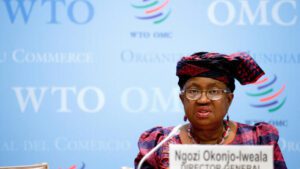
At a moment when the global economy is splintering into competing blocs and supply chains are being redrawn in real time, Ngozi Okonjo-Iweala finds herself at the center of one of the most consequential questions of this decade: can global trade survive fragmentation?
As Director-General of the World Trade Organization, Okonjo-Iweala is not simply managing an institution. She is attempting to hold together a system that has quietly underpinned decades of economic growth, poverty reduction, and international cooperation, even as that system faces its most serious test since its creation.
A System Under Strain
The WTO’s Global Trade Outlook and Statistics, released in March 2026, arrives at a precarious moment. Trade flows are no longer shaped solely by efficiency and comparative advantage, but increasingly by geopolitics, security concerns, and strategic competition.
Governments are reshoring industries. Allies are trading more with allies. Rivalries are hardening into economic boundaries.
What emerges is not the collapse of globalization, but its transformation into something more fragmented and less predictable.
Ngozi Okonjo-Iweala has been clear-eyed about this shift. The risk is not simply slower growth. It is a world in which trade becomes a tool of division rather than cooperation, amplifying inequality between nations and limiting access to critical goods, from food to energy to advanced technologies.
The Stakes for Developing Economies
For developing countries, the consequences are profound.
Many of the world’s fastest-growing economies rely on open markets to export goods, attract investment, and integrate into global value chains. A fractured trading system threatens to close off these pathways, reinforcing economic disparities at a time when climate vulnerability and debt burdens are already rising.
Ngozi Okonjo-Iweala, drawing on her experience as Nigeria’s former finance minister, has consistently framed trade not as an abstract system, but as a lifeline. Access to global markets, she argues, is essential for countries seeking to build resilience, create jobs, and lift populations out of poverty.
In this sense, the future of trade is inseparable from the future of development itself.
Reforming, Not Replacing, Global Trade
Rather than defending globalization in its previous form, Okonjo-Iweala has focused on reform.
Her approach recognizes that the old model of trade, built on assumptions of frictionless integration, no longer reflects political reality. Instead, she has pushed for a system that can adapt to new pressures while preserving core principles of openness, transparency, and fairness.
This includes efforts to modernize trade rules, address disputes more effectively, and integrate emerging priorities such as digital trade and environmental sustainability into the global framework.
It is a pragmatic strategy. Not an attempt to reverse fragmentation, but to manage it.
Trade in an Era of Crisis
The urgency of this work has only intensified as crises converge.
The war in Iran, ongoing tensions between major powers, and the politicization of supply chains have all underscored how quickly trade can become entangled with security. At the same time, climate change is reshaping production patterns, disrupting agriculture, and forcing governments to rethink how goods move across borders.
Trade is no longer just about economics. It is about resilience.
Ngozi Okonjo-Iweala has increasingly framed the WTO’s role through this lens, emphasizing that a functioning global trading system is critical not only for growth, but for stability in an interconnected world.
Leadership at a Crossroads
What distinguishes Okonjo-Iweala in this moment is her ability to navigate both the technical and political dimensions of trade.
She speaks the language of finance ministers and heads of state, but also understands the realities facing developing economies. She is as comfortable discussing supply chains as she is advocating for equity.
This dual perspective has made her one of the few global leaders capable of bridging divides in an increasingly polarized environment.
But the challenge she faces is immense. The forces driving fragmentation are structural, not temporary. They reflect deeper shifts in how nations perceive risk, power, and interdependence.
The Future of Trade
The question is no longer whether global trade will change. It already has.
The question is whether leaders like Ngozi Okonjo-Iweala can shape that change in a way that preserves cooperation in a world tilting toward division.
If the answer is yes, the WTO may yet evolve into a platform for navigating a more complex, multipolar economy.
If not, the world risks entering an era where trade no longer connects nations, but separates them.
For now, the system holds. But only just.
RELATED STORIES:
- California’s Climate Disclosure Laws Survive Motion for Preliminary Injunction – Kristina Wyatt
- A Legislature Steps Into the Ledger
- IRA’s Tax Credit Revolution: Demystifying Tax Equity Investments and Transferable Credit
- Banking on Change: 10 Key Findings Show the Way for Financial Institutions to a Low-Carbon Future
- Tariff Turmoil: Trump Spares EU and Britain, but Global Trade Faces New Uncertainty
 Follow SDG News on LinkedIn