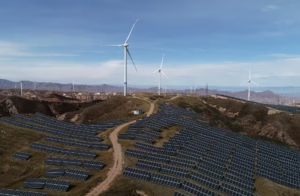
Developers race to lock in federal incentives as renewable energy enters a more expensive era driven by AI-powered electricity demand
The scramble is on.
Across the United States, renewable energy developers have spent recent weeks rushing to qualify projects before the expiration of federal clean energy tax credits, setting off one of the largest waves of solar investment in years. The surge reflects not only a final effort to preserve billions of dollars in incentives, but growing concern that the cost of clean electricity is poised to rise sharply just as artificial intelligence, data centers and electrification are driving unprecedented demand for power.
The rush follows the Trump administration’s accelerated rollback of clean energy tax incentives under its 2025 tax legislation, effectively ending subsidies that for years reduced the cost of developing utility-scale solar and wind projects by roughly 30 percent. Developers have until recently relied on “safe harbor” provisions—starting construction, purchasing equipment or meeting other federal requirements—to preserve eligibility before the deadline.
According to energy research cited by Reuters, developers have already secured incentives for more than 200 gigawatts of solar capacity—nearly enough to double today’s U.S. solar fleet—creating a massive pipeline that could sustain construction through much of the decade.
The End of Cheap Renewable Power?
The expiration of tax credits is expected to reshape renewable energy economics.
Analysis from clean energy marketplace LevelTen Energy projects that prices for long-term renewable power purchase agreements (PPAs) could increase 40 to 50 percent nationally, with early contracts in Texas already showing increases approaching 120 percent. Buyers unable to secure electricity from projects that qualified before the deadline may face dramatically higher costs over the coming years.
The timing could hardly be more consequential.
Electricity demand is accelerating at a pace not seen in decades, fueled by hyperscale AI data centers, domestic manufacturing, electrified transportation and broader industrial growth. Rather than reducing renewable deployment, many analysts argue the removal of subsidies will simply make clean electricity more expensive while demand continues climbing.
A Shift in U.S. Energy Policy
The tax credit rollback represents one of the clearest expressions of President Donald Trump’s broader energy strategy.
The administration has argued that solar and wind have become overly dependent on government support and that U.S. energy security requires greater investment in reliable baseload generation, including natural gas, coal and nuclear power. Officials have framed the policy as restoring market discipline while reducing federal spending on renewable energy.
Critics counter that utility-scale solar and onshore wind remain among the lowest-cost forms of new electricity generation even without subsidies. They argue the policy change risks slowing investment precisely when additional generation capacity is needed to support economic growth and maintain affordable electricity prices.
AI Is Changing the Economics
Ironically, artificial intelligence may prove to be renewable energy’s greatest long-term ally.
Developers increasingly believe soaring electricity demand from AI infrastructure will offset much of the impact of disappearing federal incentives. While projects may become more expensive to build, the value of the electricity they produce is also expected to increase.
Several developers told Reuters they anticipate commercial solar projects will continue to deliver attractive returns even without tax credits, although customer payback periods may lengthen from roughly three years today to five or six years.
That dynamic reflects a broader transformation underway in global energy markets: electricity itself is becoming a strategic asset. As AI systems require ever-larger amounts of power, corporations are competing more aggressively for long-term access to clean electricity, creating new pressures across renewable energy supply chains.
What Comes Next
The immediate consequence of the policy change may be a record wave of project development as previously approved facilities move toward completion.
The longer-term picture is less certain.
The existing pipeline should sustain renewable installations through the end of the decade, but analysts expect new project development to slow once those projects are exhausted. Higher financing costs, increased contract prices and reduced policy certainty could reshape investment decisions across the sector.
For global investors, the episode underscores a larger reality: climate policy can change rapidly, but underlying demand for affordable, reliable and increasingly clean electricity continues to grow.
The next phase of the energy transition may therefore be defined less by government incentives than by the economics of powering an AI-driven world—where clean electricity remains essential, even if it is no longer subsidized.
RELATED STORIES:
 Follow SDG News on LinkedIn