SDG News’ Heeta Lakhani interviews Permanent Secretary Sivendra Michael, Fiji’s chief negotiator, on the MutiRão package, missing fossil fuel language, and why SIDS are pushing to triple adaptation finance and protect 1.5°C as a red line.
Belém — Away from the closed-door rooms where the COP30 presidency is working through competing red lines, Fiji’s Permanent Secretary for the Ministry of Environment and Climate Change and chief negotiator, Sivendra Michael, took a few minutes to explain to SDG News where the MutiRão decision stands — and what is at stake for small island states if this COP ends without a credible outcome.
How the MutiRão text became a “take it or leave it” package
Michael began by outlining how the negotiations arrived at the current moment.
The first iteration of the MutiRão decision was drafted after submissions from negotiating groups and individual countries, including those not belonging to any bloc. A revised version was then circulated — but this time, it was effectively presented as a “take it or leave it” text.
Many countries objected, he said, because their core positions were not reflected. Yet, in a process built on consensus, the areas of “vast divergence” were largely removed so that the text could move forward.
The MutiRão decision now operates as a blended package, tying together other key files that have struggled for agreement in recent COPs, including:
- the Global Stocktake (GST)
- the Just Transition Work Programme
- and other decisions where consensus has repeatedly failed
This means parties could end up with a mix of outcomes — some ambitious, some moderate, some hard for countries to accept — but all held together under a single package.
“For some it may be the best text and for others it may not be,” Michael said, noting that compromise and “maximum levels of flexibility” are now the operating conditions.
A day of fire alarms, stocktakes and shrinking rooms
Sivendra Michael walked through the day’s events in detail.
Talks were meant to resume the previous day, but a fire incident at the venue forced a delay. Negotiations instead began early the next morning, with group meetings from 8:45 to 10:00, followed by an informal stocktake in plenary and then presidency consultations on the MutiRão decision.
In those consultations, groups were asked whether the text was an acceptable “starting basis” from a “start-to-strength” approach or whether it was simply unacceptable. The majority, he said, concluded that it “needed further work” and strengthening.
The presidency responded by setting strict limits: any strengthening would be confined to “very surgical insertions” — a few words that could be added without changing the procedural outcome of a paragraph.
An hour and a half into the meeting, around 30 flags were still raised. With the clock approaching 15:43, Fiji called a point of order to question the mode of work. Michael explained that Fiji proposed stopping further country interventions since groups had already spoken, and asked the presidency to take charge and bring back a new iteration of the text.
Instead, the presidency chose a different path: two representatives per group were invited into a smaller room to work through the points of divergence directly. At the time of the interview, that process had already been running for about four and a half hours.
Why fossil fuel language has disappeared from the draft
Lakhani asked about the substance of the latest text, particularly reports that fossil fuel and deforestation were no longer mentioned.
Sivendra Michael confirmed that fossil fuel language is currently absent. He said there were a couple of reasons offered in the room:
- Some groups within groups could not agree to including fossil fuel language.
- Around 80+ countries opposed its inclusion, while roughly 80+ supported it.
Because of this “vast divergence”, the language — which was present in the first iteration — fell out in the second and, he said, “cannot be included in the third iteration.”
This stands in contrast to the outcome at COP28 in Dubai, where the GST decision explicitly referred to transitioning away from fossil fuels.
Michael added that President Lula’s announcement at the start of COP30, promising a pathway towards a fossil fuel transition, was described to them as being made “in the capacity of a country,” not formally linked to the UNFCCC process. For Michael, this is a problem, because the GST decision on fossil fuels is inside the UNFCCC process — and parties want a follow-on outcome under the same framework.
Negotiators are now trying to see whether paragraph 42 of the MutiRão text can at least recall the GST and reflect mitigation ambition, but for many, simply recalling a past decision is “not enough.”
“There are hard red lines for some countries,” Sivendra Michael said, adding that for others, the positions they are defending are exactly what they need to “take back to their people.”
What Fiji and SIDS need from COP30
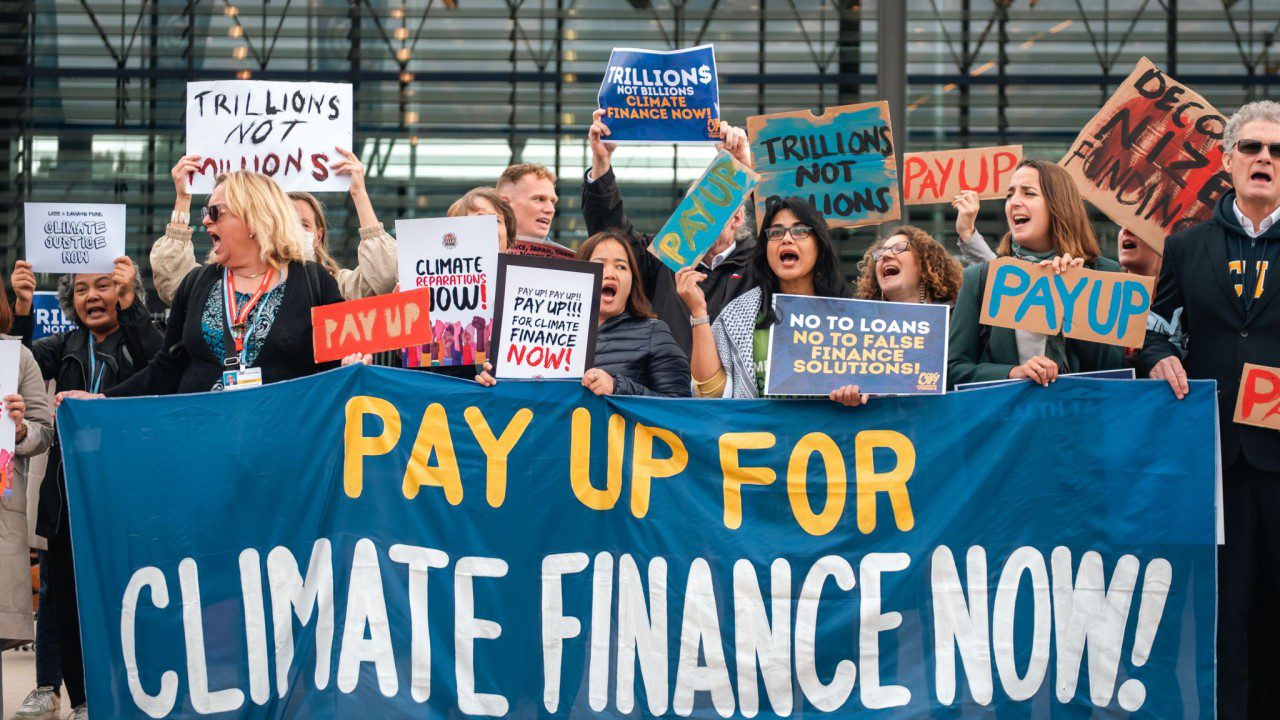
Asked what he wants to see by the end of COP30, Michael was clear that “not going home without an outcome” is essential, particularly for communities that rely on climate finance to adapt.
He set out several priorities from a SIDS perspective:
- Operationalising Article 9.1 of the Paris Agreement — ensuring legally obligated finance flows from developed to developing countries.
- Tripling adaptation finance, with a realistic and fair baseline. Fiji and other SIDS want the baseline to reflect what was agreed in the Glasgow Climate Pact in 2022 (1/CMA.3 paragraph 16), not a weaker reference point.
- Making sure the NCQG discussions reflect a public finance figure of $300 billion, and that there is a clear way forward on how and over what timeframes that finance will be mobilised.
Michael stressed that decisions unresolved for the last five COPs must now be concluded. Keeping vulnerable countries in a holding pattern, while they invest heavily in their own transitions and stretch domestic budgets, is “unfair and unjust.”
He described several red lines for SIDS:
- 1.5°C as an absolute red line
- Special circumstances for SIDS and LDCs as an absolute red line
- A refusal to renegotiate core Paris provisions that were agreed by consensus
He also pointed to 2025 as the “last chance” for NDCs under this cycle. Fiji has already submitted its NDC; many others have not. For countries that have shown leadership, clarity on how their NDCs will be financed is critical.
“Adaptation measures for a climate crisis that we did not create should not be coming from domestic budget,” he said. That message, he added, will be carried forward strongly.
A message to those still in denial — and why SIDS keep showing up
Michael ended with a direct message for those who still doubt climate science or call the crisis a hoax.
He invited them to visit Pacific Islands and see the impacts firsthand: more extreme cyclones, storms and floods, including communities at home flooding from torrential rainfall while he is at COP30 negotiating.
These are, he said, sudden weather changes that did not occur at such severity before, and science has already proven the link. “We cannot challenge science, so we should not continue challenging science,” he warned.
For SIDS negotiators, the work is personal. Michael noted that there are often only three small island developing states in the room when critical finance decisions are on the table.
“If not us, then who?” he asked. “Who will hold the line?”
His question is aimed not only at sceptics, but at the wider system: who will ensure that SIDS receive the finance they should rightfully get for a crisis they did not create?
As talks stretch into the night, that is the question Fiji is keeping at the centre of the MutiRão negotiations — and the question many in the Pacific will use to judge whether COP30 has delivered.
RELATED STORIES:
- Pacific Island Countries Unite to Launch Regional Biodiversity Finance Programme
- Climate Investment Funds (CIF) Backs Fiji’s $27 Million Nature Financing Plan
- Marie-Claire Graf: Shaping the Future of Climate Diplomacy
- Innovation and Sustainability Go Hand in Hand: KPMG
- COP30 Outcomes Set New Finance Commitments but Leave Fossil Fuel Phase-Out Unresolved
 Follow SDG News on LinkedIn