Europe’s foreign policy establishment is under mounting pressure as a growing chorus of officials, diplomats, and analysts warn that the European Union’s approach to global affairs is no longer fit for purpose. What was once framed as a carefully balanced system of shared sovereignty is now increasingly described in sharper terms: fragmented, reactive, and strategically adrift.
At the center of the debate is a simple but consequential question: can a union of 27 countries still act as a coherent geopolitical force in a world defined by speed, conflict, and great-power competition?
A System Under Strain
Recent crises have exposed deep structural weaknesses in how Europe conducts diplomacy. From the Middle East to Ukraine, the EU has struggled to project a unified voice, often issuing cautious statements while others set the terms of engagement.
The war in the Middle East, in particular, has become a defining stress test. European responses have been described by insiders as stunned, sidelined, and disunited, with member states divided over how forcefully to respond to escalating violence and violations of international law.
This lack of cohesion is not just rhetorical. It reflects a deeper institutional problem: foreign policy in the EU still requires alignment across national governments, each with its own interests, alliances, and political pressures. The result is often paralysis at precisely the moments when speed and clarity matter most.
Competing Centers of Power
Compounding the challenge is an internal power struggle over who actually speaks for Europe.
The European External Action Service, designed to function as the EU’s diplomatic arm, has increasingly found itself overshadowed by the European Commission and national leaders. Tensions between Brussels institutions and member states have blurred lines of authority, leading to overlapping initiatives and inconsistent messaging.
This institutional fragmentation has fueled criticism that Europe lacks not only unity, but also strategic direction. Diplomacy is being shaped less by long-term geopolitical thinking and more by short-term political calculations and bureaucratic competition.
A Changing Global Order
The urgency of reform is being driven by a rapidly shifting geopolitical landscape.
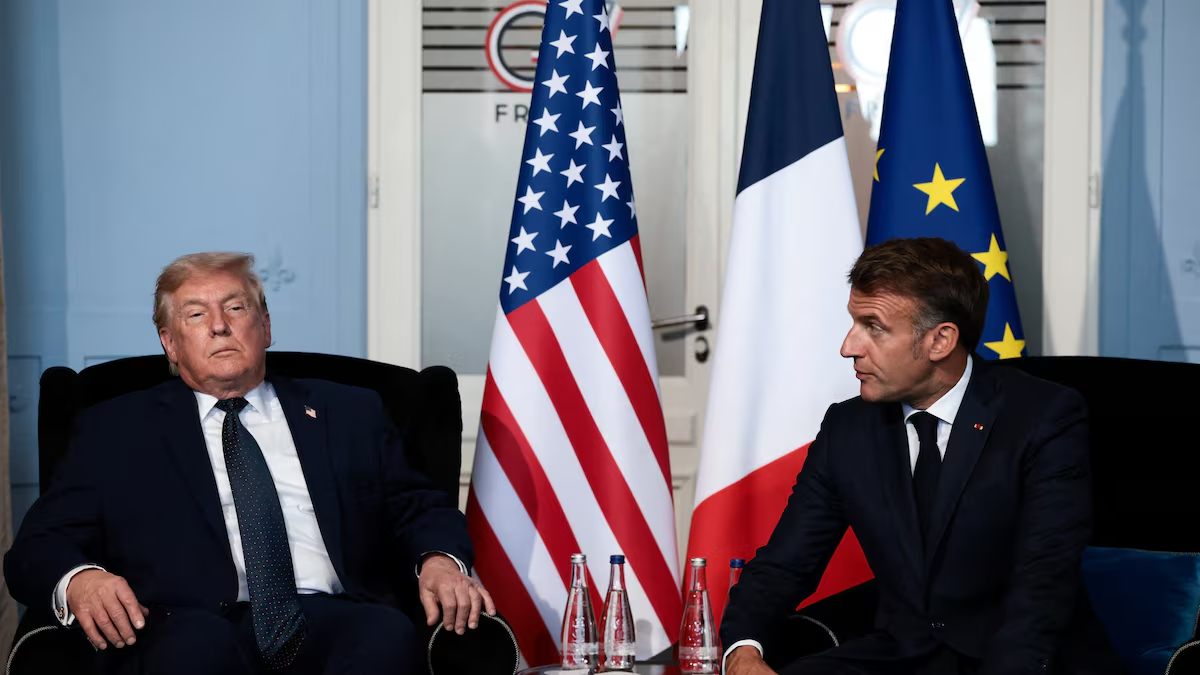
The United States, long Europe’s primary security partner, is no longer seen as a consistent anchor. European leaders now openly acknowledge that Washington’s strategic focus is shifting elsewhere and that transatlantic relations have become more unpredictable.
At the same time, global power dynamics are evolving toward a more transactional and multipolar system. As one senior EU official warned, the world is moving closer to a reality where might makes right, forcing Europe to reconsider how it defends its interests and values.
In this environment, the EU’s traditional model built on consensus, process, and normative influence is increasingly being tested by actors willing to move faster and act more decisively.
Calls for a Radical Overhaul
Against this backdrop, calls for reform are growing louder and more explicit.
Proposals range from streamlining decision-making processes to reducing the requirement for unanimity in foreign policy. Others argue for consolidating diplomatic authority, strengthening the EU’s external service, or even creating a more centralized foreign policy structure that can act with greater speed and coherence.
Underlying all of these ideas is a recognition that the status quo is no longer sustainable. The gap between Europe’s economic weight and its geopolitical influence has become more visible and more consequential.
The Stakes for Europe’s Global Role
What is at stake is not simply institutional efficiency, but Europe’s position in the world.
Without reform, the EU risks becoming a secondary player in global affairs, reacting to events rather than shaping them. Its ability to uphold international law, influence conflicts, and build strategic partnerships could erode, even as global instability increases.
But the path forward is not straightforward. Any meaningful overhaul will require member states to cede some degree of control over foreign policy, an inherently sensitive and political decision.
The debate now unfolding across Europe is, at its core, about sovereignty in a new era: how much to share, how much to centralize, and how to ensure that Europe remains not just a union of nations, but a force capable of navigating and shaping the emerging global order.
RELATED STORIES:
- PwC: How Tech Companies Can Turn Sustainability Compliance into a Competitive Edge
- Global Africa Business Initiative Pushes for Bold Overhaul of Africa’s Economic Story
- UN Report Calls for Overhaul of Mining Finance to Make Responsibility the New Default
- The Business Case for a Sustainable Blue Economy
- Europe’s Hidden Hand in the Iran War
 Follow SDG News on LinkedIn