Artificial intelligence is no longer a frontier technology waiting on the horizon. It is already reshaping economies, governments, labor markets, classrooms, elections, national security, and the basic relationship between citizens and institutions.
The question now facing the world is not whether AI will transform society. It is who will shape that transformation, whose values will guide it, and whether the international system can move quickly enough to ensure that AI becomes a force for shared progress rather than a driver of deeper inequality, instability, and concentration of power.
That is why this week’s SDG News Spotlight turns to two diplomats now positioned at the center of one of the most consequential multilateral conversations of the decade: H.E. Egriselda López, Permanent Representative of El Salvador to the United Nations, and H.E. Rein Tammsaar, Permanent Representative of Estonia to the United Nations.
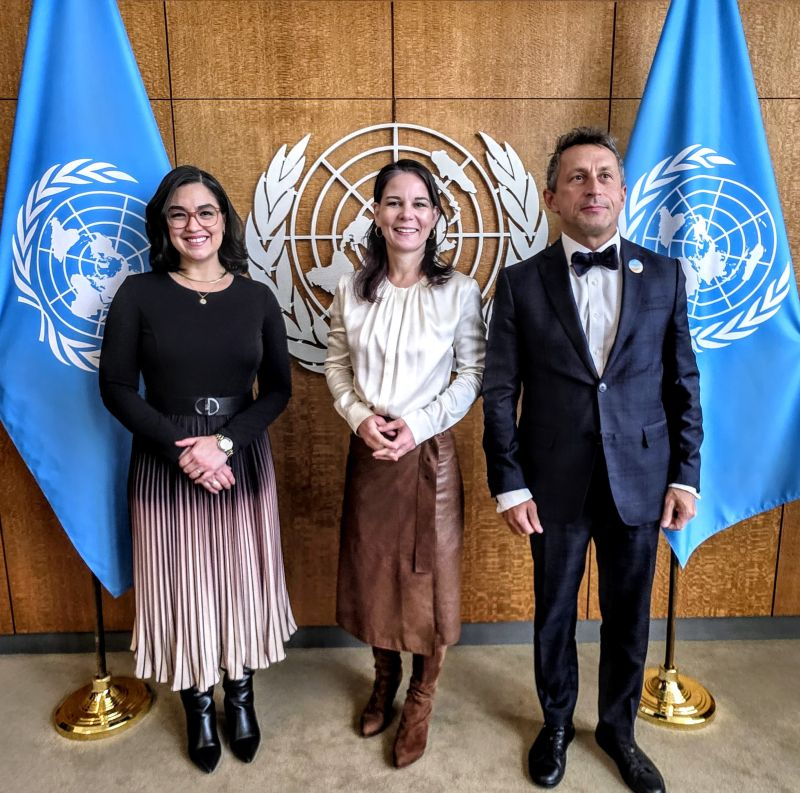
The President of the UN General Assembly has appointed Egriselda López and Rein Tammsaar as Co-Chairs of the 2026 UN Global Dialogue on AI Governance, with the first session scheduled for July 6–7, 2026 in Geneva, followed by a second session in New York in May 2027.
Their appointment gives the AI governance debate something it urgently needs: diplomatic leadership capable of bridging different national experiences, development priorities, technological capacities, and political cultures.
A Global Dialogue for a Global Disruption
The emergence of AI has created a governance challenge unlike anything the multilateral system has faced before.
Climate change, nuclear weapons, pandemics, global finance, human rights, and trade each forced governments to build international mechanisms to manage risks and coordinate action. AI now demands the same level of seriousness, but at a speed and scale that traditional diplomacy has often struggled to match.
The stakes are enormous. AI could accelerate medical breakthroughs, improve disaster preparedness, strengthen food systems, expand education access, and help governments deliver services more efficiently. It could also undermine democratic trust, automate disinformation, deepen surveillance, displace workers, reinforce bias, and widen the gap between countries that control advanced technologies and those left dependent on systems they did not design.
That tension is precisely why the UN Global Dialogue matters. It creates a diplomatic space for governments and stakeholders to move beyond fragmented national responses and begin building a shared understanding of how AI should be governed in the public interest.
Why H.E. Egriselda López and H.E. Rein Tammsaar Matter
The pairing of Egriselda López and Rein Tammsaar is significant.
El Salvador brings the perspective of a country navigating development, digital transformation, public trust, and national sovereignty in a rapidly changing technological landscape. López’s diplomatic career has been rooted in multilateral affairs, including service at El Salvador’s Permanent Mission to the United Nations and leadership roles within the General Assembly system. She has previously served as co-chair of the Ad Hoc Working Group on the Revitalization of the Work of the General Assembly and as Chair of the Fourth Committee of the General Assembly.
Estonia brings a different but complementary experience. It is widely recognized as one of the world’s most digitally advanced states, with a national identity closely tied to digital governance, cybersecurity, public-sector innovation, and trust in digital infrastructure. Tammsaar has served as Estonia’s Permanent Representative to the United Nations since 2022 and previously held senior roles in Estonia’s Ministry of Foreign Affairs, including Under-Secretary for Political Affairs, as well as diplomatic postings connected to the European Union.
Together, they represent two essential sides of the AI governance debate.
One side asks how countries can ensure that AI serves development, inclusion, sovereignty, and human dignity. The other asks how digital systems can be governed with trust, transparency, security, and institutional competence.
The world needs both.
AI Governance Is Now a Development Issue
For too long, the AI conversation has been dominated by the countries and companies building the most powerful systems. But the consequences of AI will not be confined to Silicon Valley, Shenzhen, London, Brussels, or Seoul.
Every country will be forced to answer its own questions.
How should schools use AI? How should governments protect citizens from deepfakes? How should public services deploy automated systems? How should workers be protected from disruption? How should cultures preserve identity and creativity in an age of synthetic media? How should developing countries gain access to AI tools without becoming dependent on private platforms or foreign infrastructure?
These questions will not have identical answers everywhere.
Culture matters. Governance capacity matters. Political systems matter. Economic realities matter. National development priorities matter.
That is why the Global Dialogue can become more than another UN meeting. If designed effectively, it can become a mechanism for countries to share lessons learned, identify common risks, elevate best practices, and inform a broader international framework that reflects the diversity of the world rather than the interests of only its most technologically powerful actors.
The Secretary-General Race Raises the Stakes
The timing is especially important.
The United Nations is entering a pivotal period as member states prepare for the selection of the next Secretary-General, with António Guterres’ term ending on December 31, 2026. The leadership agenda that emerges during this race will help define the priorities of the next UN era.
AI governance should be at the center of that agenda.
The next Secretary-General will inherit a world in which artificial intelligence is already changing the balance of economic power, geopolitical influence, labor markets, information ecosystems, and democratic institutions. The question is whether the UN system will treat AI as a technical issue, or recognize it as one of the defining governance challenges of the century.
H.E. Egriselda López and H.E. Rein Tammsaar’s work arrives at exactly the right moment. Their Global Dialogue can help shape the intellectual and diplomatic foundation for what the next Secretary-General may be asked to champion: a more coherent, inclusive, and legitimate global framework for AI governance.
From Fragmentation to Framework
The world does not need a one-size-fits-all AI regime imposed from the top down. But it does need a serious global process that allows countries to learn from one another, coordinate around shared risks, and build trust in how this technology is developed and deployed.
That could include regular convenings of national AI focal points from every UN member state. It could include structured exchanges on national AI policies, public-sector pilots, regulatory approaches, safety standards, data governance, education, labor-market impacts, and human rights protections. It could also create a pathway for local and national experiences to inform global norms.
This is where the leadership of Egriselda López and Rein Tammsaar becomes so important. Their role is not simply to chair a meeting. It is to help translate a fast-moving technological revolution into a diplomatic process that countries can actually use.
The success of the Global Dialogue will depend on whether it can move beyond abstract principles and become a practical engine for cooperation.
The Defining Governance Test of the AI Era
AI will test every part of the international system.
It will test whether governments can regulate technologies they do not fully control. It will test whether multilateral institutions can adapt quickly enough to remain relevant. It will test whether smaller and developing countries can shape the rules of the future rather than merely absorb decisions made elsewhere. And it will test whether humanity can govern a technology that is beginning to influence how knowledge is created, power is exercised, and reality itself is mediated.
That is why the work now being led by Egriselda López and Rein Tammsaar deserves global attention.
They are not just guiding a UN dialogue. They are helping frame one of the most important questions of our time: can the world build a governance system for artificial intelligence that is inclusive enough to be legitimate, practical enough to be useful, and ambitious enough to meet the scale of the challenge?
The answer will help determine whether AI becomes a tool for shared prosperity or another force that divides the world between those who shape the future and those forced to live inside it.
RELATED STORIES:
 Follow SDG News on LinkedIn