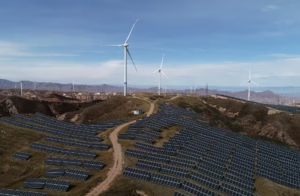
New London, CT — The Trump administration has ordered a stop to construction of the Revolution Wind project, a $4 billion offshore wind farm led by Denmark’s Orsted. With 45 of 65 turbines already standing in the waters off Connecticut and Rhode Island, the decision threatens to derail one of the largest renewable energy projects in the United States and has exposed a widening gulf between Europe’s climate leadership and America’s political retreat.
Denmark’s Wind Legacy Meets U.S. Resistance
For Denmark, the halt strikes at the heart of its global climate mission. The Scandinavian nation pioneered offshore wind in the 1990s and has since become the world’s leading exporter of clean energy technology. Nearly half of Denmark’s electricity today comes from wind, and Orsted has grown into a symbol of how public investment, private innovation, and long-term political will can transform an energy system.
The suspension of Revolution Wind not only threatens billions in Danish investment but also raises doubts about whether America can be trusted as a partner in the clean energy transition. European officials privately warn that political volatility in Washington is undermining transatlantic cooperation at a critical moment for global climate goals.
Connecticut Pushes Back
In Connecticut, state leaders are bracing for the fallout. Attorney General William Tong, who is weighing legal action, warned that halting Revolution Wind will harm consumers and weaken the state’s energy security.
Tong’s objections center on three points:
- Rising costs: Without Revolution Wind, families and businesses remain tied to expensive fossil fuels.
- Economic disruption: Hundreds of union jobs and major infrastructure investments, including the redevelopment of New London’s State Pier, are now at risk.
- Energy vulnerability: Offshore wind was designed to diversify the region’s power supply and reduce dependence on foreign fuels.
“This isn’t just about canceling a wind farm,” Tong said. “It’s about undermining our economy, our security, and our future.”
A Divided Atlantic
Across Europe, the decision is viewed as part of a pattern. The Trump administration has already rolled back solar and wind incentives and shifted federal support toward fossil fuels. In contrast, Europe is doubling down. Denmark, Germany, and the Netherlands are rapidly scaling offshore wind, while the United Kingdom and France are expanding investment to meet ambitious carbon reduction targets.
The result is a widening gap between continents. Europe is accelerating the clean energy transition and cementing global market dominance. The United States, once seen as a promising growth market for renewables, is now being treated with caution by international investors worried that political shifts can erase years of progress overnight.
The Signal to the World
The halting of Revolution Wind sends a stark message far beyond New England. If the United States is willing to abandon a nearly finished offshore wind project led by one of the world’s most trusted energy companies, it raises doubts for countries in Africa, Asia, and Latin America considering similar projects.
For Denmark, the turbines left idle off the Connecticut coast are a painful reminder of the fragility of international cooperation. For the world, they stand as symbols of two diverging paths: in Denmark, turbines are spinning toward the future; in the United States, they are being forced to stand still.
Related Content: Denmark Stands Firm: Backing Ørsted Through U.S. Policy Headwinds
 Follow SDG News on LinkedIn