Under the dense canopy of the Amazon, COP30 opens as a test of both global resolve and political realism. Delegates from nearly 200 nations have arrived in Belém, a city straining under the weight of 50,000 visitors, to determine whether the world can still coordinate its climate future — and who will bear the cost.
Brazil: The “COP of the Amazon”
President Luiz Inácio Lula da Silva has staked Brazil’s leadership on forest diplomacy. His proposed Tropical Forests Forever Facility, a $125 billion fund to reward countries and local communities for keeping forests intact, is the summit’s flagship initiative.
The fund’s early momentum has faltered — the UK declined to contribute, and donor commitments have underwhelmed. Yet Lula’s message is clear: climate progress must start where the planet breathes.
Brazil’s reluctance to press for deeper global emissions cuts, however, has drawn quiet frustration. With only 60 countries having submitted updated Nationally Determined Contributions (NDCs), and most far below the 60% reduction needed to keep warming below 1.5°C, COP30 risks leaving the Paris Agreement’s core promise unfulfilled.
The United States: Absent but Disruptive
While Donald Trump has dismissed climate action as “the greatest con job ever perpetrated,” Washington’s absence has not meant silence. Reports of U.S. interference in international maritime carbon pricing talks have unsettled many delegations, reviving memories of obstructionism from Trump’s first term.
Without a credible U.S. presence, negotiators expect a vacuum in climate finance leadership — and growing latitude for emerging economies to shape the agenda.
China: Pragmatism Over Rhetoric
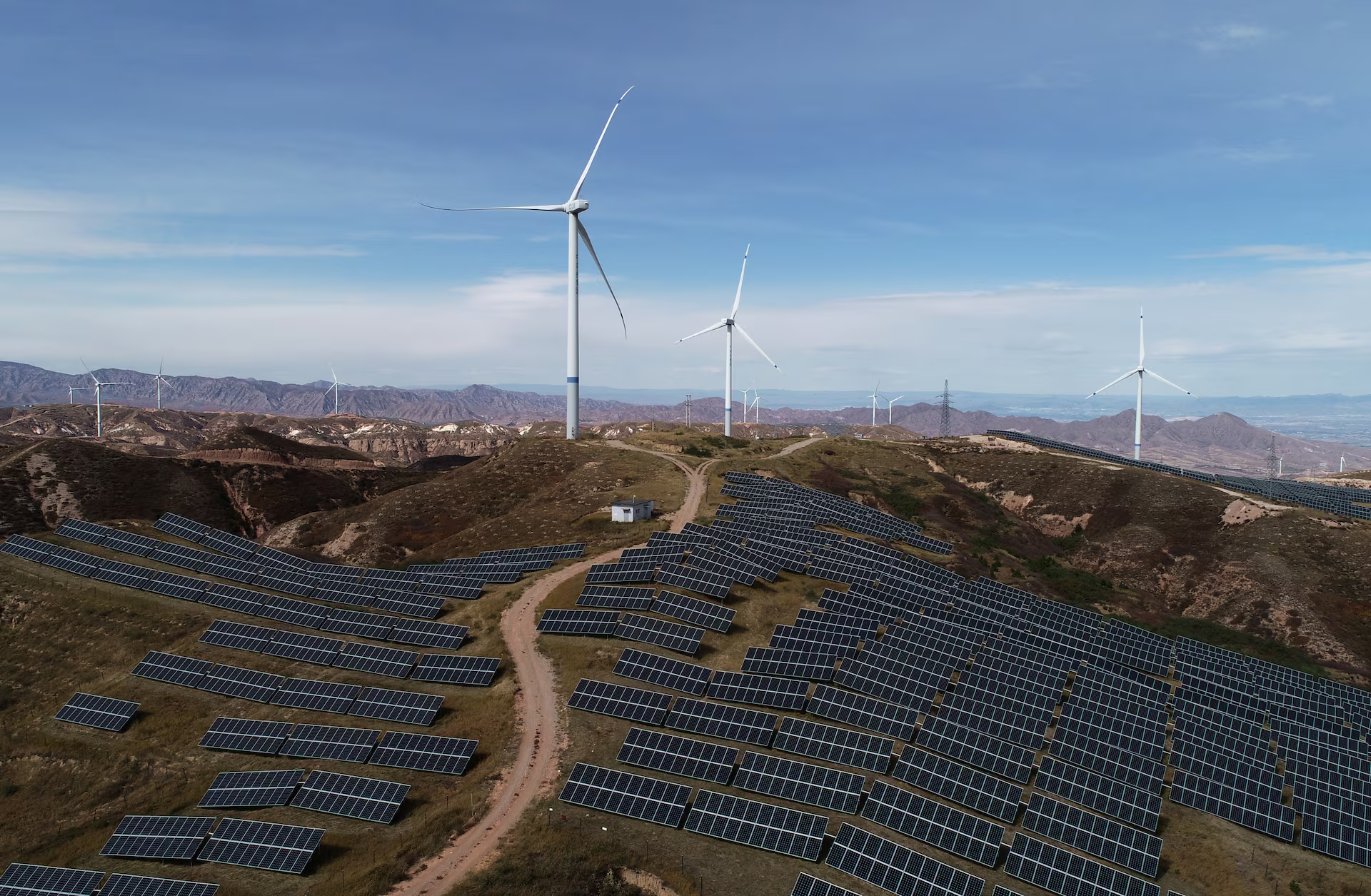
Xi Jinping’s government arrives with a modest pledge to cut emissions 7–10% below their peak by 2035, short of the 30% experts recommend. Still, Beijing’s domestic progress on renewables is unrivaled: over half of China’s electricity capacity now comes from clean sources, and half of all new cars sold are electric.
China’s warm relations with Lula could translate into new partnerships on forest finance or methane reduction, even as the country resists taking on formal climate finance obligations.
India: Finance, Fairness, and Coal’s Shadow
Prime Minister Narendra Modi’s delegation enters COP30 focused on ensuring that developed nations uphold the $1.3 trillion-per-year climate finance goal by 2035. India’s negotiators argue that rich economies must shoulder the cost of decarbonisation, while developing nations retain the right to use fossil fuels for growth.
Domestically, India remains one of the fastest-growing renewable producers — nearly half its installed capacity now comes from clean energy. But coal remains politically untouchable. Modi’s balancing act — between development and decarbonisation — will define India’s credibility in Belém.
The European Union: Divided Ambition
The EU arrives in Belém with an emissions target of 66.25%–72.5% cuts by 2035, but internal fractures reveal a bloc struggling to maintain unity. Right-wing political shifts in France, Germany, and Eastern Europe have weakened the EU’s once-unquestioned climate leadership.
Even so, negotiators led by Wopke Hoekstra aim to position the EU as a bridge-builder, exploring alignment with China to counterbalance U.S. disengagement. Diplomats say a revived EU–China climate partnership could emerge as COP30’s diplomatic surprise.
Small Island States and LDCs: The Moral Core
For the Alliance of Small Island States (AOSIS) and the Least Developed Countries (LDCs), COP30 is about survival. They want clear progress on enforcing the International Court of Justice ruling that holds states legally responsible for climate harm, and on converting the Baku to Belém Roadmap into actual funding flows.
With many LDC delegations struggling even to reach Belém, their demands center on debt relief, climate grants, and debt-for-climate swaps — mechanisms that could free fiscal space for adaptation without deepening debt.
A New Climate Order
As the first post-U.S. COP unfolds, the alliances forming in Belém hint at a global realignment: forest nations seeking equity, developing economies demanding fairness, and small islands pressing legality.
Whether these forces can converge on implementation — or fracture under competing priorities — will determine whether COP30 becomes a new foundation for climate cooperation or another summit of unrealized ambition.
MORE RELATED STORIES:
- EU Proposes 90% Emissions Cut by 2040 Under Amended Climate Law
- UN Climate Report Reveals Just Transition Still Missing from Most National Climate Plans
- What Is Blue Finance? How a $24 Trillion Ocean Market Is Beginning to Make Waves
- Green Building Revolution: $1.8 Trillion Opportunity to Cut Emissions by 80%
- COP 16 vs COP 29: Key takeaways and the Fight for Funds
 Follow SDG News on LinkedIn