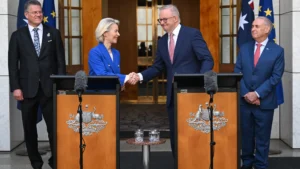
The European Union and Australia have reached a sweeping trade agreement that eliminates tariffs on nearly all goods, promising billions in new economic activity and closer ties between two distant but increasingly aligned economies.
European exporters are expected to save roughly $1.2 billion annually, while Australia projects economic gains of about $7 billion each year. Trade flows are set to expand across sectors, from agriculture to advanced manufacturing.
But the agreement arrives at a moment when trade deals are no longer just about trade.
They are about how power is being reorganized.
A Deal for a Different Era
For decades, global commerce was shaped by a single, interconnected system built on efficiency and scale. That system is now under strain, as geopolitical tensions, supply chain disruptions, and shifting alliances force governments to rethink how—and with whom—they do business.
The deal between Europe and Australia reflects this shift. Beneath its technical provisions lies a strategic objective: to build economic relationships that are not only profitable, but reliable.
Central to that effort is a shared focus on critical minerals, including lithium, cobalt, and rare earth elements. These materials underpin everything from electric vehicles and renewable energy systems to semiconductors and defense technologies. Securing access to them has become a defining priority for governments across the developed world.
Australia, rich in these resources, is emerging as a cornerstone supplier. Europe, seeking to reduce dependence on concentrated supply chains, is looking outward.
The agreement binds those interests together.
The Quiet Rise of Minerals Diplomacy
In recent years, a new kind of diplomacy has taken shape, one centered not on territory or ideology, but on materials.
The United States, the European Union, Japan, and Australia have all moved to deepen cooperation on critical minerals, forming partnerships designed to secure supply chains and reduce exposure to geopolitical risk. Financing frameworks, industrial policies, and trade agreements are increasingly aligned around this goal.
The EU–Australia deal is a natural extension of that trend. It integrates supply chains across continents, lowers barriers to investment in mining and processing, and formalizes cooperation between governments that see economic security as inseparable from resource access.
What is emerging is less a global marketplace than a network of trusted partners.
Moving Beyond Dependence
The urgency behind these efforts is clear.
China continues to dominate large portions of the global minerals supply chain, particularly in processing and refining. For Western governments, that concentration has become a strategic vulnerability.
The response has been to diversify—geographically, politically, and economically.
Trade agreements like this one are part of that recalibration. They are designed to create alternative pathways for critical inputs, ensuring that supply chains can withstand shocks, whether economic or geopolitical.
In this sense, trade policy is being reimagined as a form of risk management.
Europe’s Expanding Map
The agreement with Australia is not an isolated development. It is part of a broader European strategy to expand its economic reach and reduce reliance on any single partner.
Negotiations with India have accelerated. Long-delayed talks with Mercosur have regained momentum. Across these efforts, a common thread is emerging: access to resources, resilience of supply chains, and alignment with partners that share political and economic priorities.
Europe is not retreating from globalization.
It is reshaping it.
A World of Networks, Not Systems
The deal offers a glimpse into what may define the next phase of the global economy.
Rather than a single, integrated system, the world is moving toward a patchwork of overlapping networks—groups of countries bound together by shared interests, common standards, and strategic trust.
In this environment, trade agreements serve a dual purpose. They facilitate commerce, but they also signal alignment.
The EU–Australia agreement does both.
It links Europe more closely to the Indo-Pacific. It secures access to the materials that will power the energy transition and the digital economy. And it reinforces a broader shift toward partnerships that prioritize resilience over efficiency.
For policymakers, the implications are profound.
The question is no longer simply how to grow.
It is how to position one’s economy within a world where supply chains, like alliances, are becoming instruments of strategy.
RELATED STORIES:
- UN Global Compact meets at the EU Parliament to advance corporate sustainability
- Australia Unveils Sustainable Finance Roadmap to Lead in Global Sustainability Efforts
- Australia Passes Mandatory Climate Reporting Bill for Large and Medium-Sized Companies
- Caribbean Launches $110M Renewable Energy Facility to Cut Costs and Boost Resilience
- First Climate Migrants From Tuvalu Arrive in Australia Under Visa Deal
 Follow SDG News on LinkedIn