BRUSSELS — At a moment when the global order is being stress-tested from Ukraine to the Middle East, one of the most consequential diplomatic voices in the world does not come from Washington or Beijing—but from Brussels.
Kaja Kallas, the European Union’s High Representative for Foreign Affairs and Security Policy, has emerged as a defining figure in a new era of geopolitical competition, where alliances are shifting, institutions are under strain, and the rules of engagement are being openly contested.
From Tallinn to the Global Stage
Kaja Kallas’ rise is both rapid and revealing. A former Prime Minister of Estonia from 2021 to 2024, she led a small Baltic nation with an outsized understanding of geopolitical risk—particularly from Russia.
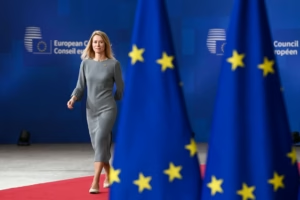
That experience now shapes her worldview at the highest levels of diplomacy. Since assuming her role in December 2024, Kallas has effectively become the European Union’s chief diplomat and one of its most powerful strategic actors, responsible for coordinating foreign policy across 27 member states.
Her mandate is clear: make Europe more assertive, more unified, and more capable of shaping global outcomes.
A Doctrine of Clarity in a Fog of War
Kaja Kallas has distinguished herself with a style that is unusually direct for European diplomacy—earning her a reputation as one of the bloc’s most candid voices on security.
Nowhere is this more evident than in her approach to Russia’s war in Ukraine. She has consistently argued that concessions to aggression only invite more instability, warning against proposals that would pressure Ukraine to cede territory.
Her position reflects a broader strategic doctrine: deterrence through strength, not compromise through fatigue.
It is a stance shaped not just by policy, but by proximity—Estonia sits on NATO’s eastern flank, where the consequences of miscalculation are not theoretical.
Navigating a Fractured Alliance System
Kaja Kallas’ tenure comes at a time when the traditional pillars of Western alignment are showing signs of strain.
Tensions between the United States and Europe have intensified, particularly amid an increasingly unpredictable U.S. foreign policy posture. Kallas has not hesitated to push back, rejecting narratives that diminish Europe’s global relevance and warning against diplomatic approaches that could embolden adversaries.
At the same time, she is working to expand Europe’s strategic autonomy—without breaking from NATO. She has cautioned against the creation of a standalone European army, arguing that fragmentation of command could weaken collective defense rather than strengthen it.
The balance she is attempting to strike is delicate: a Europe that is stronger, but not separate; independent, but not isolated.
Diplomacy in an Age of Overlapping Crises
Beyond Ukraine, Kallas is operating across a widening arc of instability.
She has been actively engaged in Middle East diplomacy, holding talks with regional powers to prevent escalation and safeguard critical energy routes like the Strait of Hormuz.
At the same time, she has linked conflicts across regions—highlighting how Russia’s actions in Ukraine intersect with broader geopolitical tensions, including its relationships in the Middle East.
This systems-level view of conflict—where crises are interconnected rather than isolated—is increasingly shaping EU foreign policy under her leadership.
The Face of a More Assertive Europe
Kaja Kallas represents something larger than her office. She is the embodiment of a Europe that is being forced to redefine itself in real time.
No longer able to rely on the stability of the post-Cold War order, the European Union is stepping into a more consequential role—one that requires clarity of purpose, speed of action, and political courage.
Kallas has leaned into that moment.
Whether navigating war in Europe, instability in the Middle East, or shifting alliances with global powers, she is helping to shape what may become the defining question of this decade:
Can Europe move from being a participant in the global order to becoming one of its architects?
In Kaja Kallas, the answer increasingly looks like yes.
RELATED STORIES:
 Follow SDG News on LinkedIn