Key Points:
• ICJ unanimously declares states must prevent environmental harm and cooperate on climate under international law
• Obligations derive from treaties, customary law, UNCLOS, biodiversity agreements, and human rights law
• States may face legal consequences — including reparations — for failure to act on climate change
ICJ Issues Landmark Climate Advisory Opinion
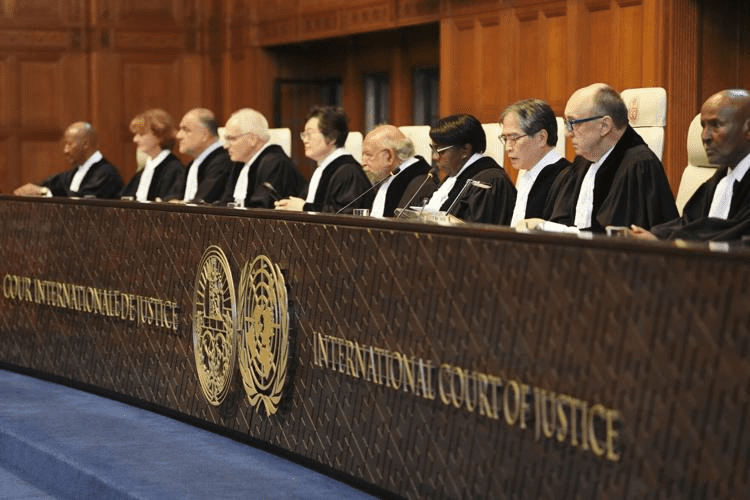
On 23 July 2025, the International Court of Justice (ICJ) issued a unanimous Advisory Opinion outlining the legal obligations of states under international law to address climate change — and the consequences for failing to do so. The opinion responds to a 2023 request from the UN General Assembly under resolution 77/276.
“This marks only the fifth time in the Court’s 78-year history that it has delivered a unanimous advisory opinion.”
The Questions Before the Court
The General Assembly asked the ICJ to answer two legal questions:
(a) What are the obligations of States under international law to ensure the protection of the climate system and other parts of the environment from anthropogenic emissions of greenhouse gases for present and future generations?
(b) What are the legal consequences under these obligations for States where they, by their acts and omissions, have caused significant harm to the climate system and environment — particularly with respect to vulnerable states and affected peoples?
The Court accepted jurisdiction and found no reason to decline the request, noting the “unprecedented” global relevance of climate change.
Legal Obligations: What States Must Do
The Court confirmed that states have binding legal obligations to address climate change under multiple bodies of law:
1. Climate Treaties
States are bound by the UN Framework Convention on Climate Change (UNFCCC), the Kyoto Protocol, and the Paris Agreement. These include obligations to:
- Mitigate greenhouse gas emissions
- Prepare and update nationally determined contributions (NDCs)
- Act in accordance with “common but differentiated responsibilities”
- Adapt to climate change and support others through finance and technology transfer
2. Customary International Law
States must:
- Prevent significant harm to the climate system by acting with due diligence
- Cooperate continuously and in good faith to prevent climate-related harm
- Regulate private actors whose emissions may cause harm
3. Other Environmental Treaties
Obligations also derive from the:
- United Nations Convention on the Law of the Sea (UNCLOS)
- Vienna Convention and Montreal Protocol (and its Kigali Amendment)
- Convention on Biological Diversity
- Convention to Combat Desertification
4. Human Rights Law
States must protect the climate system to ensure the effective enjoyment of human rights, including the rights to life, health, and a clean, healthy, and sustainable environment.
“Due diligence must be exercised not only through state actions but also through regulation of private actors contributing to emissions,” the Court stated.
What Happens When States Fail
The ICJ held that a breach of these obligations constitutes an internationally wrongful act, which may trigger:
- Cessation of the wrongful conduct
- Assurances of non-repetition, if warranted
- Full reparation, including restitution, compensation, or satisfaction, provided a causal link is established
The Court explained that:
“A sufficiently direct and certain causal nexus” is the applicable legal standard, and attribution to specific states is possible even in complex, cumulative climate harm cases.
While states’ emissions may collectively contribute to climate change, the Court emphasized that each injured state can invoke responsibility against any state that breaches its climate obligations.
No Special Treatment for Vulnerable States — But Rights Apply Equally
The Court found that legal consequences apply equally, regardless of whether a state is particularly vulnerable (e.g., a small island state) or specially affected. However, it acknowledged that such states may experience disproportionately greater harm — and remain entitled to the same remedies.
The Court also clarified that whether individuals can bring claims depends on the specific treaties governing their rights, not on general state responsibility rules.
Obligations Owed to All: Climate as a Global Legal Interest
In a significant legal determination, the ICJ declared that states’ obligations to protect the climate system are erga omnes — owed to the international community as a whole.
“All States have a legal interest in the fulfillment of these obligations,” the Court stated, enabling collective responsibility enforcement under international law.
A Turning Point in Climate Law
The opinion follows the highest participation in ICJ history:
- 91 written submissions
- 96 states and 11 international organizations presented oral arguments in hearings held December 2024
The ICJ stressed that while it does not rule on individual state responsibility, its conclusions provide a clear legal framework for states, courts, and future claims.
📘 Read the Full Advisory Opinion (PDF)
📄 ICJ Press Release (PDF)
📄 Opinion Summary (PDF)
 Follow SDG News on LinkedIn