Chile has elected a new president at a moment when climate ambition, economic anxiety, and political polarization are colliding across Latin America.
Conservative leader José Antonio Kast won the presidential runoff with a decisive majority, capitalizing on public frustration over crime, migration, and the rising cost of living. His victory marks a clear political shift for a country that has spent the last decade positioning itself as one of the developing world’s most credible climate and clean energy leaders.
The result does not immediately undo Chile’s climate trajectory. But it fundamentally reframes the question facing the country and the region: can climate action survive, and even accelerate, when it is no longer driven by progressive politics but by competitiveness, security, and economic growth?
A conservative figure shaped by Chile’s post transition politics
Kast is no newcomer to Chilean politics. A lawyer by training and a former member of Congress, he served for more than fifteen years representing Santiago districts, where he became known as a staunch social conservative and an outspoken advocate for free markets, limited government, and strong law enforcement.
Born in Santiago in 1966 to a family of German immigrants, Kast was educated at the Pontifical Catholic University of Chile before entering public service. Over time, he broke with Chile’s traditional center right, arguing that mainstream parties had failed to respond to voter concerns around security, economic stagnation, and institutional drift.
In 2019, he founded the Republican Party of Chile, which rapidly grew by channeling voter fatigue following years of social unrest, constitutional uncertainty, and declining trust in political institutions. Kast first ran for president in 2021, losing in a runoff but emerging as the dominant voice of Chile’s conservative movement. His second campaign sharpened its focus on restoring order, reducing bureaucracy, and accelerating economic growth.
That message resonated in a country where climate ambition has increasingly collided with everyday anxieties.
Why Chile still matters for the global climate agenda
Chile occupies an outsized role in the global climate transition.
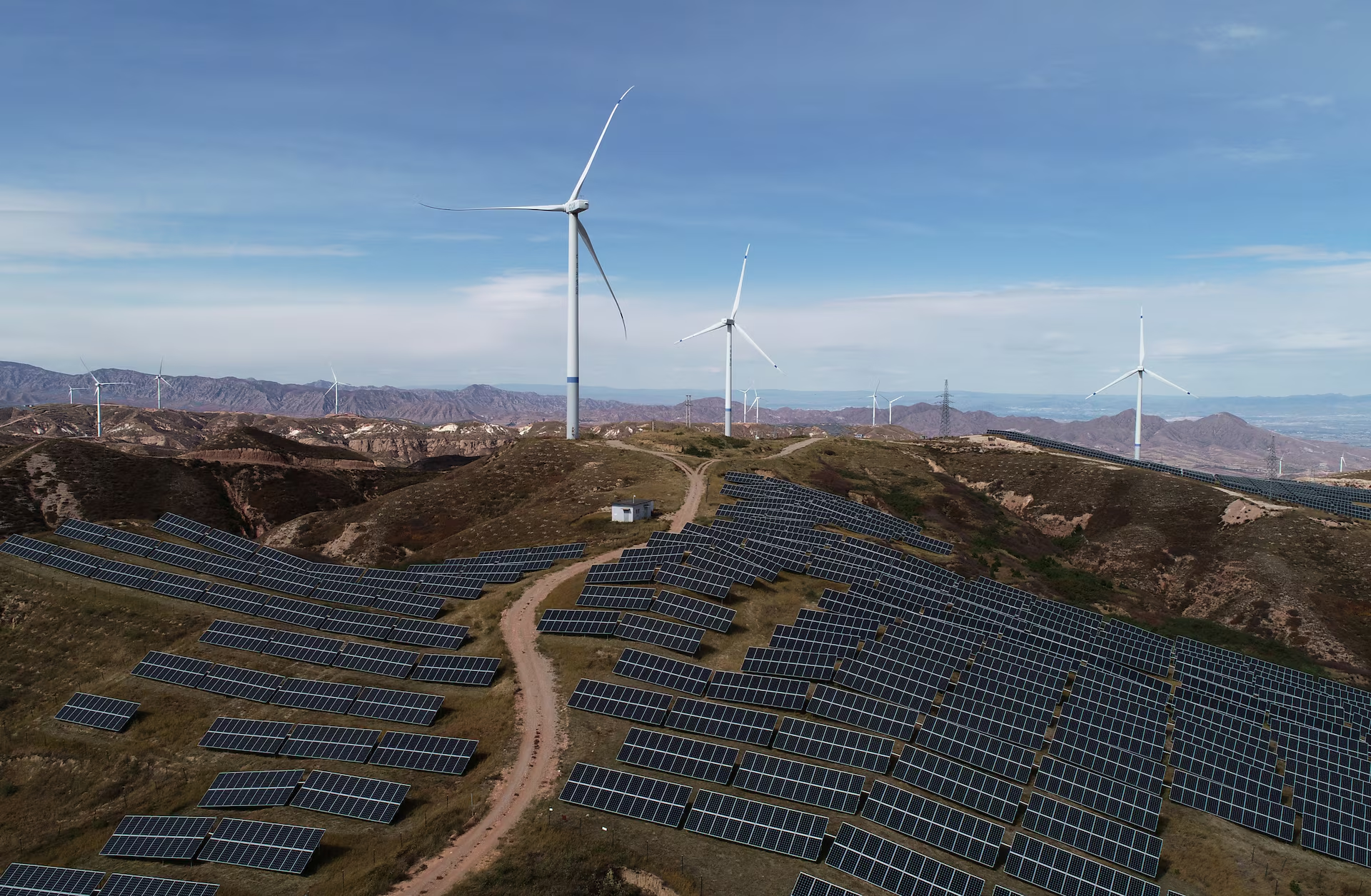
It is one of the world’s most advanced emerging renewable energy markets, a critical supplier of copper and lithium for electrification, and a country with extraordinary solar and wind resources. Over the past decade, Chile has also built a robust climate governance framework, embedding long term emissions goals into law and aligning national planning with international commitments.
This means Kast inherits a climate architecture that is not easily dismantled. Targets, planning instruments, and regulatory institutions are already embedded across government, finance, and the private sector. For investors and international partners, the more pressing question is how that framework will be interpreted and implemented under a leader skeptical of regulation but openly supportive of private investment.
From climate ambition to climate economics
Kast has not campaigned as a climate champion. He has criticized what he describes as ideologically driven environmental policy and warned against regulations that slow investment and job creation. At the same time, he has acknowledged the economic reality of the energy transition and the role of technology and markets in driving change.
Under his leadership, climate policy is likely to shift in tone rather than disappear.
Expect less emphasis on global symbolism and more focus on energy security, competitiveness, and growth. Renewable energy, transmission infrastructure, storage, and clean industry are all likely to advance if they are framed as engines of economic modernization rather than moral imperatives.
The risk lies in what falls outside that framing. Adaptation, biodiversity protection, and community consultation may struggle for political oxygen if they are perceived as obstacles rather than safeguards.
Lithium at the center of Chile’s climate test
No issue captures Chile’s crossroads more clearly than lithium.
The country holds some of the world’s most valuable lithium reserves, concentrated in fragile salt flat ecosystems. In recent years, Chile has sought to balance expansion with environmental protection, emphasizing lower impact extraction technologies and stronger community engagement.
Kast’s pro investment stance could accelerate development and attract capital from global battery and electric vehicle supply chains. But faster expansion without credible safeguards risks undermining Chile’s reputation as a responsible supplier and triggering domestic opposition that slows projects rather than speeds them up.
How the new administration handles lithium will be a defining signal to markets, communities, and climate partners alike.
Guardrails on reversal
Chile’s institutions place real limits on abrupt policy reversals. Climate targets are embedded in law. Courts, regulatory agencies, and Congress all shape implementation. International trade relationships increasingly reward low carbon credibility and penalize backsliding.
For the private sector, this continuity offers reassurance. For civil society, it provides leverage. For the new president, it narrows the space for dramatic departures while still leaving room to reshape priorities.
What to watch next
The first months of Kast’s presidency will offer clear signals about Chile’s climate direction:
- Whether permitting reforms accelerate clean energy without eroding environmental trust
- How lithium policy balances speed with stewardship
- Whether long term emissions targets remain central to economic planning
- How climate adaptation and nature protection are treated amid competing priorities
Chile’s election reflects a broader global trend. Climate action increasingly must coexist with political pressure for security, affordability, and growth. If Chile can navigate this transition without losing momentum, it may offer a model for climate durability in a polarized era.
If it cannot, the lesson will be equally influential.
Either way, Chile’s climate future now hinges not on ambition alone, but on whether climate policy can prove itself indispensable to national strength.
RELATED STORIES:
- Chile Pushes to Protect Pacific Biodiversity Hotspot as 2026 High Seas Deadline Nears
- Over 130 Nations Rally at Largest Biodiversity Finance Conference in Chile to Fund Nature’s Future
- Inside Project 2025: Everything You Need to Know About the EPA Blueprint
- UNEP Launches $100 Million Programme to Accelerate Climate and Nature Action
- SDG News Feature: A New Era Under Sanae Takaichi — Implications for Japan’s Agenda
 Follow SDG News on LinkedIn