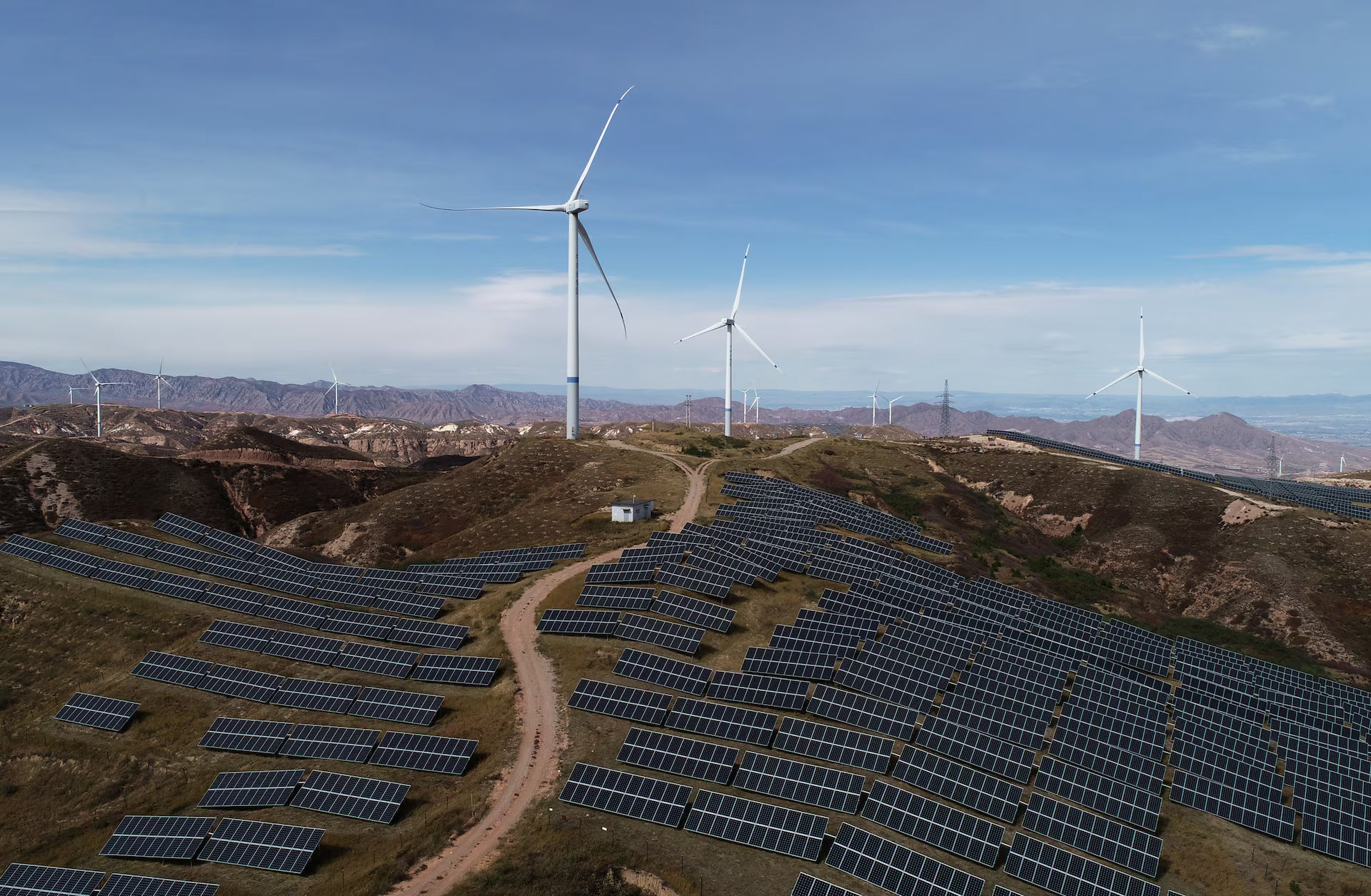
Japan mega-solar regulations are set to tighten as the government moves to curb large-scale solar power developments, ending financial support for some projects in an effort to protect the natural environment, ensure safety, and preserve landscapes.
The measures form part of a package of countermeasures targeting mega-scale solar farms endorsed this week and align with Prime Minister Sanae Takaichi’s position calling for limits on large solar installations. Government officials say the policy shift reflects mounting concerns about environmental damage, visual impact, and the structure of Japan’s renewable energy incentives.
Financial support to be phased out for large projects
At the centre of the policy change is a plan to discontinue support for ground-mounted, large-scale commercial solar power generation under Japan’s feed-in tariff and feed-in premium schemes. According to an official at the industry ministry, the government is considering ending FIT and FIP support starting in the fiscal year beginning in April 2027.
Under the current framework, the FIT scheme guarantees renewable power producers a fixed electricity purchase price over a defined period, while the FIP system allows producers to sell power into the market while receiving a premium. Details such as the exact project size threshold for terminating support have not yet been finalised.
Support for existing solar facilities will continue, as will backing for residential solar installations, officials said, indicating that the policy is aimed specifically at curbing the expansion of large, ground-mounted commercial projects rather than household or small-scale systems.
Environmental assessments and land-use concerns
Japan mega-solar regulations may also be tightened through expanded environmental oversight. An official at the environment ministry said the government is considering broadening the scope of national environmental assessments for solar projects.
Currently, projects under 30 megawatts are not subject to national-level environmental assessments. Lowering or expanding this threshold would bring a wider range of developments under regulatory scrutiny, potentially increasing planning requirements for future projects.
The discussions follow a series of disputes over mega-solar developments near Kushiro Wetland National Park in Hokkaido and other locations. The industry and environment ministries began talks on strengthening regulations in September after concerns were raised about the impact of large solar farms on sensitive landscapes and ecosystems.
Implications for Japan’s renewable energy trajectory
The move comes at a delicate moment for Japan’s energy transition. Uncertainty surrounding offshore wind projects, driven by rising costs and developer withdrawals, has already complicated the outlook for renewable energy expansion. Officials acknowledge that a slowdown in large-scale solar development could further dampen the pace of renewable growth.
Japan is the world’s fifth-largest carbon dioxide emitter, and renewable energy plays a central role in its decarbonisation strategy. At the same time, the government has signalled a shift toward supporting next-generation technologies, including perovskite solar cells, a technology developed in Japan for which policy backing will be strengthened.
By tightening rules on mega-solar projects while maintaining support for residential systems and emerging technologies, the government is recalibrating how it balances climate objectives with environmental protection and land-use constraints.
RELATED STORIES:
- Trump’s Treasury Set to Blow Down Hundreds of Clean Energy Projects
- What you need to know about nature finance ahead of COP30 – Keith Tuffley
- UN Forum Launches First Global Net-Zero Transition Guide for Insurance Underwriting Portfolios
- CTrees Uses AWS to Track Carbon in Every Tree on Earth
- Japan Launches $1.3 Billion Clean Energy Investment Subsidies Under GX 2040
 Follow SDG News on LinkedIn