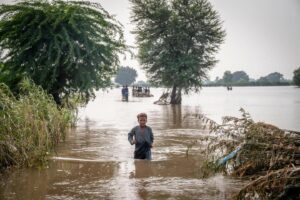
Nearly half of the world’s children—an estimated 1.1 billion boys and girls—are now exposed to at least three overlapping climate and environmental hazards, according to UNICEF’s newly released Children’s Climate Risk Report 2026. The report paints a sobering picture of childhood in an era of intensifying climate disruption, where extreme heat, droughts, floods, storms, and wildfires are increasingly shaping children’s daily lives and futures.
The findings underscore a stark reality: the climate crisis is not a distant environmental challenge. It is rapidly becoming one of the defining child rights issues of the 21st century.
A Generation Growing Up in Crisis
UNICEF’s report found that almost every child on Earth is now exposed to at least one climate hazard, while more than 4 million children face as many as six overlapping threats simultaneously.
The most common combination of climate hazards confronting children globally is the convergence of drought, extreme heat, and increasingly severe heatwaves. Nearly 1.5 billion children—roughly two in every three children worldwide—are exposed to heatwaves that are becoming more frequent, longer-lasting, or more severe. Meanwhile, 1.2 billion children live in conditions of extreme heat, exposing them to growing health risks that range from dehydration and respiratory illnesses to malnutrition and mental health challenges.
“Half of the world’s children are now living with at least three overlapping climate threats shaping their daily lives,” said UNICEF Executive Director Catherine Russell. “The lives of children continue to be upended by the impact of heatwaves, wildfires, droughts, and floods.”
Where Children Face the Greatest Risks
The report found that climate hazards are not evenly distributed.
Children living in the Sahel region of Africa are among the most vulnerable, with millions facing a dangerous convergence of heatwaves, extreme heat, and sand and dust storms. Meanwhile, countries across South Asia, including Bangladesh, Myanmar, and Pakistan, are exposed to more overlapping climate hazards than almost anywhere else in the world.
Yet UNICEF emphasizes that no country is immune.
Even in high-income nations, climate shocks are becoming increasingly common. In Italy alone, more than 6 million children are exposed to prolonged heatwaves and drought conditions, illustrating how climate risks are rapidly becoming universal.
Climate Change Is Reshaping Childhood
The implications extend far beyond environmental exposure.
Extreme weather events are disrupting access to education, damaging health systems, destroying infrastructure, and undermining the social services upon which children depend. UNICEF documented examples of children being unable to attend school safely because bridges and transportation networks have been washed away or degraded by repeated climate shocks. In many communities, climate events are deepening existing inequalities, particularly for girls and marginalized populations.
The report warns of a “dangerous cascade” of multiple, overlapping hazards that could overwhelm public services and leave millions of children increasingly vulnerable.
The Numbers Behind the Crisis
According to UNICEF, 1.1 billion children are exposed to at least three overlapping climate hazards, while more than 4 million children are living with as many as six simultaneous threats. The organization estimates that nearly 1.5 billion children are exposed to increasingly frequent and severe heatwaves, and 1.2 billion children are living under conditions of extreme heat. Taken together, the findings reveal that virtually every child on Earth now faces at least one climate-related hazard, whether in the form of floods, droughts, wildfires, storms, or extreme temperatures.
The Defining Test of Our Time
UNICEF is calling on governments, businesses, and international institutions to accelerate both climate mitigation and adaptation efforts, with children placed at the center of planning and investment decisions.
The organization argues that building resilient schools, health systems, water infrastructure, and disaster preparedness mechanisms is no longer simply environmental policy—it is an investment in human development and the future of an entire generation.
For today’s children, climate change is not a future scenario. It is already determining whether they can attend school, access healthcare, remain safe during disasters, and realize their aspirations. The question now confronting policymakers is whether the world can move quickly enough to ensure that a generation growing up under multiple climate threats is not defined by crisis, but by resilience.
Read the full Children’s Climate Risk Report 2026
RELATED STORIES:
 Follow SDG News on LinkedIn