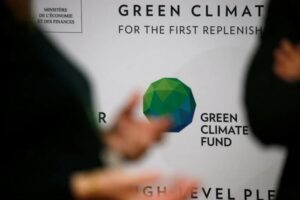
The global race to finance climate resilience took a decisive turn this week as the Green Climate Fund approved $440 million for a new wave of projects across Africa—an investment that signals both urgency and momentum in the world’s most climate-vulnerable regions.
Announced following the Fund’s latest board meeting, the financing will support seven projects spanning the continent, with a focus on strengthening energy systems, agriculture, and infrastructure in the face of intensifying climate shocks.
But the headline number tells only part of the story.
Catalyzing Capital at Scale
The $440 million commitment is expected to unlock an additional $1.1 billion in co-financing from public and private partners—an increasingly critical dynamic in global climate finance, where multilateral funding is used to crowd in larger pools of capital.
In total, nearly half of the Fund’s latest global allocation—approximately 46 percent—has been directed toward Africa, underscoring a strategic shift toward regions bearing the brunt of climate disruption.
At the center of this portfolio is a flagship $250 million energy access program designed to expand clean, reliable electricity across 21 countries, targeting a region where an estimated 600 million people still lack access to power.
The implications are immediate: energy access is not just a climate issue, but a foundational requirement for economic growth, industrialization, and social stability.
Africa at the Epicenter of Climate Reality
The investment comes as African nations face a convergence of climate pressures—droughts, floods, rising temperatures, and volatile food and energy prices—that are already reshaping economies and livelihoods.
The question is no longer whether action is needed, but how quickly and how fairly solutions can be delivered.
By directing capital toward resilient agriculture, green infrastructure, and energy systems, the Fund is aligning climate action with broader development priorities, including trade integration and regional economic growth.
This is a critical shift. Climate resilience is no longer treated as a parallel agenda—it is becoming the backbone of economic strategy.
A System Under Pressure—and Evolving
Established under the UN climate framework, the Green Climate Fund has become the world’s largest dedicated vehicle for financing climate action in developing countries.
Yet expectations continue to rise.
The scale of need across Africa—and the Global South more broadly—far exceeds current funding levels. What distinguishes this latest round of approvals is not just the volume of capital, but the increasing emphasis on leveraging partnerships, accelerating deployment, and delivering results at speed.
The Fund is also expanding its regional presence, signaling a move toward more localized engagement and faster execution on the ground.
Beyond the Numbers
This latest investment reflects a broader transformation underway in global climate finance: from fragmented pledges to coordinated capital flows designed to drive systemic change.
Africa is emerging not only as a priority for funding, but as a proving ground for how climate finance can unlock growth, resilience, and stability at scale.
The real test now lies ahead.
If this capital can be deployed effectively—mobilizing private investment, strengthening national systems, and delivering measurable outcomes—it may offer a blueprint for how the world finances the transition in the decades to come.
If not, the gap between ambition and reality will continue to widen—precisely where it matters most.
RELATED STORIES:
- Catalyzing Action for Our Ocean & Climate: World Ocean Day
- Microsoft, Carbon Direct Set Standards for Environmental Certificates in Low-Carbon Concrete and Steel
- Arctic Heat Wave Breaks the Ice
- Caribbean Launches $110M Renewable Energy Facility to Cut Costs and Boost Resilience
- GEF Approves $372 Million for Environmental Projects in Developing Countries
 Follow SDG News on LinkedIn