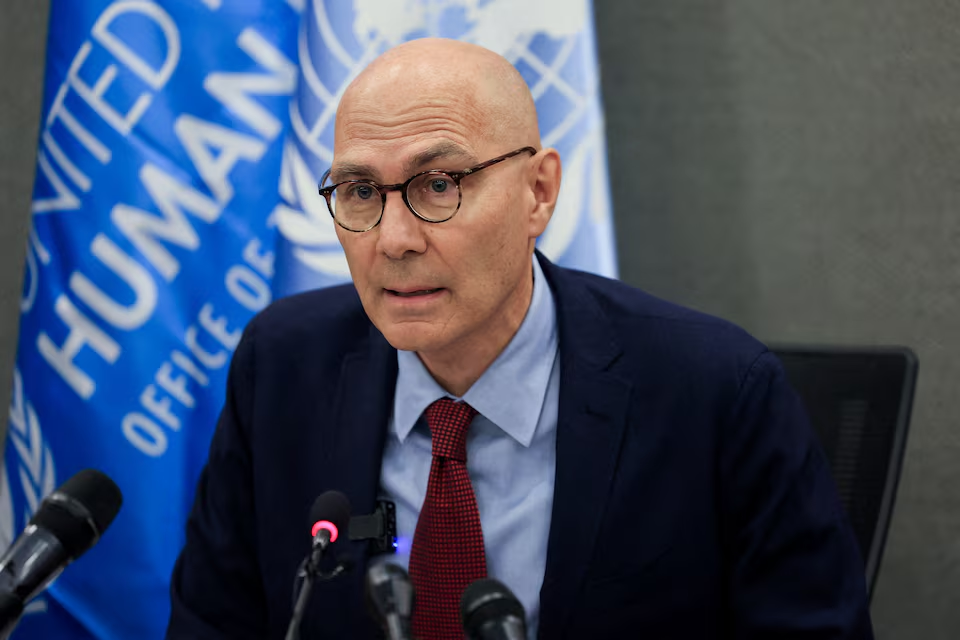
Few positions within the United Nations are as scrutinized—or as consequential—as that of the UN High Commissioner for Human Rights. At a time when armed conflicts, democratic backsliding, mass displacement, and geopolitical rivalry are testing the international rules-based order, Volker Türk has emerged as one of the UN system’s most prominent and outspoken advocates for the universality of human rights.
Last week, the UN General Assembly voted decisively to extend Türk’s mandate for another four years, making him the first UN High Commissioner for Human Rights to serve two full terms since the office was established in 1993. The vote—144 in favor, with opposition from a small group of member states including the United States, Russia, and Israel—highlighted both the broad international support for his leadership and the increasingly contested nature of global human rights diplomacy.
A Career Dedicated to Protection and Prevention
An Austrian lawyer by training, Volker Türk has spent more than three decades within the United Nations system, much of it focused on protecting refugees, stateless persons, and people displaced by conflict. Before becoming High Commissioner in 2022, he held senior leadership roles at the UN Refugee Agency (UNHCR) and later served as Assistant Secretary-General for Strategic Coordination in the Executive Office of the Secretary-General.
That experience has shaped an approach centered on prevention—arguing that safeguarding human rights is not only a legal and moral imperative, but also a cornerstone of peaceful, resilient, and prosperous societies.
A Consistent Voice Across Global Crises
Throughout his tenure, Volker Türk has spoken publicly on human rights concerns across a wide range of conflicts and political contexts. His office has documented alleged abuses related to Russia’s war in Ukraine, the humanitarian situation in Gaza, violence in Sudan and Myanmar, restrictions on civil liberties in Nicaragua, and concerns surrounding migration, discrimination, and arbitrary detention in numerous countries.
This willingness to address issues across regions and political divides has earned praise from many governments and civil society organizations while also drawing criticism from states that argue his office has exceeded its mandate or demonstrated political bias.
Human Rights at the Center of Global Stability
Volker Türk has consistently argued that respect for human rights should not be viewed as separate from global security, economic development, or international cooperation. Rather, he has maintained that societies are more stable, resilient, and capable of long-term progress when institutions uphold the rule of law, protect fundamental freedoms, and ensure equal treatment under the law.
As governments increasingly grapple with challenges ranging from armed conflict and migration to artificial intelligence and geopolitical competition, those principles continue to shape debates well beyond the human rights community.
Why His Leadership Matters
Volker Türk begins his second term during one of the most turbulent periods for the international system in decades. Multiple conflicts continue to strain humanitarian resources, democratic institutions face mounting pressure in many regions, and geopolitical rivalries have made consensus within multilateral institutions increasingly difficult.
Against that backdrop, his renewed mandate reflects the continued confidence of a large majority of UN member states in maintaining an independent global institution dedicated to documenting abuses, promoting accountability, and supporting the protection of human dignity.
Whether viewed through the lens of diplomacy, international law, or global governance, Volker Türk’s leadership represents one of the United Nations’ most visible efforts to uphold universal human rights amid an increasingly fragmented world.
RELATED STORIES:
 Follow SDG News on LinkedIn