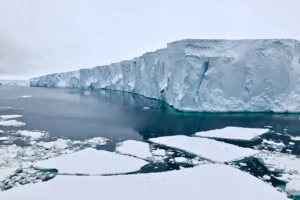
In the remote expanse of West Antarctica, a single glacier is commanding the attention of scientists, governments, and coastal cities worldwide. The Thwaites Glacier, often referred to as the “Doomsday Glacier,” is no longer a distant climate concern. It is rapidly becoming one of the most consequential tipping points for global sea level rise and, with it, the future of human settlement along coastlines.
What is unfolding in Antarctica is not isolated. It is a global story, with implications that stretch from major financial capitals to the smallest and most vulnerable island nations.
A Glacier Holding Back the Ocean
Thwaites Glacier is not just massive. It is systemically critical. Roughly the size of Florida, it acts as a natural barrier holding back a vast portion of the West Antarctic Ice Sheet. Scientists often describe it as a cork in the system. If it destabilizes, the consequences extend far beyond its immediate footprint.
Today, Thwaites is already contributing meaningfully to global sea level rise. But its true danger lies in what comes next. The glacier’s floating ice shelf, which provides structural support, is weakening. Warmer ocean waters are eroding it from below, while fractures spread across its surface.
If that ice shelf collapses, the glacier’s flow into the ocean could accelerate dramatically.
From Gradual Rise to Sudden Acceleration
The potential impact of a Thwaites collapse is measured in feet, not inches. The glacier alone holds enough ice to raise global sea levels by more than two feet.
More critically, Thwaites acts as a gateway to the broader West Antarctic Ice Sheet. Once destabilized, it could trigger a chain reaction that unlocks significantly larger volumes of ice. This process, known as marine ice sheet instability, could lead to a long-term and irreversible retreat of the ice sheet.
This is what makes Thwaites uniquely dangerous. It is not just a contributor to sea level rise. It is a trigger for a much larger system.
Flood Risk on a Global Scale
Even relatively small increases in sea level have outsized consequences. Each additional increment of water amplifies storm surges, increases the frequency of flooding, and erodes coastlines.
Major cities such as New York, Miami, Lagos, Mumbai, and Jakarta are already grappling with rising seas. Infrastructure built for a stable climate is being tested in ways it was never designed to withstand. Housing markets, insurance systems, and national planning frameworks are beginning to adjust to a new reality where coastal risk is no longer theoretical.
Governments are being forced to think not just about mitigation, but about adaptation, relocation, and long-term resilience.
Small Island Developing States on the Frontlines
For small island developing states, the implications of Thwaites Glacier are not abstract. They are immediate and existential.
Many of these nations sit just a few meters above sea level. Even modest increases in ocean height can contaminate freshwater supplies, erode coastlines, and damage critical infrastructure such as ports, roads, and hospitals. Storm surges become more destructive, reaching further inland and occurring more frequently.
In some cases, entire communities face the prospect of relocation within a generation. In others, the long-term viability of the nation itself is called into question.
Beyond physical impacts, there are profound economic and political consequences. Tourism-dependent economies face declining viability as beaches disappear and ecosystems degrade. Fisheries are disrupted. Insurance becomes prohibitively expensive or unavailable. Sovereign credit ratings come under pressure as climate risk intensifies.
Perhaps most critically, rising seas challenge traditional notions of sovereignty. If land is lost, what happens to maritime boundaries, exclusive economic zones, and national identity?
For small island developing states, Thwaites Glacier is not just a climate issue. It is a defining test of survival, resilience, and global solidarity.
A Race Between Science and Time
Scientists are working urgently to better understand the glacier’s dynamics and explore potential interventions. Concepts such as underwater barriers to block warm ocean currents and advanced monitoring systems are being studied. However, these approaches remain experimental and logistically complex.
At the same time, it is increasingly clear that mitigation alone will not stop the changes already set in motion. Heat stored in the oceans will continue to interact with Antarctic ice for decades to come.
The world is now in a race not just to reduce emissions, but to prepare for impacts that are already unfolding.
A Defining Test of Global Resilience
The story of Thwaites Glacier is ultimately a story about preparedness and leadership.
It is about whether governments can anticipate systemic risks before they cascade into crises. It is about whether capital can be mobilized at scale to protect vulnerable populations. And it is about whether innovation in science, infrastructure, and policy can keep pace with a rapidly changing planet.
The glacier’s fate will unfold over time, but its implications are already shaping decisions today.
In Antarctica, the ice is cracking. Around the world, the question is whether humanity is ready for what follows.
RELATED STORIES:
- 2025: The Year of the Glacier – A Call to Protect Earth’s Ice
- America’s Renewable Race Against the Clock
- Exclusive to Insiders: United States’s Renewable Race Against the Clock
- Sustainable Funds See 11% Growth in 2023: Key Performers and Insights
- Antarctica Faces Abrupt Shifts That Could Reshape the World
 Follow SDG News on LinkedIn