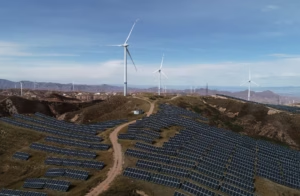
DILI, Timor-Leste — Timor-Leste has secured an $85.7 million financing package for its first utility-scale solar and battery storage project, advancing efforts to modernize its electricity system as the country confronts the decline of its petroleum revenues.
The project will include a 73.7-megawatt solar plant, an 80.2-megawatt-hour battery storage system, transmission lines and supporting infrastructure in Manatuto Municipality.
Development partners expect the facility to generate enough electricity annually to match the typical consumption of approximately 80,000 households, representing around 400,000 people. It is also projected to reduce diesel use and avoid about 93,000 metric tons of carbon dioxide-equivalent emissions each year.
The development will become Timor-Leste’s first independent power producer project, introducing privately developed and operated utility-scale renewable infrastructure into a power system historically dominated by the state.
Energy Security Moves Up the Government’s Agenda
The project is being advanced under the Ninth Constitutional Government, led by Prime Minister Kay Rala Xanana Gusmão, whose 2023–2028 program identifies reliable electricity, infrastructure development and economic diversification as national priorities.
The government has called for stronger transmission and distribution networks, expanded rural electrification, improved management of the electricity sector and greater private participation in infrastructure.
Renewable energy forms part of that strategy. Timor-Leste has long aimed to increase the share of solar, wind, hydropower and biomass in its electricity mix, although several earlier targets remain unmet.
The Manatuto project therefore represents a tangible step toward converting those ambitions into operational infrastructure.
Between Two Petroleum Eras
Timor-Leste’s current energy strategy is closely tied to the oil and gas resources that have shaped the country since independence.
Production from the Bayu-Undan offshore field began in 2004 and became the financial foundation of the new state. Petroleum revenues helped fund roads, electricity systems, public institutions and social programs.
Timor-Leste established its Petroleum Fund in 2005 to invest those revenues and preserve part of the country’s resource wealth for future generations. Over time, however, the government became heavily dependent on withdrawals from the fund to finance public spending.
Production at Bayu-Undan ended in 2025, closing the country’s principal source of new petroleum revenue. Although the Petroleum Fund remains substantial, international financial institutions have warned that continued large withdrawals could exhaust it within the coming decades.
That pressure has increased the urgency of diversifying the economy, attracting private capital and developing new sources of state revenue.
Greater Sunrise Remains Central
The government’s principal petroleum priority is the undeveloped Greater Sunrise gas field in the Timor Sea.
Discovered in 1974, the field has been delayed by disputes over maritime boundaries, revenue sharing and where the gas should be processed. A 2018 maritime boundary treaty with Australia established a framework for development, but the project has yet to reach a final investment decision.
Prime Minister Gusmão has long advocated bringing the gas to Timor-Leste’s southern coast. The government believes an onshore pipeline could support an LNG facility, ports, roads, industrial development and employment through the wider Tasi Mane project.
Greater Sunrise is therefore viewed not only as a source of royalties, but as a potential engine of industrialization and fiscal renewal. The government has also identified domestic gas as a possible replacement for imported diesel in electricity generation.
However, the field remains commercially unresolved and is unlikely to address Timor-Leste’s immediate energy and fiscal pressures.
Solar Addresses a Near-Term Vulnerability
The Manatuto project responds to a more immediate problem.
Despite its offshore petroleum resources, Timor-Leste continues to rely heavily on imported diesel to generate electricity. That leaves the country exposed to international fuel prices, supply disruptions and recurring import costs.
Solar generation can reduce diesel consumption during daylight hours, while battery storage can supply electricity when solar output falls or demand rises.
The government is therefore pursuing parallel strategies: protecting electricity access, reducing imported fuel dependence, developing Greater Sunrise and expanding renewable infrastructure.
These priorities are not necessarily contradictory. Greater Sunrise is intended to support revenue and industrial development, while solar and storage address the cost and resilience of the existing power system.
Development Partners Share Risk
The financing package brings together the Asian Development Bank, the World Bank Group, the Japan International Cooperation Agency and the governments of Canada and Japan.
It includes senior loans from ADB, the International Finance Corporation and JICA, alongside concessional financing supported by development funds from Canada, Japan and the World Bank Group.
The World Bank Group’s Multilateral Investment Guarantee Agency has also approved political-risk insurance covering the project sponsors’ investments for up to 20 years.
ADB advised state-owned utility Electricidade de Timor-Leste on the project’s structure and competitive procurement. Electricity will be sold to the utility under a 25-year power purchase agreement.
Manatuto Renewables Power, backed by EDF power solutions and a subsidiary of Japan’s ITOCHU Corporation, will develop and operate the facility.
A Test of Diversification
The project will test whether concessional finance, political-risk guarantees and competitive procurement can attract private capital into Timor-Leste’s infrastructure beyond offshore petroleum.
Its impact will depend on construction, grid integration, battery performance and the financial terms of the power purchase agreement. Expected reductions in electricity costs, diesel consumption and emissions remain projections until the facility becomes operational.
The timing is nevertheless significant. Bayu-Undan has stopped producing, Greater Sunrise remains unresolved and the Petroleum Fund cannot support current spending indefinitely.
Against that backdrop, solar and battery storage form part of a broader effort to reduce immediate energy vulnerability while building an economy less dependent on a single offshore resource.
RELATED STORIES:
 Follow SDG News on LinkedIn