Key Impact Points:
- New funding stream: A global coalition of eight countries aims to tax business class, first-class, and private jet travel to finance climate resilience and development efforts.
- Revenue potential: Research suggests global implementation could raise over €78 billion ($92 billion) annually.
- Policy timeline: The coalition will present detailed proposals at COP30, with national legislative action expected in 2025.
Coalition Targets Luxury Air Travel to Fund Climate Action
Eight nations—France, Spain, Kenya, Barbados, Somalia, Benin, Sierra Leone, and Antigua & Barbuda—have formed a new coalition to introduce levies on premium air travel and private jets to generate new, debt-free financing for global climate adaptation.
The plan was launched at the UN’s Fourth Financing for Development (FFD4) summit in Seville. The global coalition operates under the Seville Platform for Action and draws from the work of the Global Solidarity Levies Task Force, launched at COP28.
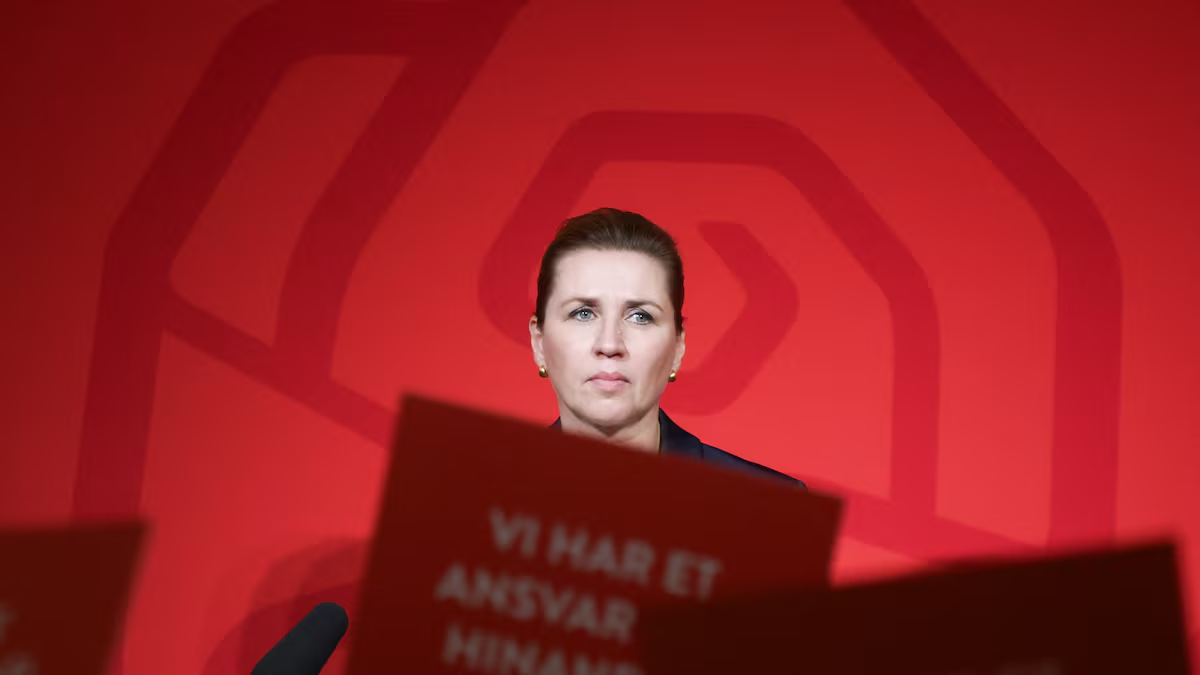
“We need those that benefited from globalisation to contribute more to financing,” said French President Emmanuel Macron. “I urge all possible countries to join this international framework because it is absolutely key.”
A Pragmatic First Step: Taxing Flights
Targeting aviation was described as a “very pragmatic” starting point by Friederike Röder, Director of the Task Force’s Secretariat.
“It’s something that can be put in place quite quickly, it makes sense economically speaking from a tax justice and climate perspective, and can generate a significant sum,” Röder said.
According to task force estimates:
- Taxes on business and first-class tickets could raise €37 billion ($43.7 billion) annually.
- Taxes on kerosene for private jets could add €41 billion ($48.5 billion) more.
Learning from Precedent
France has already raised over $2 billion since 2011 from plane ticket levies to support Unitaid’s health initiatives. The new global coalition hopes to follow a similar model and scale it internationally.
Röder emphasized that the initiative could serve both domestic and global needs.
“This would be a powerful signal because it would show that levies are used for global public goods,” she said.
Funding Resilience and Equity
The coalition aims to invest proceeds in resilient infrastructure and fair transitions, both domestically and in vulnerable nations.
While final mechanisms are still under consultation, the global coalition is expected to outline concrete plans ahead of COP30 in Belém, Brazil.
“Solidarity levies need to be a critical piece of the puzzle,” said Röder, adding they “should not be used to allow advanced economies to escape their commitments and responsibilities.”
A Push for Global Adoption
The aviation sector, which emits over 2.5% of energy-related CO₂, remains under-taxed—especially international kerosene use. In 2021, the G20 average carbon price on kerosene was just €9/ton, compared to €68 for gasoline and €79 for diesel.
The global coalition’s broader goal is to:
- Increase adoption of aviation levies across more countries
- Harmonize levy structures where they already exist
- Explore international taxation mechanisms via ICAO
- Ensure revenues support climate, health, and development goals
What’s Next?
Backed by the European Commission’s technical support, the global coalition plans to deliver a unified proposal for premium flyer contributions at COP30. The initiative aligns with Brazil’s roadmap to raise $1.3 trillion annually by 2035 in climate finance—up from the $300 billion committed at COP29.
As state budgets tighten and climate risks rise, solidarity levies are being repositioned as essential, scalable, and just financing tools for climate resilience.
Related Article: Green Claims Directive in Limbo as EU Commission Denies Withdrawal
 Follow SDG News on LinkedIn