The Himalayan catastrophe could cost Nepal roughly a tenth of its economy, exposing a climate finance gap between the scale of vulnerability and the resources available to countries facing catastrophic losses.
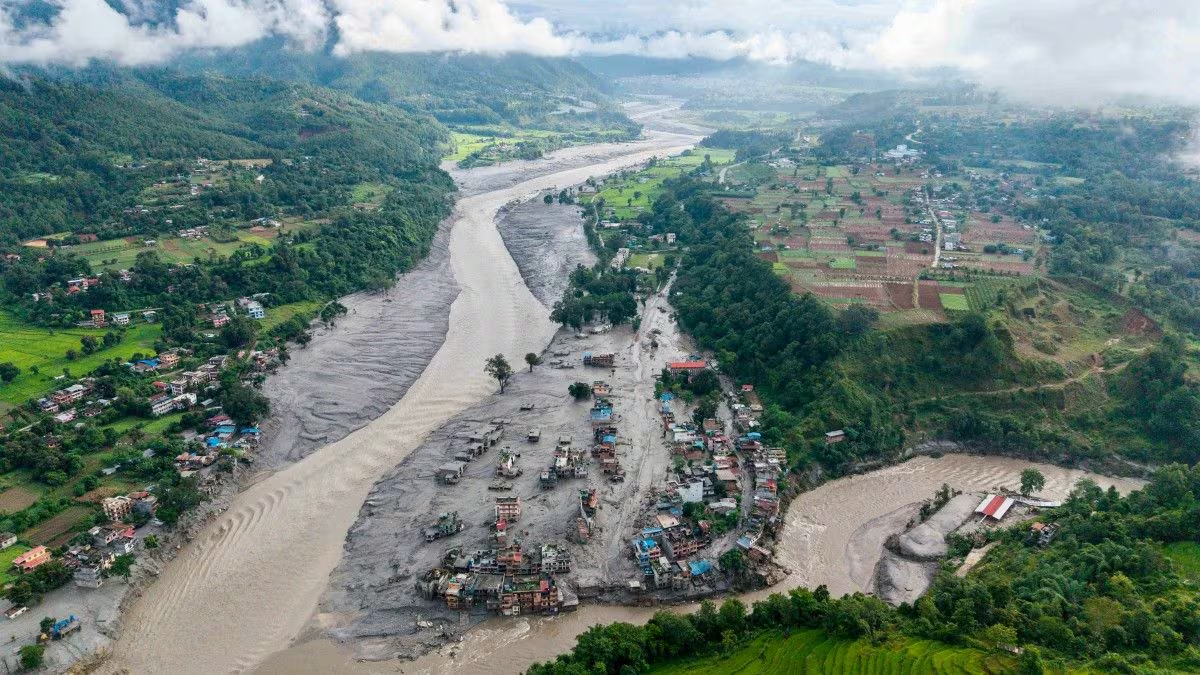
Nepal is confronting a reconstruction bill of as much as $5 billion after catastrophic flooding tore through the Himalayan country, destroying communities, damaging critical infrastructure and disrupting a significant share of its hydropower system.
Finance Minister Swarnim Wagle has estimated rebuilding costs at between $4 billion and $5 billion. At the upper end, Reuters calculates that the losses would amount to roughly one-tenth of Nepal’s annual economic output.
The scale of the disaster has turned the crisis into something larger than a humanitarian emergency.
It is becoming a test of whether the international financial system can respond when climate-related losses overwhelm the fiscal capacity of vulnerable developing economies.
Nepal has formally sought urgent support from the Fund for Responding to Loss and Damage, the financing mechanism created through U.N. climate negotiations to assist developing countries confronting climate impacts that cannot be avoided through mitigation or adaptation alone.
The question is increasingly difficult to ignore: how wide has the climate finance gap become, and can existing mechanisms operate at the scale of the losses now emerging?
A Disaster in a Changing Himalaya
The August 26 catastrophe followed a massive collapse of rock and ice beneath a Himalayan glacier near the Nepal-China border, sending water, sediment and debris through downstream river systems.
Scientists caution against attributing a single geological event directly and exclusively to climate change.
But the broader risk environment is changing rapidly.
Rising temperatures are accelerating glacier retreat, thawing permafrost and destabilizing mountain slopes across the Hindu Kush Himalaya. Researchers have warned that these changes can increase exposure to glacial lake outburst floods, landslides, avalanches and debris flows.
The International Centre for Integrated Mountain Development has documented accelerating ice loss across the region and increasingly volatile hydrological conditions.
That matters far beyond Nepal.
The Hindu Kush Himalaya contains the largest concentration of ice outside the polar regions and feeds river systems supporting hundreds of millions of people across Asia. Changes in the cryosphere increasingly carry consequences for agriculture, hydropower, infrastructure, migration and regional economic security.
Hydropower’s Climate Paradox
The disaster has also exposed a difficult contradiction at the heart of Nepal’s development model.
Hydropower is one of the country’s greatest economic opportunities. Nepal has expanded generation capacity with the expectation that its Himalayan rivers can supply domestic electricity, attract foreign investment and support a growing regional energy-export market.
Yet the same river systems underpinning that strategy are increasingly exposed to physical climate risk.
Reuters reported that more than 12 percent of Nepal’s electricity-generating capacity was affected by the disaster, with hydropower installations among the hardest-hit infrastructure.
That creates a strategic challenge extending well beyond reconstruction.
The issue is not whether Nepal should abandon hydropower. It is whether the next generation of energy infrastructure must be designed around fundamentally different assumptions about extreme weather, mountain instability, redundancy, early warning and insurability.
Climate adaptation is increasingly becoming an infrastructure-investment requirement.
The Value of 14 Minutes
One of the clearest lessons from the disaster may also be one of the least expensive.
At a school in Bidur, an informal warning from upstream reportedly gave administrators approximately 14 minutes to evacuate more than 900 students and staff before floodwaters destroyed the school.
The evacuation saved hundreds of lives.
The episode stands in stark contrast to broader gaps in Himalayan disaster monitoring. Nepal had previously sought additional information from China about upstream glacier risks and water levels, highlighting the importance of cross-border data sharing in a region where rivers and climate hazards do not respect national boundaries.
The comparison carries an important policy lesson.
Climate resilience cannot be measured only in billion-dollar infrastructure projects.
Monitoring systems, satellite data, community preparedness, communication networks and cross-border early-warning mechanisms can generate extraordinary returns by preventing losses before they occur.
For developing countries, that may represent some of the highest-value climate finance available.
A Sovereign Financial Shock
The scale of Nepal’s reconstruction bill nevertheless presents a much larger fiscal challenge.
Before the disaster, the World Bank was already projecting economic growth of approximately 2.3 percent in fiscal year 2026, down from 4.6 percent the previous year.
Remittances remain central to the economy, equivalent to roughly one-third of GDP in recent years, while public debt is close to half of annual output.
Nepal is still assessed by the IMF and World Bank as being at low risk of overall debt distress.
That distinction is important.
The problem is not that Nepal is currently insolvent. It is that a shock approaching $5 billion can dramatically reduce the fiscal space available for development.
The government must now rebuild roads, bridges, schools and energy infrastructure while continuing to finance healthcare, education, economic growth and climate resilience.
This is one of the defining economic consequences of climate vulnerability: development capital can repeatedly be redirected toward replacing infrastructure that has already been built once.
The Loss and Damage Test
That is precisely the problem the international loss-and-damage system was created to address.
But Nepal exposes the climate finance gap confronting it.
As of March 2026, governments and other contributors had pledged roughly $822 million to the Fund for Responding to Loss and Damage.
Nepal’s estimated $5 billion reconstruction bill from a single disaster is approximately six times that amount.
The comparison requires context.
The Fund was never designed to pay the full cost of every climate disaster. Nepal will likely draw on a combination of domestic resources, bilateral assistance, multilateral development banks, concessional finance, humanitarian funding and eventually private capital.
But the disparity remains revealing.
The financing needs created by a single extreme event in one relatively small developing economy can exceed the resources pledged to an entire global climate fund several times over.
That points to a structural feature of the climate finance gap.
Climate losses are increasingly being measured in billions and, globally, trillions. The mechanisms built to absorb them are often still measured in millions.
From the Climate Finance Gap to Financial Architecture
Closing the climate finance gap is therefore a larger task than expanding a single fund.
Climate vulnerability is becoming a sovereign financial risk.
Development banks, insurers, investors and governments increasingly need to incorporate physical climate exposure into decisions about infrastructure, sovereign credit, lending and public investment.
Vulnerable countries will also need access to a broader range of tools before disasters occur, including resilient infrastructure finance, catastrophe insurance, contingent credit lines, parametric instruments, debt clauses triggered by natural disasters and significantly stronger early-warning systems.
The objective should not simply be to mobilize more money after catastrophe.
It should be to reduce the economic cost of catastrophe before it happens.
Nepal makes that distinction unusually clear.
A 14-minute warning helped save more than 900 people at one school. Yet rebuilding the broader destruction may ultimately cost the country as much as $5 billion.
That contrast defines the climate finance gap the international system has yet to close.
The world is getting better at recognizing loss and damage. The next test is whether it can build a financial architecture capable of preventing, absorbing and financing those losses without forcing vulnerable countries to choose between rebuilding from the last disaster and investing in their future.
 Follow SDG News on LinkedIn