- The second session of the Preparatory Commission is tackling financial rules and procedures for the new treaty’s institutions.
- Developing countries pressed for equity, transparency and stronger representation in decision-making.
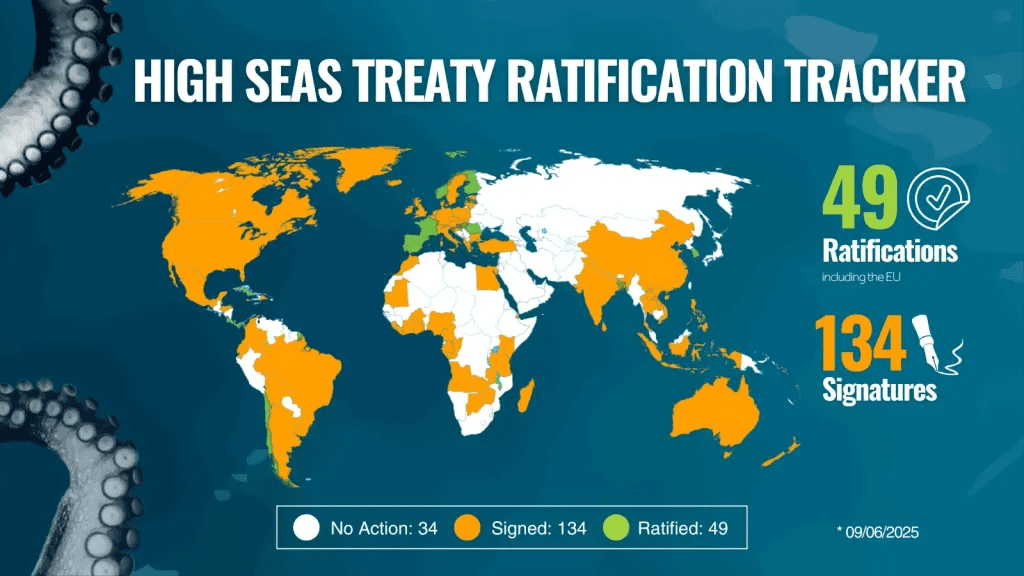
- Moldova signed and Cabo Verde ratified this week, bringing totals to 140 signatories and 54 ratifications.
Treaty Nears Entry into Force
Delegates continued work at the Preparatory Commission for the Entry into Force of the High-Seas Biodiversity Treaty in New York this week, debating draft rules on funding and procedures as the treaty moves closer to becoming operational.
The Agreement — formally adopted in June 2023 — covers marine genetic resources, environmental impact assessments, area-based management tools, and the transfer of marine technology. It remains open for signature until September 2025.
On 26 August, Moldova signed, and on 27 August, Cabo Verde ratified, bringing the treaty to 140 signatories and 54 ratifications. As the session entered its final days on 28 August, delegates reviewed oral reports of progress and resumed debate on the rules of procedure, with the afternoon devoted to exploring ways to strengthen cooperation with existing legal instruments and frameworks.
Official Launch of SDG News – SDG Leaders Luncheon
September 25 • United Nations Headquarters, New York
Hosted on the 10th anniversary of the Sustainable Development Goals, this invitation-only luncheon convenes 80 leaders across government, philanthropy, and business — marking the official launch of SDG News.
Financial Rules Take Center Stage
Delegates spent much of the session reviewing draft financial rules that will guide the Conference of the Parties, its secretariat, and subsidiary bodies.
“It is important to fully consider the requirements of developing countries,” said Iran’s representative, noting that a finance committee would be responsible for needs assessments.
Oman’s delegate urged drawing on UN financial rules to ensure “efficiency, efficacy and transparency,” while the Philippines cautioned against excessive budget flexibility that could divert funds away from capacity-building and technology transfer for developing states.
Nigeria, speaking for the African Group, welcomed draft language clarifying the relationship between the secretariat and the finance committee but called for more detail on how budgets will estimate miscellaneous income.
Saint Lucia, on behalf of CARICOM, stressed that “the finance committee’s role should remain strictly advisory,” ensuring that final budget authority rests with the Conference of the Parties.
Meanwhile, Papua New Guinea, representing Pacific small island developing states, questioned whether modeling the treaty’s finance committee on the International Seabed Authority was appropriate given “a different orientation in terms of mobilization of funds and the assessment of needs.”
Special Circumstances of Small States
The financing debate repeatedly returned to the priorities of developing and small island states.
Maldives, speaking for the Alliance of Small Island States, underlined that financial rules must guarantee their eligibility for support under the voluntary trust fund. Canada stressed that unfunded mandates, particularly for the Scientific and Technical Body, must be addressed to avoid undermining the treaty’s implementation.
The European Union, participating as observer, urged consistency between the financial rules and the terms of reference for the trust fund, while Chile, on behalf of the Core Latin American Group, called for focusing on “the operationalization of the special fund” rather than creating duplicative rules.
Rules of Procedure Revisited
In the afternoon session, delegates turned to draft rules of procedure for the Conference of the Parties.
CARICOM and the African Group said in-person meetings should remain the default, with virtual or hybrid formats reserved for “clearly defined” exceptional circumstances.
“The COVID-19 pandemic has demonstrated that events not foreseen can suddenly create unusual circumstances,” noted Jamaica’s delegate.
The European Union opposed hybrid meetings, favoring either in-person or fully virtual formats. Singapore, speaking for the Alliance of Small Island States, pressed for more flexibility, including the option for pre-recorded statements.
Norway, with support from Canada, Australia, New Zealand, Singapore and Iceland, proposed simplifying the rules to clearly set conditions for when virtual meetings can be held and what decisions they can take.
Looking Ahead
The Preparatory Commission will reconvene on 28 August to continue negotiations. While disagreements remain over financing and procedures, momentum is building toward operationalizing the High-Seas Biodiversity Treaty.
For many delegations, the stakes are clear: ensuring that the treaty delivers equitable participation and effective governance for all states. As Cecilia Scharp of UNICEF recently said in a different context, global commitments risk falling behind unless action is bold and inclusive.
With 54 ratifications already secured, entry into force is no longer a question of if — but how quickly governments can agree on the rules to make the High-Seas Biodiversity Treaty work.
Related Content: Protecting the Blue Frontier: EU Takes Bold Step to Enforce High Seas Treaty
 Follow SDG News on LinkedIn