Japan is entering a moment of political change as Sanae Takaichi prepares to assume the mantle of prime minister. Her rise marks a historic milestone: she is expected to become the country’s first woman in that role. Her ideological leanings, policy priorities, and leadership style suggest both opportunities and challenges for Japan’s pursuit of sustainable development across social, economic, and environmental fronts.
From Conservative Roots to Strategic Vision
Sanae Takaichi, long affiliated with the governing Liberal Democratic Party, is known for her strongly conservative perspective, close alignment with the Abe-era faction, and advocacy of a robust national posture. She has called for “crisis management investment” in sectors like artificial intelligence, semiconductors, biotech, and advanced materials, framing them as essential to Japan’s resilience.
On the economic front, she supports aggressive fiscal measures, including stimulus spending and the possibility of additional bond issuance if required, while also speaking of the need to monitor debt levels.
In her recent speeches, she has pledged to raise Japan’s global engagement and to affirm that “Japan is back,” signaling that she intends to shift the tone of diplomacy and active external outreach.
Yet her conservatism comes with strings attached. On social issues, her past record has drawn criticism: she has opposed reforms such as married couples keeping separate surnames, and she has voiced reservations over changes to the imperial household succession.
Economic Inclusivity and Innovation: A Test of Balance
One of the great tests for Takaichi’s government will be balancing large-scale, strategic investment with more inclusive growth. Her push for high-tech and strategic sectors could catalyze innovation, create new forms of value, and attract private investment. But unless matched by policies that address income inequality, regional disparity, and labor market access, Japan could deepen existing divides.
Her proposals for tax relief and direct cash payments are intended to ease costs for ordinary households. But delivering meaningful progress in areas like quality jobs, social mobility, and regional revitalization will depend on whether she embeds social safeguards and equitable distribution within her growth agenda.
Japan faces demographic pressures like aging, labor shortages in rural areas, and population decline. Her government’s approach to migration, rural investment, and care systems will be decisive in shaping future social equity.
Environmental Strategy: Between Caution and Transformation
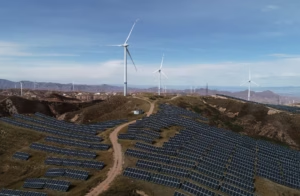
On energy and the environment, Sanae Takaichi’s stance seems to tilt toward pragmatism and technological substitution over sweeping renewables expansion. In the wake of her election, conventional solar stocks fell sharply, reflecting market concerns about her skepticism toward large-scale, foreign-made solar installations.
She is a proponent of increasing the role of nuclear power in Japan’s energy mix as a way to reduce reliance on imported fossil fuels and preserve energy security.
At the same time, she has expressed support for nascent domestic technologies, such as perovskite solar cells, positioning them as alternatives to conventional solar imports.
Her “crisis management investment” framework could stimulate research and deployment in cleaner, high-efficiency technologies, giving direction to Japan’s shift toward a low-carbon future. But success will hinge on reconciling environmental goals with industrial strategy and local communities’ acceptance of infrastructure.
Social Equity, Gender, and Representation
Sanae Takaichi’s gender alone carries symbolic weight: in a society where political, corporate, and civic leadership remain overwhelmingly male, her ascent offers the potential for visibility and momentum in gender inclusion. Observers, however, caution that her track record is insufficiently transformative.
She has recently offered some pro-women rhetoric, pledging greater female participation in public life. But critics suggest such commitments may be tactical rather than foundational, given her past resistance to reforms that would strengthen gender parity.
To deliver substantive progress, her government would need policy instruments such as childcare expansion, active promotion of women in leadership, wage equality enforcement, and systemic change in corporate governance. Whether she embraces those tools remains an open question.
Governance, Coalition Risks, and Institutional Leverage
Sanae Takaichi inherits a fractured political landscape. The LDP and its coalition partner, Komeito, lost their outright majorities in both parliamentary chambers under the previous administration.
Maintaining coherence in her coalition and building cross-party alliances will be vital to passing legislation and sustaining continuity in governance. Early signals suggest she is rewarding allies with top posts, an effort to shore up internal unity.
Her ambitious agenda—spanning defense, foreign affairs, industrial policy, and social reform—will demand institutional coherence. Success will depend on her ability to coordinate ministries, align local governments, and ensure that bureaucracy moves in step rather than resisting change.
Outlook: Hopes, Risks, and Leverage
Sanae Takaichi’s premiership offers Japan both potential leverage and peril. On the upside, her emphasis on strategic investment and technological leadership could push Japan into new growth frontiers. Her status as the first woman in the role could help normalize female leadership at the highest levels.
But the risks are equally real. If her social policy remains conservative, she could miss opportunities to strengthen equity and inclusion. If energy or climate strategy leans too much on status quo paths, Japan may lag in global transitions. And if political fragmentation undermines governance, her capacity to deliver reforms will be severely tested.
For Japan’s journey toward a more sustainable, inclusive, and resilient future, the Sanae Takaichi era may prove pivotal. Her choices in the coming months will shape whether the country leans into transformation or falls back on inertia.
Related Content: Moldova’s 2025 Elections — A Vote at the Crossroads for the Future
 Follow SDG News on LinkedIn