A Deal Decades in the Making
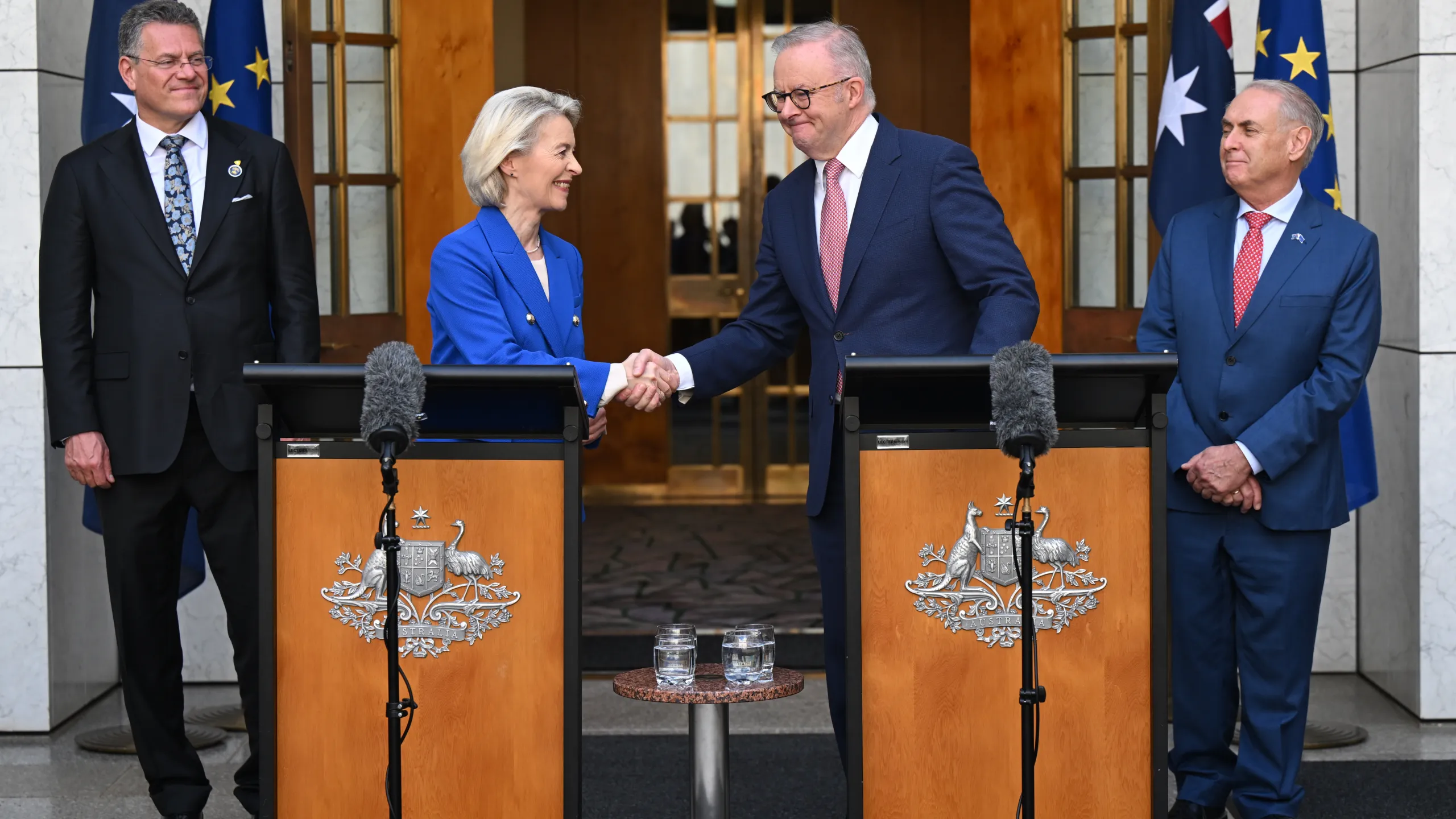
For nearly two decades, trade negotiators from Europe and India circled one another, meeting, pausing, restarting, and retreating again. On January 27, that long courtship ended. The European Union and India reached a sweeping free trade agreement that leaders on both sides now describe as one of the most consequential economic deals of the decade.
The scale alone is striking. When fully implemented, the agreement is expected to cover the vast majority of goods traded between the two economies and significantly expand access for services, manufacturing, and investment. Ursula von der Leyen, the president of the European Commission, called it the “mother of all deals,” a phrase meant less for drama than for emphasis. Europe has never signed a trade agreement of this breadth with a country of India’s size and growth trajectory.
The Geopolitical Shock That Changed the Math
What finally pushed the talks across the line was not just economics, but geopolitics.
Over the past year, trade officials in Brussels and New Delhi found themselves navigating a far less predictable global environment. The return of aggressive U.S. tariff policy under President Donald Trump reshaped the incentives. New duties on imports and renewed threats of escalation jolted allies and competitors alike. In response, Europe and India accelerated their negotiations, seeking insulation from volatility and greater control over their economic futures.
In private briefings, European officials acknowledged that Washington’s posture became an unexpected catalyst. Faced with the prospect of higher costs and disrupted supply chains, both sides saw strategic advantage in locking in access to one another’s markets. The result was a deal that had lingered on the margins for years, suddenly completed with urgency.
Opening Markets Without Rewriting Politics
The agreement sharply lowers tariffs on a wide range of European exports to India, from industrial machinery and chemicals to high-end manufactured goods. For automakers, long deterred by India’s punishing import duties, the pact opens the door to a market of more than a billion consumers through a phased reduction regime.
Indian exporters, in turn, gain expanded access to European markets for textiles, gems, marine products, and manufactured goods, sectors that employ millions across the country. Sensitive areas were deliberately carved out. Agriculture, particularly dairy, rice, and sugar, remains largely protected, reflecting political realities on both sides. Trade negotiators opted for pragmatism over perfection, prioritizing what could be agreed rather than reopening fault lines that had stalled talks in the past.
India’s Global Ambition, Europe’s Strategic Pivot
For Prime Minister Narendra Modi, the deal reinforces India’s ambition to position itself as a central pillar of global manufacturing and trade. It aligns with New Delhi’s broader effort to attract investment, diversify supply chains away from China, and deepen partnerships with advanced economies without formal alliances.
In Europe, the agreement arrives at a moment of recalibration. As the continent reassesses its economic dependencies and strategic autonomy, India emerges as a rare partner that offers scale, growth, and democratic legitimacy. The deal signals a willingness to think beyond traditional transatlantic frameworks and invest in long-term relationships with rising powers.
Markets React, Momentum Builds
Markets reacted swiftly. Investor confidence lifted, currency pressures eased, and industry groups on both sides welcomed the clarity the agreement provides. For companies that have waited years for predictability in EU–India trade, the announcement felt less like a breakthrough than a release of pent-up potential.
Ratification remains ahead, with approvals required from the European Parliament, EU member states, and India’s cabinet. But the political momentum appears strong, bolstered by a shared understanding that delay now would carry its own risks.
A Signal Beyond Trade
Beyond tariffs and trade volumes, the agreement reflects a broader shift in the global order. As multilateral institutions strain and economic nationalism resurfaces, countries are increasingly turning to large, strategic bilateral deals to anchor stability. In that sense, the EU–India pact is not just about commerce. It is about positioning in a world where economic ties are once again instruments of power.
What began as a long, hesitant negotiation has ended as a statement. Europe and India are betting that deeper integration with each other is the best response to uncertainty elsewhere. Whether that bet reshapes global trade in the years ahead will depend on implementation. For now, the message is unmistakable. A new axis of economic cooperation has arrived, and it did not wait for anyone else’s permission.
RELATED STORIES:
- BlackRock’s GIP Invests Up to $335 Million in Aditya Birla Renewables
- TotalEnergies takes action to give access to clean cooking to 100 Million people in Africa and India
- Bill Gates’ Breakthrough Energy Ventures Raises $839 Million for Largest Climate Fund of 2024
- What to Know About the COP30 Climate Deal and Its Global Implications
- The Board of Peace and a Shifting Global Architecture
 Follow SDG News on LinkedIn