By Thomas Östros – Vice President, European Investment Bank
Landlocked developing countries (LLDCs) face unique economic and social challenges due to their geographical constraints. At the European Investment Bank (EIB) we recognize the urgent need for long-term investment to alleviate these challenges and unlock the potential for sustainable development in these nations. We welcome the focus on innovative solutions, strategic partnership and high-impact investment guiding the 3rd UN Conference on Landlocked Developing Countries.
“It is imperative for development and private sector partners to recognize the potential of investing in LLDCs.” – Mr Östros Said.
EIB’s Commitment to LLDC Development
As one of the largest multilateral development banks (MDB) in the world, an implementing partner of the European Union’s Global Gateway, and part of Team Europe, at the EIB we believe that together we can catalyse positive change and foster economic growth in LLDCs.
Through EIB Global, our branch for development and international partnerships outside the EU, we focus on supporting construction, upgrading and modernisation of critical infrastructure links, on facilitating access to finance for smallholders, and on renewable energy, together with development finance and banking partners.
Record High Financing in 2023
In 2023, EIB Global provided EUR 940 million of new high-impact financing to projects in LLDCs. This represented the largest ever annual engagement with these countries, since our support for textile investment in Chad 57 years ago, and is helping to upgrade transport links to Moldova and North Macedonia, improve rural telecom access and digitalisation in Uganda, and reduce the need for fossil fuel energy imports in Rwanda, Armenia and Uzbekistan.
Over the last 10 years the EIB has backed targeted business financing, clean energy, sustainable transport, water, health and telecom investment in 24 LLDCs, with five of the six largest investments helping to improve transport links and address the geographic isolation challenges facing LLDCs.
Technical Assistance for Long-Term Impact
In addition to financing, we also provide technical assistance. Such support ranges from helping banks in landlocked African states to better understand climate risks, to enabling Moldovan business to reorientate exports after the closure of Russian markets, and to supporting cross-border energy cooperation that benefits landlocked countries in West Africa, the Caucasus and Asia.
Renewable Energy as a Growth Driver
One of the most promising avenues for development in the 32 LLDCs is renewable energy. Landlocked countries in Africa, Asia and Latin America have vast untapped renewable energy potential, including solar, wind, and hydropower.
Private sector-led renewable energy projects in these nations have not only expanded access to clean and reliable electricity but have also spurred economic activity, reduced the need for energy imports and created skilled jobs in rural areas.
In Mongolia and Uzbekistan, for example, the EIB has partnered with local and international stakeholders to finance wind and solar energy projects, reducing reliance on imported fossil fuels and mitigating the impact of climate change. Similarly, in Nepal and Uganda, investment in hydropower and rural electrification has provided communities with a sustainable source of electricity, improving living standards and driving economic development.
Pioneering cooperation between Rwanda, the IMF and the EIB is mobilising EUR 300 million of climate finance through strategic use of special drawing rights to help farming communities adapt to the impact of a changing and more extreme climate and pave the way for a greener and more prosperous future.
Supporting Agriculture and Smallholder Farmers
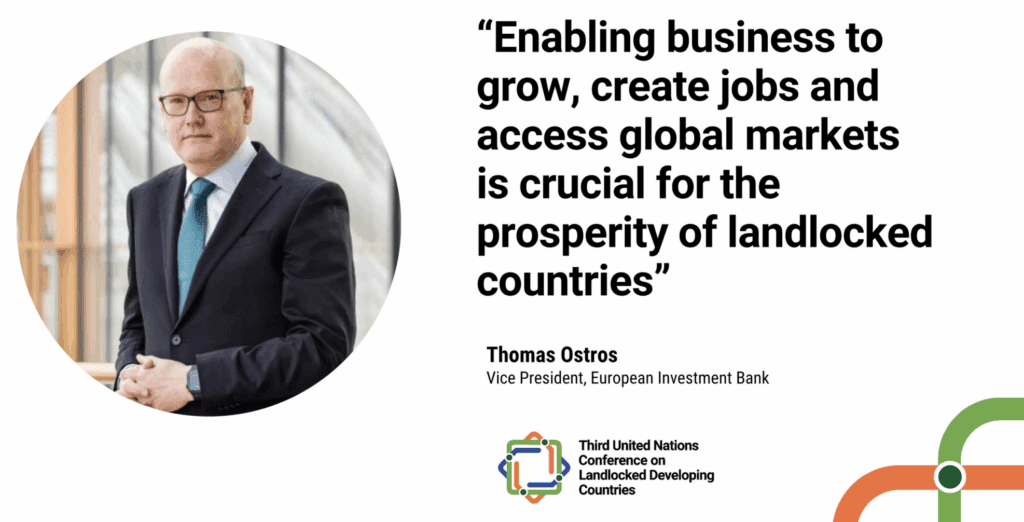
Enabling business to grow, create jobs and access global markets is crucial for the prosperity of landlocked countries. Access to finance is crucial for empowering smallholder farmers and enhancing food security in LLDCs.
In Mali, Malawi, Zambia, and Zimbabwe, the EIB has worked with local financial institutions to develop innovative financing mechanisms tailored to the needs of smallholder farmers and agribusiness. By providing access to credit and business finance training, these initiatives enable farmers to modernise agricultural practices, increase productivity, and improve their livelihoods.
Infrastructure for Trade and Connectivity
In addition to energy and agriculture, upgrading transport connectivity is essential for enhancing connectivity and reducing trade barriers. Moldova, North Macedonia, Chad, Armenia, and Bolivia, despite their landlocked status, now benefit greatly from EIB-backed improved rail and road links to neighbouring countries and ports, as well as support to enable trade insurance coverage for landlocked African states.
This investment has both cut costs for the movement of goods and people and stimulated regional trade and economic integration.
Call for Coordinated Action
It is imperative for development and private sector partners to recognize the potential of investing in LLDCs. By addressing geographic barriers and reducing transportation costs, together we can unlock new opportunities for trade, investment, and economic growth in these nations. Removing barriers to new investment can contribute to both delivering the Sustainable Development Goals and promoting inclusive and sustainable development worldwide.
However, realizing the full potential of LLDCs requires a coordinated and sustained effort from many stakeholders. Governments must create an enabling environment for long-term investment by implementing sound policies, improving governance, and enhancing regulatory frameworks.
Development finance institutions, including the EIB, must continue to prioritize investments in key sectors such as renewable energy, agriculture, and infrastructure, while leveraging partnerships with other stakeholders.
Furthermore, private sector engagement is essential for scaling up investments and fostering innovation in LLDCs. By harnessing the expertise and resources of the private sector, we can accelerate progress towards sustainable development goals and create shared value for communities and investors alike.
Delivering Global Gateway through EIB Global
As the financing arm of the European Union and leading implementing partner of the Global Gateway initiative, the EIB is helping to deliver the EU strategy to better connect the world through sustainable investment and closer partnership.
Delivering Global Gateway through EIB Global means mobilising investment that addresses both the specific needs of LLDCs and the strategic values and interests of the European Union. Through EIB Global, the EIB stands ready to further strengthen its support for LLDCs and work with relevant stakeholders by backing high-impact sustainable investment that strengthens private sector growth and prosperity.
Thomas Östros serves as Vice President of the European Investment Bank (EIB), the EU Bank. Prior to joining the EIB in January 2020, Mr Östros worked at the International Monetary Fund since 2015, serving as Executive Director of the Nordic-Baltic Constituency as of 2016.
 Follow SDG News on LinkedIn