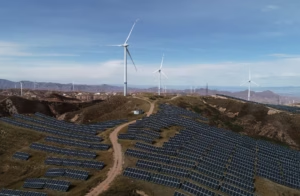
A Milestone Few Thought Would Arrive So Soon
For the first time in American history, solar energy generated more electricity than coal in a single month, signaling a profound shift in the country’s energy landscape.
According to new analysis from global energy think tank Ember, solar power supplied 12.8% of U.S. electricity generation in May 2026, edging past coal, which accounted for 12.2%. The milestone comes despite renewed federal efforts to bolster the coal industry and highlights the growing momentum of solar energy across the United States.
The achievement represents more than a symbolic victory for clean energy advocates. It underscores how rapidly economics, technology, and market demand are reshaping the world’s largest economy.
Market Forces Continue to Favor Solar
The milestone arrives at a moment of political tension over America’s energy future.
Earlier this month, President Donald Trump announced a $700 million federal initiative to support coal plants and mines, invoking emergency powers to strengthen domestic coal production amid rising electricity demand driven by artificial intelligence and data centers.
Yet even as policymakers attempt to revive coal, market dynamics continue pushing utilities and investors toward solar.
Solar generation reached a record 45.5 terawatt-hours in May, increasing 17% from the same month last year and surpassing previous records. Meanwhile, coal’s share of the electricity mix has continued its long-term decline, reaching one of its lowest monthly levels ever recorded.
The trend is being driven by declining technology costs, expanding battery storage capacity, and growing demand for new electricity generation sources that can be deployed quickly and at scale.
The AI Era Is Accelerating Electricity Demand
The timing is particularly significant because the United States is entering a new era of energy consumption.
The U.S. Energy Information Administration projects national electricity demand will reach record highs in both 2026 and 2027, fueled by artificial intelligence infrastructure, advanced manufacturing, electrification, and data center expansion. Commercial electricity consumption is expected to exceed residential consumption for the first time on record.
Meeting that demand is becoming one of the defining economic and national security challenges of the decade.
While natural gas remains America’s largest source of electricity generation, solar has emerged as the leading source of new power capacity. Industry analysts estimate that more than 90% of new electricity generation capacity added in the United States this year will come from solar, wind, and battery storage projects.
America’s Energy Transition Is Happening in Unexpected Places
One of the more surprising aspects of the solar boom is where it is occurring.
Recent industry data shows that approximately 74% of new solar capacity installed during the first months of 2026 was built in states that supported President Trump in the last election, including major projects in Texas and Florida.
Texas, long synonymous with oil and gas production, is expected to see solar generation surpass coal generation for the first time this year as utilities race to meet rapidly growing power demand.
The development illustrates how renewable energy is increasingly being driven by economics and energy security concerns rather than solely by climate policy.
A Signal of What Comes Next
The significance of solar surpassing coal extends beyond the United States.
Globally, renewable energy generation recently overtook coal as the world’s largest source of electricity for the first time in more than a century, with solar accounting for the majority of new electricity growth worldwide.
For governments, investors, and businesses, the message is becoming increasingly clear: the future energy system is being built now, and solar is emerging as one of its foundational pillars.
The debate over energy policy is likely to continue. But the market has delivered a powerful signal. In May 2026, the sun generated more electricity for Americans than coal.
That moment may be remembered as one of the clearest indicators yet that the global energy transition has moved from aspiration to reality.
RELATED STORIES:
 Follow SDG News on LinkedIn