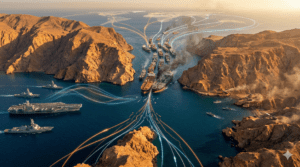
The world is watching the Strait of Hormuz for oil.
It may soon realize it should have been watching it for food.
As tensions escalate between the United States, Israel, and Iran, the narrow maritime corridor—long viewed as the world’s most critical energy chokepoint—is emerging as something more consequential: a pressure point for the global food system itself. The disruption is not only about crude shipments. It is about fertilizer, the invisible backbone of modern agriculture, and the cascading risks now spreading across global markets.
The Supply Chain No One Sees
Nearly one-third of the world’s traded fertilizer moves through the Strait of Hormuz. Unlike oil, these flows rarely command attention. There are no strategic fertilizer reserves, no daily price tickers on cable news. Yet without it, the global agricultural system begins to falter.
Nitrogen-based fertilizers, derived from natural gas, are essential to maintaining crop yields at scale. Wheat, corn, and rice production depend on them. When supply tightens, farmers are forced into difficult trade-offs: reduce application and accept lower yields, or absorb rising costs that may not be recoverable.
Now, both pressures are mounting.
Disruptions to shipping routes and production across the Gulf are pushing up the cost of key inputs like ammonia and urea. The impact is arriving at the worst possible moment, just as farmers across the Northern Hemisphere begin planting season. Decisions made in the coming weeks will shape harvests months from now.
And those harvests are already under threat.
Collision Course With Climate
The fertilizer shock is converging with a second, less visible force: climate volatility.
The anticipated return of La Niña threatens to disrupt weather patterns across key agricultural regions. Historically, it has brought drought to parts of the Americas and flooding to regions of Asia, undermining crop stability on both sides of the globe.
The result is a compounding effect. Lower fertilizer use weakens yields. Extreme weather further reduces output. Together, they tighten global supply in ways that are difficult to reverse.
Early signals are already appearing in commodity markets, where prices for staple crops and inputs are beginning to climb. For traders, the warning signs are familiar. For policymakers, they are lagging indicators of a deeper structural problem.
From Input Shock to Global Inflation
Fertilizer is not just another agricultural input. It is one of the largest cost drivers in food production, accounting for more than half the cost of growing key crops in some regions.
As prices rise, the consequences ripple outward.
Livestock feed becomes more expensive. Meat and dairy prices follow. Food processors face higher input costs. Retail prices begin to climb. At the same time, elevated energy prices—also tied to disruptions in Hormuz—push up transportation and logistics costs across the system.
What begins as a supply chain disruption in a narrow stretch of water quickly becomes a synchronized inflationary shock.
For advanced economies, this may translate into higher grocery bills and renewed inflationary pressure. For developing countries, it is more existential. Many rely heavily on imported fertilizer to sustain domestic agriculture. Without it, yields fall, imports rise, and food insecurity deepens.
The timeline is unforgiving. Fertilizer shortages today do not create headlines tomorrow. They create failed harvests months later.
A Strategic Blind Spot
For decades, global energy security has centered on the Strait of Hormuz. Naval patrols, diplomatic strategies, and contingency planning have all been built around ensuring the steady flow of oil.
Food has not been part of that equation.
The current crisis is exposing a critical blind spot. The same corridor that fuels the global economy also feeds it. Yet the systems designed to protect energy flows have not been mirrored in agriculture.
There is no coordinated international mechanism to safeguard fertilizer supply. No equivalent to strategic petroleum reserves. No rapid response system capable of stabilizing flows when disruptions occur.
In an interconnected global economy, that absence is no longer theoretical. It is now material.
Rethinking Resilience in a New World Order
The implications extend beyond this moment.
As geopolitical tensions rise and climate volatility intensifies, the vulnerabilities of global supply chains are becoming harder to ignore. Food systems, once assumed to be resilient through diversification and trade, are proving more fragile than expected.
The emerging crisis in the Strait of Hormuz is not an isolated event. It is a preview.
It suggests that future shocks will not arrive neatly categorized as energy, climate, or geopolitical crises. They will arrive as all three at once, interacting in ways that amplify their impact.
For governments, investors, and institutions, the challenge is no longer simply to respond. It is to anticipate.
Because by the time the consequences appear on supermarket shelves or in food security statistics, the underlying decisions—on fertilizer, on planting, on supply—will already have been made.
And the window to act will have closed.
RELATED STORIES:
- Nestlé and UNESCO Launch Global Initiative to Empower Youth in Climate Resilience
- $100 Oil and Rising: Iran War Triggers Global Energy Shock and Rewrites the Rules of the Energy Transition
- The Cost of Trump’s Transactional Alliance Doctrine Is Now Unfolding in Real Time
- Sustainable Finance Market Set to Surge to $35.7 Trillion by 2034
- ‘The U.S.A. Won’t Be There to Help You Anymore’: Trump Tells Allies to ‘Take’ Oil as Global Order Frays
 Follow SDG News on LinkedIn