A sudden reprieve for major U.S. allies highlights the chaotic evolution of American tariff policy, which has shaken markets and diplomatic trust.
WASHINGTON — President Donald Trump on Tuesday announced that the European Union and the United Kingdom would be spared the highest tariff burdens under his expanding trade regime, opting instead to keep them on comparatively lighter rates. The move came as global markets wobbled and policymakers in Europe and London sought clarity amid weeks of shifting U.S. tariff policy.
Under the new order, the United States will impose a 10 percent tariff on imports from the EU and U.K., a rate significantly lower than the 15 percent global tariff initially invoked by the administration after the Supreme Court struck down the legal basis for its broader tariff scheme. The concession represents a tactical retreat by Washington but underscores the profound uncertainty roiling international trade relations.
European and British officials welcomed the limited reprieve but emphasized that it did not resolve deeper doubts about the sustainability of trade agreements with the United States. Lawmakers in the European Parliament, who had been preparing to ratify a comprehensive trade deal with Washington, pushed back the vote, demanding legal certainties before moving forward.
Markets Rally and Dip on Policy Whiplash
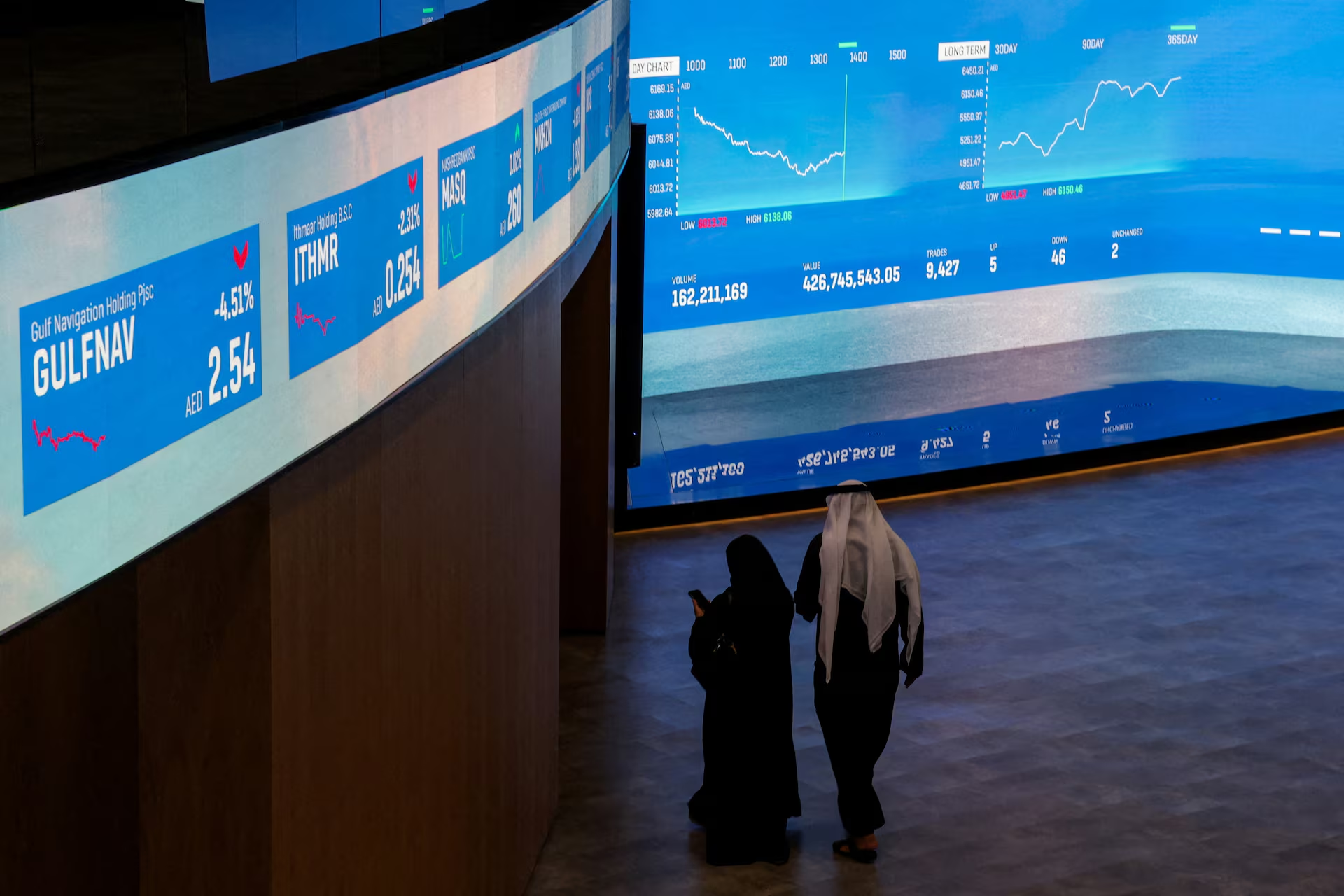
Financial markets reacted sharply to the tariff developments. European stock benchmarks such as the STOXX 600, Germany’s DAX and France’s CAC 40 experienced volatility in early trading, swinging between gains and losses as traders digested the news. In London, the FTSE 100 saw similar back-and-forth movements as investors weighed the economic impact of renewed tariff pressures, particularly on export-heavy sectors.
Analysts noted that the industry’s response reflected broader anxieties over the predictability of U.S. trade policy. While the decision to limit tariffs on the EU and U.K. offered a near-term boost to sentiment, the underlying legal and diplomatic confusion continued to weigh on confidence.
A Policy Shift Born of Legal Setback
The current episode was triggered by a ruling last week from the U.S. Supreme Court, which found that the administration had overstepped its authority in imposing broad tariffs under emergency powers. That decision invalidated the sweeping tariff framework Mr. Trump had spent much of 2025 attempting to put in place, forcing the White House to pivot quickly to alternative legal authority.
In response, the administration enacted a temporary global tariff set at 15 percent on nearly all imported goods, a rate intended to uphold negotiating leverage with foreign governments. The high rate, however, alarmed trading partners and market participants, who feared a sharp escalation in the cost of goods and further disruption of global supply chains.
Trade Deals That Once Seemed Durable
To understand how the world arrived at this point, one must trace the trajectory of policy shifts over the past year.
In the spring of 2025, Mr. Trump ushered in a new tariff agenda that raised baseline duties to roughly 10 percent on most imports while threatening reciprocal tariffs of up to 50 percent on countries with significant trade surpluses with the United States. The objectives were framed as a bid to correct longstanding trade imbalances, but international reaction was swift and uncertain.
Under pressure to avoid a global trade war, the United States negotiated a transatlantic framework in mid-2025 with the European Union in which most EU exports would face a 15 percent tariff into the U.S. market, while the EU reduced barriers on U.S. goods. The accord, hailed by negotiators at the time as averting broader conflict, nevertheless rested on the assumption that the U.S. tariff framework would remain legally intact.
The United Kingdom, negotiating separately after Brexit, secured even lower tariff treatment — 10 percent — under its own economic partnership agreement with Washington, a deal London touted as a symbol of its new economic independence.
Legal Upheaval and Diplomatic Strain
The Supreme Court’s override of the administration’s emergency tariff authority rocked those assumptions. With the original legal foundation struck down, the administration’s abrupt switch to a new tariff regime called into question whether earlier deals could be implemented as intended.
In practical terms, the administration’s newest tariff order sets a 15 percent global tariff in place broadly, with carve-outs keeping the EU and U.K. at 10 percent for now. But trade envoys and foreign ministers said they needed written guarantees before moving forward with ratification or legislative approval of bilateral agreements.
The unpredictable oscillation in U.S. policy has made markets jittery. Stock indexes across Europe and the United States have swung in recent days as investors reassess the risks posed by uneven trade costs and uncertain market access. Economists warn that policy unpredictability itself — even more than any tariff rate — can slow investment, disrupt decisions on where to build factories, and dampen cross-border commerce.
Allies Seek Certainty
Brussels has insisted that “a deal is a deal,” urging Washington to respect the spirit and letter of earlier agreements. In London, government officials pressed for assurances that the U.K.’s favored tariff rates would remain in place and would not be swept aside by future executive actions or court decisions.
For many of America’s closest trading partners, the ordeal has been a test of trust. Efforts to stabilize the relationship this week offered some reassurance, but they did not resolve deeper questions about how agreements negotiated under one legal framework can survive abrupt policy changes under another.
The Road Ahead
The decision to spare the EU and the U.K. from the highest tariff rates may ease immediate tensions. But the broader message of the past year is unmistakable: trade policy has become a source of profound uncertainty, with legal rulings, executive shifts, and political calculation reshaping the landscape more quickly than allies and markets can adjust.
As governments on both sides of the Atlantic work to reaffirm commitments and secure legal guarantees, businesses and investors will be watching closely. The world’s trade architecture, long anchored in predictability and rules, is now navigating a period of tumult that shows few signs of settling soon.
RELATED STORIES:
- The Red Line Moment: Trump’s 100 Percent Tariff Tests the Limits of Trade Power
- Breaking News: Supreme Court Blocks Trump’s Tariff Powers, Sending Shockwaves Through U.S. Diplomacy
- The Global Climate Consequences of Escalating U.S. Trade Tensions
- US Tariff Wars Threaten Africa’s Trade and Investment Prospects
- Trump Tariffs Spark Warnings Over U.S. Clean Energy Slowdown
 Follow SDG News on LinkedIn