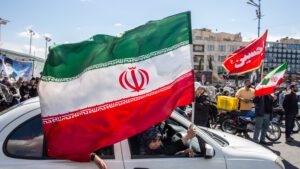
The Iran that has emerged from the ceasefire is not simply intact. It is transformed.
It is governed by a new leader shaped by loss and war. It is animated by a narrative of survival. And it is now holding new strategic cards that are reshaping the balance of power in the Middle East.
But this is not just a story about Iran’s resilience. It is a story about what Iran has gained—and what the United States may have lost.
A New Leader, Forged in Conflict
At the center of this transformation is Iran’s new supreme leader, Mojtaba Khamenei.
He steps into power not as a caretaker of the old regime, but as the son of a leader killed in war—an event that has already begun to shape both his rhetoric and his rule.
In his first major statements, he did not signal reconciliation. He signaled retribution.
He denounced the United States and Israel as “criminal aggressors” and demanded what he described as “blood money” for the war. Compensation, he said, would be required for every loss—for the dead, for the wounded, for the destruction inflicted on Iran.
“We will certainly not let go of the criminal aggressors who attacked our country,” he said in a message attributed to him. “We will undoubtedly demand compensation for every single damage inflicted, the blood money of the martyrs, and the diyah of the war-wounded.”
This is not the language of de-escalation.
It is the language of a leader consolidating power through grievance—and preparing his country for a longer confrontation.
The Strait Becomes Strategy
Nowhere is Iran’s new leverage more visible than in the Strait of Hormuz.
Before the war, Iran could threaten the Strait. Now, it is actively shaping how it operates.
Khamenei has warned that Iran will take the “management of the Strait of Hormuz into a new phase,” a statement that reflects more than rhetoric. It signals a shift from disruption to control.
Iran is no longer relying solely on the threat of closure. It is experimenting with regulation—limiting flows, influencing access, and signaling that one of the world’s most critical energy corridors may now function on Iranian terms.
The implication is profound.
Energy markets, shipping routes, and global supply chains are now exposed not just to instability, but to structured leverage.
The New Cards Iran Holds
The ceasefire did not end the conflict. It reorganized it.
Iran now holds a set of strategic cards that did not exist before the war.
It has operational influence over a global chokepoint.
It has reasserted its position as an indispensable regional actor.
It has preserved its nuclear ambiguity.
And it has constructed a domestic narrative in which survival itself is victory.
But perhaps the most consequential card is psychological.
Iran’s leadership now believes it can absorb extraordinary pressure and endure. That belief changes how it negotiates, how it deters, and how it escalates.
A Transactional America
Running parallel to Iran’s rise is a quieter shift in the United States.
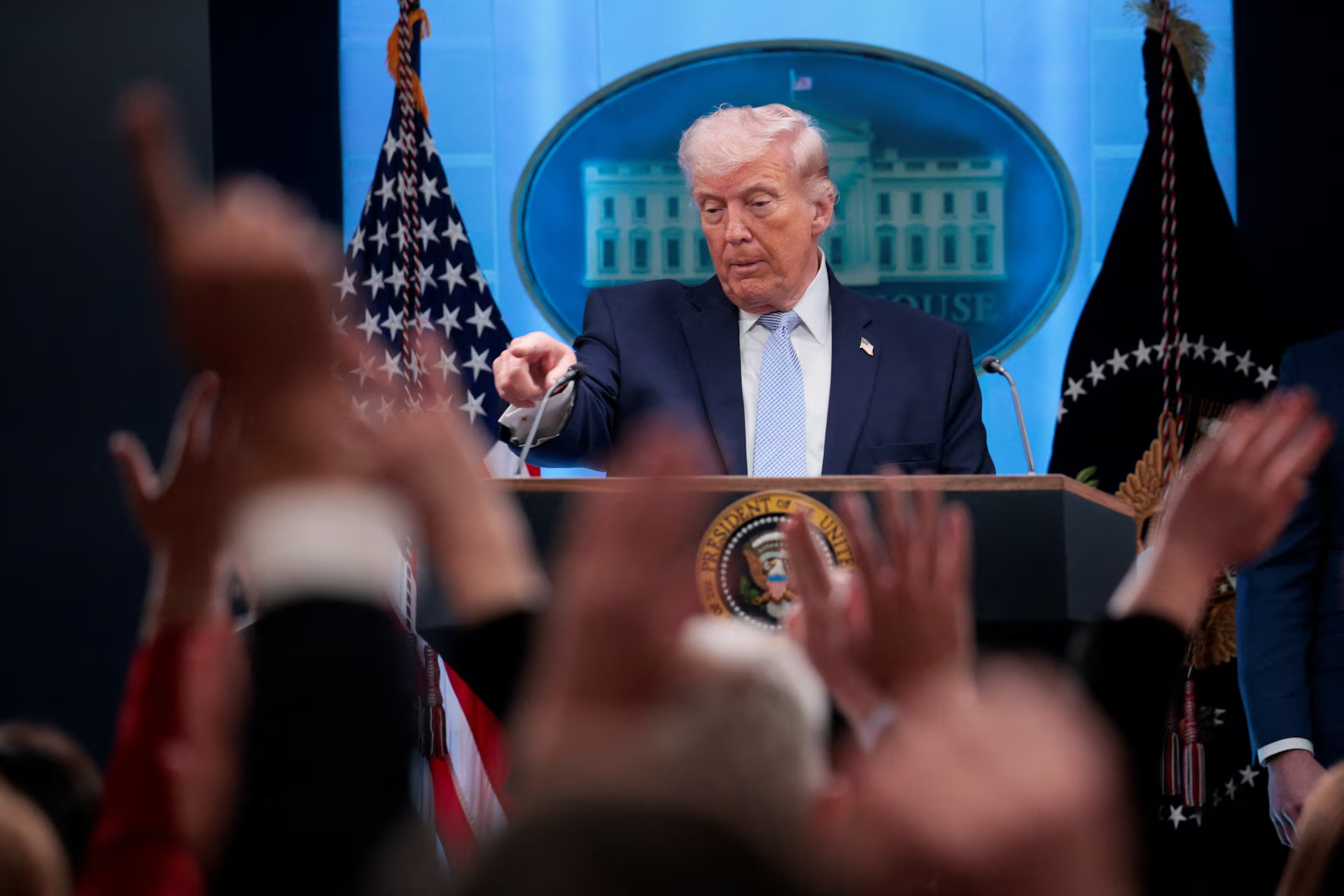
Under Donald Trump, the war increasingly took on the contours of a transaction.
Objectives evolved. Red lines blurred. And by the end, the outcome resembled a negotiated arrangement more than a decisive strategic victory.
At one point, the idea of a joint U.S.-Iran framework tied to the Strait itself entered the conversation—a proposal that would have been almost unthinkable in previous administrations.
This is the defining tension of the moment.
When war becomes transactional, it may produce short-term outcomes. But it also reframes how power is perceived.
The Cost of That Shift
For decades, American influence has rested not only on strength, but on credibility—the belief that it operated within a broader system of norms, alliances, and principles.
That credibility is now under pressure.
A foreign policy that treats conflict as negotiable, and outcomes as deals, introduces uncertainty into the system. Allies begin to question consistency. Adversaries begin to test limits.
Iran has already adapted.
It is meeting the United States on transactional terms—but from a position of defiance, not dependence.
A More Dangerous Balance
The New Iran is not without weakness. Its economy is strained. Its infrastructure is damaged. Its people are under pressure.
But it is stronger in one critical respect.
It has learned that survival is enough.
Enough to claim victory.
Enough to extract concessions.
Enough to reshape the terms of engagement.
And now, under a leader defined by loss and hardened by war, Iran is signaling that the next phase will not be about recovery.
It will be about leverage.
The ceasefire has paused the conflict.
But the New Iran suggests something more enduring: a shift in power, in posture, and in perception—one that the world is only beginning to confront.
RELATED STORIES:
- The Cost of Trump’s Transactional Alliance Doctrine Is Now Unfolding in Real Time
- The Final Countdown: Inside the Deadline That Could Reshape the Middle East
- The Price of a Pause: How the U.S.–Iran Ceasefire Reveals Strategic Concessions and Reputational Risk
- How the Iran War Is Accelerating the World’s Shift to Energy Independence
- The War That Burns Twice: How the Iran Conflict Is Rewriting the Future of Energy
 Follow SDG News on LinkedIn