The post–World War II international order was built on a simple, fragile premise: that power would be constrained by rules, that sovereignty would be respected, and that the horrors of unchecked militarism would never again be normalized. That premise is now being openly challenged by the President of the United States.
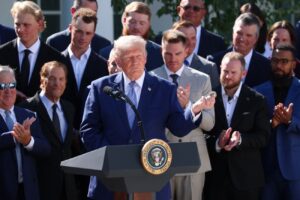
In a recent New York Times interview, Donald Trump articulated a worldview that marks a decisive break from eight decades of international law, multilateral cooperation, and collective security. Asked whether there were any limits on his ability to use American military might, the president replied:
“Yeah, there is one thing. My own morality. My own mind. It’s the only thing that can stop me.”
He went further:
“I don’t need international law. I’m not looking to hurt people.”
With those words, Trump placed personal judgment above treaties, norms, alliances, and institutions. The implication is profound. The restraints that have governed the global system since 1945 are no longer viewed as binding by the world’s most powerful military actor.
From Rules to Willpower
For generations, U.S. power was legitimized not only by its scale but by its anchoring in international frameworks such as the UN Charter, NATO, the Geneva Conventions, and a dense web of alliances and legal commitments. Trump’s statements signal a shift away from that architecture toward a worldview in which legitimacy flows from strength, speed, and unilateral decision-making.
This shift is not theoretical. It follows concrete actions and threats, including military operations justified outside traditional multilateral processes, the reassertion of a hemispheric doctrine reminiscent of nineteenth-century power politics, and explicit pressure on sovereign territories deemed strategically valuable to U.S. interests.
The message to the world is unmistakable. Rules apply when convenient, and power decides when they do not.
Europe Pushes Back
The response from U.S. allies has been unusually direct. French President Emmanuel Macron publicly criticized Washington for breaching international law, warning that such actions weaken the global system designed to prevent conflict rather than manage it after the fact.
At the same time, European heads of state issued a rare joint statement affirming the sovereignty of Greenland, following Trump’s renewed rhetoric suggesting U.S. control of the territory was inevitable. When pressed on the issue, Trump responded bluntly that the United States would proceed “the easy way or the hard way.”
For European leaders, this was a line crossed. The principle at stake was not Greenland alone, but whether borders, sovereignty, and self-determination remain protected concepts or negotiable obstacles.
The End of the Post-1945 Assumption
What is collapsing is not merely a diplomatic norm, but a foundational assumption: that great powers accept limits on themselves.
International law has always relied on voluntary compliance, reinforced by legitimacy, reciprocity, and reputational cost. When a major power openly declares it does not need international law, the system’s deterrent effect erodes rapidly. Smaller states lose protection. Regional disputes harden. Other powers are incentivized to mirror the same logic.
The danger is not chaos overnight, but normalization. It is a gradual shift toward a world where coercion replaces consensus and precedent replaces principle.
What Happens to the United Nations?
No institution embodies this moment more clearly than the United Nations.
Already strained by budget shortfalls, political paralysis, and declining public confidence, the UN now faces an existential challenge. If its most influential members bypass its authority while continuing to invoke it selectively, its credibility erodes further.
Yet this moment may also force evolution.
Multilateral institutions cannot survive as moral reference points alone. They must demonstrate relevance, speed, and impact in a world that increasingly rewards decisiveness over deliberation. That may mean smaller coalitions of aligned states, stronger enforcement mechanisms, closer integration with regional bodies, and a renewed focus on tangible outcomes rather than consensus statements.
The UN’s purpose of preventing war, safeguarding sovereignty, and coordinating collective action has never been more necessary. But its methods, incentives, and power structures are being tested as never before.
A World Reimagined, Whether We Like It or Not
Trump’s declaration is not just a soundbite. It is a signal flare.
The post–World War II order is no longer assumed. It is contested. The question now confronting governments, institutions, and civil society is not whether the system will change, but who will shape what comes next.
A world governed by personal morality rather than shared rules may feel decisive in the short term. History suggests it is far less stable in the long run.
The era of multilateralism as it has been known may be ending. What replaces it, whether fragmentation, reinvention, or renewal, will define the next chapter of global order.
RELATED STORIES:
- From Canal to Catalyst: Big Moves in Ocean Climate Leadership at the Nature Summit in Panama
- Top 53 New Sustainability Startups Named – Here’s the Top 10
- Young Leaders Drive Political Change: Challenges for Law Firms
- Trump Shakes the World: A U.N. Speech That Will Redefine Global Order
- U.S. Clean Energy Set to Surpass 51% of Power Generation in April
 Follow SDG News on LinkedIn