The world’s largest climate finance institution is moving closer to the frontlines—and Panama has emerged at the center of that shift.
The Green Climate Fund (GCF) has selected five locations for its first-ever regional hubs, marking a structural transformation in how climate finance is delivered to developing countries. Among them, Panama City stands out—not just as a host city, but as the top-ranked location globally in a highly competitive selection process involving 43 applicant countries.
A Strategic Shift in Climate Finance
For more than a decade, the Green Climate Fund has operated primarily from its headquarters in South Korea. This new decentralized model aims to bring funding closer to where it is needed most—on the frontlines of climate vulnerability.
The newly announced hubs will be located in Panama City, Amman, Suva, Nairobi, and Abidjan, with Africa receiving two offices to reflect the scale of demand across the continent.
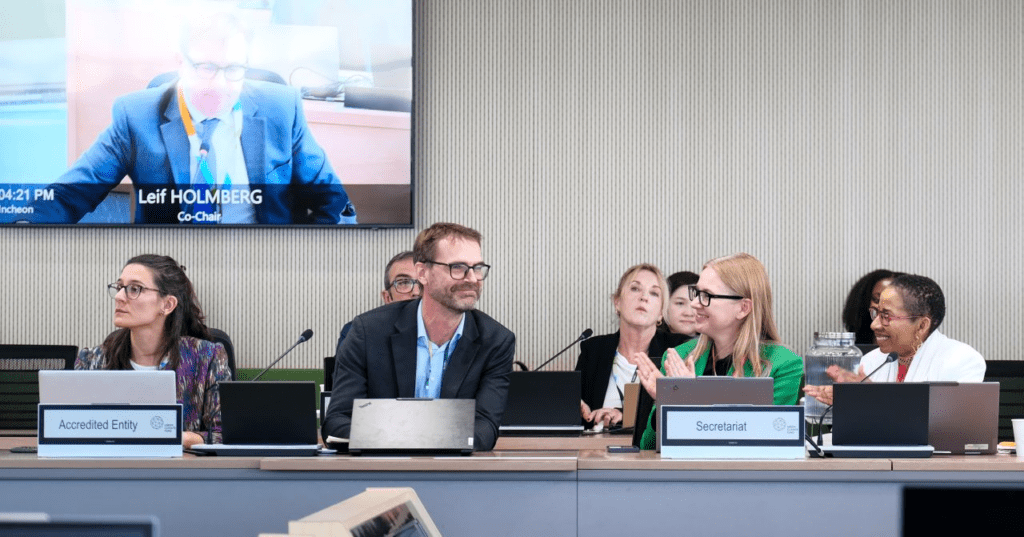
By embedding teams on the ground, the Green Climate Fund is seeking to streamline access to finance, accelerate project approvals, and strengthen partnerships with governments, private sector actors, and civil society.
Panama’s Moment—A Whole-of-Government Achievement
Panama’s emergence as the top-ranked location is more than a geographic win—it is a signal of growing institutional strength and coordinated leadership.
Behind the ranking lies a whole-of-government effort, with the country’s environmental, foreign affairs, and economic ministries aligning to position Panama as a global hub for climate action. This level of coordination reflects a broader national strategy: to elevate Panama as a bridge between global capital and nature-based solutions across Latin America and the Caribbean.
The selection criteria—ranging from connectivity and cost efficiency to quality of life—underscore that Panama’s advantage is not accidental. It is the result of deliberate policy alignment and international engagement at the highest levels.
A Signal to the Global South
The decision comes at a time when demand for climate finance is surging. The Green Climate Fund has already built a portfolio exceeding $20 billion, supporting hundreds of projects aimed at mitigation and adaptation.
Yet access to that capital has often been criticized as slow and bureaucratic. By establishing regional hubs—and by selecting countries like Panama to lead them—the fund is signaling a shift toward greater country ownership and accessibility.
For developing nations, this is more than administrative reform. It is a rebalancing of where decisions are made, who shapes them, and how quickly resources reach vulnerable communities.
The Bigger Picture
The creation of regional hubs across Latin America, Africa, the Pacific, and the Middle East signals a deeper transformation in the architecture of global climate finance.
For years, developing countries have called for a system that is not only better funded, but closer, faster, and more responsive to local realities. These new offices are a direct response to that pressure—bringing decision-making power nearer to governments, improving coordination with regional institutions, and unlocking more agile pathways for investment.
If successful, this model could redefine how multilateral climate finance operates—shifting from a centralized, approval-heavy system to a distributed network capable of scaling solutions at speed.
In a world where climate impacts are accelerating and geopolitical fragmentation is reshaping global cooperation, the Green Climate Fund’s move is more than administrative reform. It is an attempt to rebuild trust, deliver results on the ground, and prove that the global financial system can still meet the urgency of the moment.
RELATED STORIES:
 Follow SDG News on LinkedIn