As the war between Iran and a U.S.-Israel alliance enters a decisive phase, a single moment now anchors the trajectory of the conflict: Tuesday at 8:00 p.m. Eastern Time (00:00 GMT).
What happens—or fails to happen—by that deadline could determine whether the region steps back from the brink or accelerates into a far more destructive chapter.
A Ceasefire Rejected, A Broader Vision Demanded
In the final days leading up to the deadline, a proposed 45-day ceasefire emerged as the most viable off-ramp. Brokered through regional intermediaries, the framework aimed to pause hostilities and reopen the Strait of Hormuz, restoring stability to global energy markets.
Iran rejected the proposal.
Tehran’s position has hardened around a broader objective: not a temporary pause, but a permanent end to the war. Its demands extend beyond de-escalation to include sanctions relief, reconstruction commitments, and long-term guarantees for regional security.
For Washington, those terms go too far. For Tehran, anything less falls short.
The result is a diplomatic impasse at the exact moment when urgency is highest.
The 8:00 p.m. Ultimatum
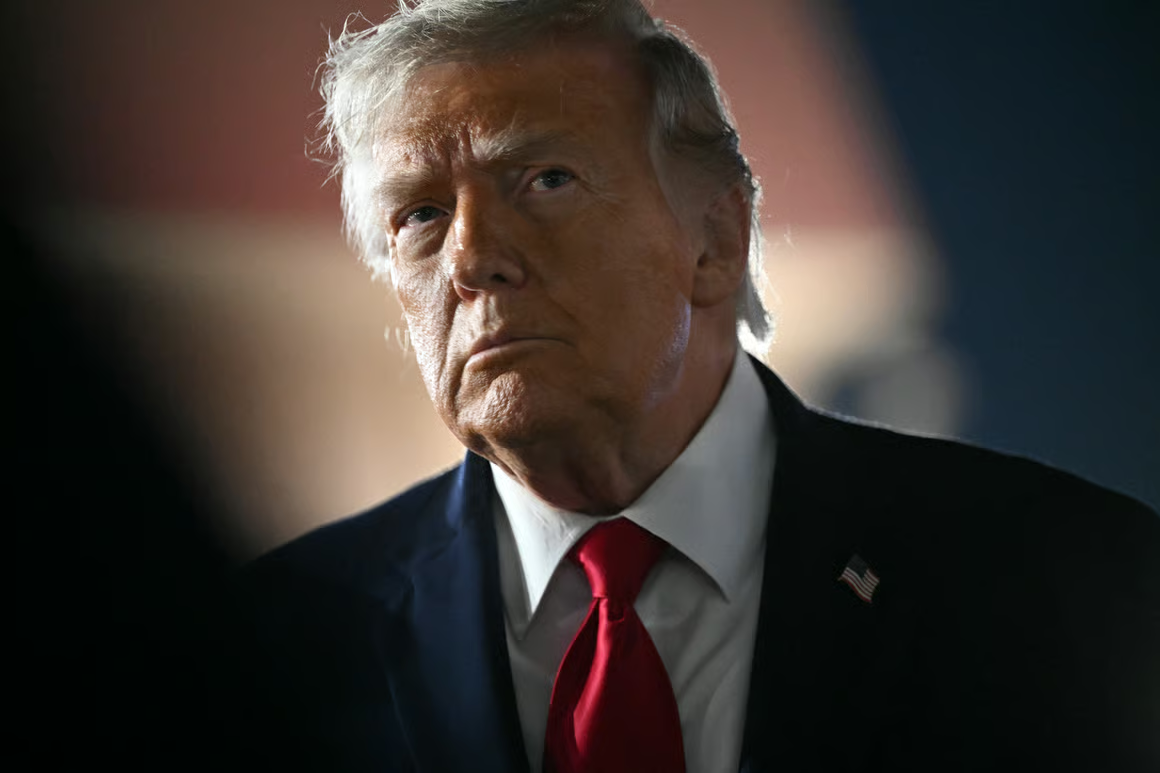
The deadline imposed by President Trump is not symbolic. It is operational.
If Iran does not meet U.S. demands—most critically, reopening the Strait of Hormuz—Washington has signaled it is prepared to launch sweeping strikes targeting Iran’s core infrastructure: energy systems, transport networks, and strategic assets.
But in the final hours before the deadline, the rhetoric escalated dramatically.
Trump warned that “a whole civilization will die tonight” if a deal is not reached, framing the moment as one of historic consequence and irreversible loss.
The statement marked a sharp intensification—not just of military posture, but of language—suggesting that the consequences of inaction would extend far beyond conventional escalation. The framing elevated the stakes from regional conflict to civilizational risk.
Iran, in turn, has refused to concede under pressure, signaling that it is prepared to absorb escalation rather than capitulate. The result is a high-risk standoff with global implications.
War in Motion
Even as the clock counts down, the war itself is not waiting.
Airstrikes have intensified across Iranian cities, targeting military and infrastructure sites. In response, Iranian missile and drone attacks have struck regional targets, including critical economic and logistical nodes.
The Strait of Hormuz remains the most consequential pressure point. Its disruption has already begun to ripple through global energy markets, injecting volatility into oil prices and heightening concerns about supply disruptions.
What is unfolding is not just a regional conflict, but a system-level shock with global economic implications.
A Press Conference That Signaled More Than Strategy
In the lead-up to the deadline, President Trump appeared alongside Defense Secretary Pete Hegseth in a press conference that offered a clear signal of intent.
Trump emphasized that the United States is prepared to act decisively, underscoring overwhelming military capability and warning that failure to comply would bring consequences that fundamentally alter Iran’s strategic landscape.
But it was the tone, as much as the substance, that stood out.
Both Trump and Hegseth invoked religious language, framing the moment not only as a geopolitical confrontation but as one of moral and historical consequence. References to divine guidance and destiny introduced a broader narrative—one that blended national security with civilizational framing.
The message was clear: this is not being positioned as a limited tactical operation, but as a defining moment with enduring significance.
The Legal Line: Infrastructure and the Laws of War
The potential targeting of energy infrastructure introduces not only strategic risk, but legal scrutiny under international humanitarian law.
Under the framework of the Geneva Conventions and their Additional Protocols, parties to a conflict are bound by the principles of distinction and proportionality. Civilian objects—including infrastructure indispensable to the survival of the civilian population, such as electricity, water, and energy systems—are protected from attack unless they are being used for direct military purposes.
Deliberate or indiscriminate attacks on such infrastructure can constitute violations of international law, and in certain circumstances may rise to the level of war crimes, particularly if they cause excessive harm to civilians relative to the anticipated military advantage.
Legal experts have increasingly warned that modern warfare—especially strikes targeting power grids and energy systems—sits in a gray zone where strategic objectives and humanitarian protections collide. The classification of any specific strike would ultimately depend on intent, targeting, and proportionality.
Diplomacy on Borrowed Time
Behind the scenes, a network of intermediaries—including Pakistan, Egypt, and Turkey—continues to push for a breakthrough. Proposals remain on the table. Channels remain open.
But the conditions for agreement are narrowing.
Ongoing military operations, compounded by deep mistrust between Washington and Tehran, have eroded the space for compromise. Each passing hour reduces the likelihood that diplomacy can outpace escalation.
What Comes After the Clock Runs Out
This is the defining tension of the moment: a fixed deadline imposed on a fluid and deeply complex conflict.
A short-term ceasefire could stabilize markets and reduce immediate violence. A broader agreement could reshape the region’s long-term trajectory. But neither appears within reach as the clock approaches zero.
The risk is not simply that the deadline passes without agreement. It is that the deadline itself becomes the trigger.
As the world moves toward 8:00 p.m., the question is no longer whether the conflict will change—but how dramatically, and at what cost.
What follows may not only reshape the Middle East, but redefine the boundaries between diplomacy and war in a rapidly shifting global order.
RELATED STORIES:
- HLPF 2025 Puts Gender Equality at the Center of Global SDG Push
- The Cost of Trump’s Transactional Alliance Doctrine Is Now Unfolding in Real Time
- Weimar+ Leaders Strengthen Ukraine Assistance While Weighing Escalated Sanctions on Russia
- Maersk Suspends Key Shipping Routes as Iran War Disrupts Global Trade
- ‘The U.S.A. Won’t Be There to Help You Anymore’: Trump Tells Allies to ‘Take’ Oil as Global Order Frays
 Follow SDG News on LinkedIn