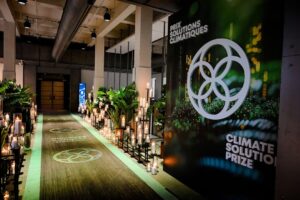
DALLAS — On Earth Day, inside the packed halls of EarthX’s 2026 Nature Summit, Panama did not just show up as a participant. It arrived with a proposition to reshape the global framework itself.
At the flagship forum of Global Resilience Partners (GRP), where governments, investors, and philanthropies converge to turn ambition into action, Panama used the moment to elevate a bold new doctrine: the Universal Declaration of the Rights of Nature.
The message was clear. Nature is no longer just an asset to be managed. It is an entity with rights to be recognized.
From Panama to the World Stage
Led by Environment Minister Juan Carlos Navarro, Panama positioned the declaration as more than a national initiative. It is a diplomatic campaign.
Fresh off its unveiling, the declaration is already building momentum ahead of the United Nations General Assembly this September, where Panama plans to formally present it to the international community. The ambition is nothing short of historic: to establish a global standard that reframes humanity’s relationship with the natural world.
At EarthX, that vision resonated. Not as theory, but as strategy.
The Nature Summit as a Dealmaking Engine
The Nature Summit has quickly emerged as GRP’s flagship platform, engineered not for rhetoric but for results. Its design is deliberate: a government co-host paired with a philanthropic co-host, convening capital and leadership across sectors to unlock scalable solutions within the nature-based economy.
That model was on full display in Dallas.
Panama’s presence was not incidental. It is the product of a deepening partnership with GRP, formalized through a Memorandum of Understanding signed at the United Nations Headquarters during the 2025 General Assembly. The agreement established Panama as the inaugural government co-host of the Nature Summit Series and mandated GRP to help identify and structure public-private partnerships that advance the country’s leadership in both the blue and green economy.
Over the past year, that mandate has translated into action. The inaugural Nature Summit Series in Panama convened alongside the world’s most important environmental negotiations on climate, biodiversity, and land—placing the country at the center of global environmental diplomacy.
Dallas was the next chapter.
A Changing of the Guard, A Continuity of Vision
While Panama passed the government co-host mantle to the Kingdom of Tonga for 2026, its influence was unmistakable.
The summit was chaired by Prime Minister Lord Fatafehi Fakafanua, whose leadership anchored the forum in the realities of frontline nations. Under his stewardship, the conversation moved fluidly between urgency and opportunity, reinforcing a central theme: resilience is not achieved in isolation. It is built through partnership.
Panama’s Rights of Nature framework fit squarely within that narrative. It offers a philosophical foundation for the kinds of partnerships GRP is designed to catalyze—ones that align government policy, private capital, and philanthropic purpose around a shared understanding of value.
Thought Leadership Defining a New Financial Paradigm
If Panama provided the political vision, Ralph Chami provided the economic blueprint.
With over three decades as a financial economist—including 25 years at the International Monetary Fund—Dr. Chami brought credibility forged across global financial systems, fragile states, and macroeconomic policy. But it is his more recent work that captured the attention of the room.
Over the past seven years, Chami has pioneered the field of “science-based finance,” a framework that assigns tangible economic value to the ecosystem services provided by living nature. From carbon sequestration to biodiversity preservation, his work reframes nature not as an externality, but as a foundational asset class.
At the Nature Summit, this was not presented as abstract theory. It was positioned as a mechanism for action.
Chami demonstrated how governments—particularly those on the frontlines—can leverage the intrinsic value of their natural assets to unlock new forms of financing. In doing so, they are not forced to choose between conservation and development. They can pursue both, simultaneously, at scale.
The implications are profound.
For investors, it signals the emergence of a new category of investable opportunity grounded in measurable ecological value.
For governments, it provides a pathway to access capital without compromising sovereignty or natural heritage. For the broader system, it marks the acceleration of a global shift toward “nature-as-an-asset.”
This is precisely the kind of scalable solution the Nature Summit was built to elevate.
Redefining Value in the Nature-Based Economy
At its core, the Universal Declaration of the Rights of Nature challenges the prevailing economic model.
For decades, nature has been treated as external to financial systems—its degradation tolerated, its restoration underfunded. Panama is proposing a reset. By recognizing nature as a rights-bearing entity, it creates a new lens through which investments, policies, and partnerships can be structured.
Chami’s framework gives that lens financial clarity.
Together, they form a powerful convergence: a political movement to recognize nature’s rights, and a financial architecture to operationalize its value.
For investors and family offices in the room, the implications were immediate. This is not just about conservation. It is about redefining risk, opportunity, and long-term value in a world where ecological stability underpins economic resilience.
From Dallas to the United Nations
The summit closed not with a conclusion, but with a signal.
In a moment that captured the trajectory of the entire forum, it was announced that the next Nature Summit will be held inside the United Nations Headquarters during the United Nations General Assembly this September.
The implication is enormous.
What began as a high-level convening to connect leaders and capital is now moving directly into the center of global governance. The Nature Summit is not orbiting power. It is entering it.
For Panama, the timing could not be more consequential. As it prepares to formally present the Universal Declaration of the Rights of Nature to the world’s governments, the Nature Summit will now sit inside the very institution where global norms are defined and adopted.
This is how ideas become doctrine.
This is how momentum becomes mandate.
And this is how a concept introduced on a stage in Dallas begins its journey toward reshaping the rules of the international system.
At Earthx2026, the message was unmistakable: the nature-based economy is no longer emerging.
It is organizing—and it is moving straight to the United Nations.
RELATED STORIES:
- Lord Fatafehi Fakafānua: A Tongan Statesman Shaping the Future of Global Leadership
- Juan Carlos Monterrey Gómez to Help Lead Nature Summit as Panama Hosts Global Climate Week
- Panama Minister Juan Carlos Navarro: “Nature Financing Isn’t a Luxury—It’s a Necessity”
- Peter Simek: The Architect Behind EarthX’s Breakthrough Moment
 Follow SDG News on LinkedIn