Brazil Launches National Carbon Credit Certifier Ecora to Strengthen Climate Market Integrity
11 月 18, 2025
4:54 上午
In This Article
In Belém, as COP30 brought global attention back to the Amazon, Brazil made one of its most strategic climate governance announcements in years: the creation of Ecora, a national carbon credit certifier designed to reshape the architecture of Brazil’s carbon markets and anchor the country’s rising influence in the global low-carbon economy. For a nation whose natural capital underpins the world’s climate stability, the launch signals a structural shift in how carbon integrity, traceability, and certification will be governed.
COP30’s setting made the announcement especially resonant. Surrounded by the world’s largest tropical forest, and amid new debates on integrity standards and carbon finance, Brazil’s move positions the country to define its own certification methodologies rather than rely on foreign systems. With Ecora, Brazil signals it is ready to become a global hub for credible, high-integrity carbon credit generation.
A new national institution for Brazil’s carbon economy
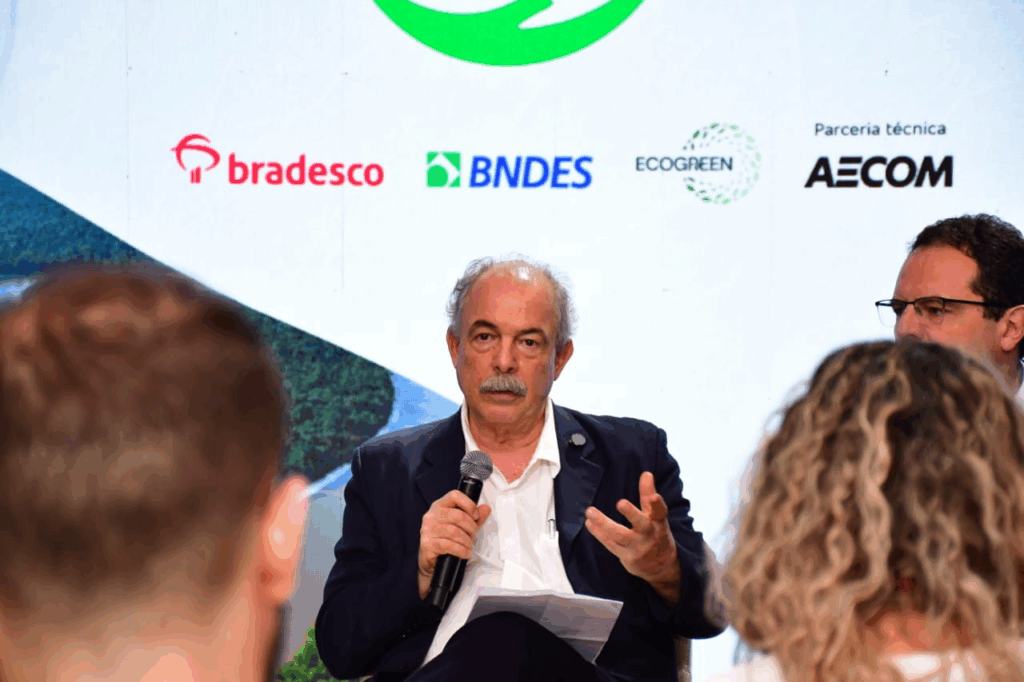
Ecora was announced on 11 November at COP30 and is the result of a partnership between BNDES, Bradesco, and the Ecogreen Fund, with technical support from Aecom, one of the largest global consultancies in engineering, infrastructure, and sustainability. It will operate across all Brazilian biomes and serve a rapidly expanding national market shaped by both voluntary credit demand and the country’s move toward a regulated carbon framework.
The new institution is expected to reduce Brazil’s dependence on international certifiers and develop methodologies calibrated to the realities of Brazilian ecosystems. Speaking in Belém, BNDES President Aloizio Mercadante said Ecora will democratize access to certification, reduce costs for small producers, and align with forthcoming legislation for the regulated carbon market.
“This initiative makes perfect sense for a country that has the largest tropical forest cover, provides the most environmental services to the planet, and is responsible for two-thirds of all flora and fauna diversity,” he said.
BNDES President Aloizio Mercadante
Technology, traceability, and a unified national standard
Ecora will be structured on the Conservare platform, an advanced digital system designed to integrate public registries, geospatial analyses, project management, and automated lifecycle tracking. Conservare will manage carbon credits from feasibility assessments through validation, monitoring, issuance, and final retirement, providing end-to-end oversight.
This digital backbone addresses a long-standing structural barrier in Brazil’s carbon markets: the lack of a unified, transparent, nationally governed certification chain. For investors, buyers, and subnational governments, the centralized system is expected to significantly increase credibility and reduce transaction costs.
Aecom’s Senior Vice President Vicente Mello described Ecora as “a milestone for the climate infrastructure of Brazil and the Global South,” emphasizing that the system is being designed to reflect the complexity of Brazil’s biomes and adhere to rigorous scientific and transparency standards.
A market-shaping move for forests, finance, and innovation
Brazil’s broader strategy is clear. As the world accelerates toward decarbonization, nature-based solutions are emerging as critical components of global mitigation and adaptation pathways. The ability to certify high-quality credits rooted in Brazilian ecosystems — from the Amazon and Cerrado to the Pantanal and Atlantic Forest — creates new economic opportunities in forest concessions, bioeconomy chains, and rural development.
Nelson Barbosa, BNDES Director for Planning and Institutional Relations, noted that carbon credits are becoming an increasingly important revenue stream for public-private forest concessions. Strengthening domestic certification capacity, he said, is essential to generating credits that reflect national biomes and support employment and technological development.
For financial institutions, the emergence of Ecora is equally strategic. Bradesco CEO Marcelo Noronha emphasized that “Brazil can be the world’s main hub for carbon credit solutions,” pointing to the bank’s presence in all Brazilian biomes.
He called Ecora a commitment to transparency, science, and sustainable development, and said it will help build a robust carbon market aligned with best international practices.
Ecogreen Fund director Hélio Barbosa Júnior framed Ecora as a bridge between Brazil’s ecological assets and global demand for high-quality carbon solutions. “Ecora is born with a Brazilian soul and a global connection,” he said. “This initiative values Brazilian identity and our biomes, strengthens Brazil’s role in confronting the climate crisis, attracting investments, and boosting sustainable innovation.”
Toward a Brazilian-led carbon market architecture
The creation of Ecora comes at a pivotal moment. Brazil’s voluntary carbon market is expanding rapidly, and the country is finalizing legislation for a regulated scheme that will reshape emissions governance across sectors. A national certifier aligned with both markets strengthens regulatory cohesion, builds domestic expertise, and enhances Brazil’s negotiating position in international carbon governance, including Article 6 mechanisms.
By anchoring carbon credit certification within national institutions, Brazil joins a growing group of forest-rich countries asserting greater control over the verification and quality of their environmental assets. For many observers at COP30, Ecora signals a broader shift: the emergence of the Global South as a standard-setter in the integrity debate.
Brazil’s ambition is unmistakable. With Ecora, the country is not merely participating in global carbon markets — it is seeking to shape them.

 Follow SDG News on LinkedIn