The government of Spain has unveiled a sweeping new Social Climate Plan worth nearly €9 billion ($9.8 billion USD), positioning the initiative as one of Europe’s most ambitious attempts to ensure the energy transition does not deepen social inequality.
Announced by Prime Minister Pedro Sánchez, the plan focuses heavily on affordable housing, energy efficiency, and sustainable transportation, with the government arguing that climate policy must deliver tangible benefits to ordinary citizens if political support for decarbonization is to endure.
“The ecological transition will only succeed if it is fair,” Sánchez said during the presentation of the proposal, warning against a growing wave of climate skepticism across parts of Europe.
Housing and Mobility at the Center
According to reporting from Euronews, roughly €4.7 billion of the funding will go toward housing-related measures, including neighborhood rehabilitation, energy efficiency upgrades, and support for household self-consumption energy systems such as rooftop solar. The remaining €4.3 billion will target transport decarbonization through cleaner mobility infrastructure, vehicle replacement incentives, and expanded low-cost public transportation systems.
Spanish officials framed the initiative not simply as a climate package, but as an economic modernization strategy designed to lower household energy costs, improve quality of life, and strengthen resilience amid rising climate pressures across Southern Europe.
Transport Minister Óscar Puente described mobility as a “fundamental right,” while Housing Minister Isabel Rodríguez linked the plan to mounting public frustration over housing affordability.
A European Test Case for Climate Politics
Spain’s proposal arrives at a pivotal moment for climate policy across European Union member states, many of which are facing growing political backlash over energy costs, inflation, and the social consequences of decarbonization measures.
The plan is closely tied to the EU’s broader Social Climate Fund framework, which was designed to cushion the impact of expanding carbon pricing into sectors such as transportation and buildings. Earlier this year, the European Investment Bank and European Commission announced additional financing mechanisms to support member states navigating those reforms.
A key political hurdle remains: Spain’s parliament must still approve legislation linked to the EU’s expanded emissions trading system (ETS2), which would unlock significant portions of the European funding tied to the plan.
Spain’s Renewable Energy Momentum
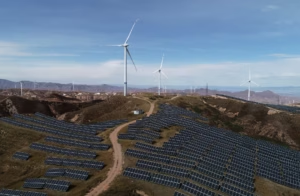
The announcement also reinforces Spain’s growing role as one of Europe’s renewable energy leaders. Since 2019, the country has rapidly expanded its solar and wind generation capacity, helping reduce exposure to fossil fuel volatility while lowering energy import costs.
Sánchez emphasized that emissions in Spain have fallen significantly since his government took office, even as the economy continued to grow and employment expanded. Renewable energy now accounts for more than half of the country’s electricity generation.
The broader challenge now facing governments across Europe is whether climate action can remain politically durable during a period of economic anxiety, geopolitical instability, and rising public pressure over affordability.
Spain is effectively wagering that the answer depends on whether citizens feel the benefits of the transition directly in their homes, neighborhoods, and daily lives.
RELATED STORIES:
 Follow SDG News on LinkedIn