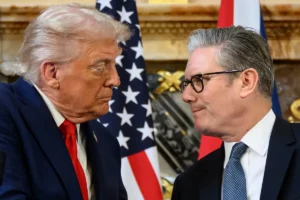
The so-called “Special Relationship” between the United States and the United Kingdom has long been defined by private disagreements and public unity. Today, that balance is unraveling in real time.
In a striking moment that underscores the shifting tone of transatlantic ties, U.S. President Donald Trump amplified a satirical sketch from the newly launched British version of Saturday Night Live, portraying U.K. Prime Minister Keir Starmer as weak and intimidated.
What might once have been dismissed as political theater now reads as something more consequential: a public display of strain between two leaders navigating an increasingly transactional alliance.
From Strategic Alliance to Public Friction
For decades, the U.S.–U.K. partnership has been considered one of the most enduring alliances in modern geopolitics, rooted in shared intelligence, military cooperation, and economic alignment.
But recent months have introduced a different dynamic.
Trump has openly criticized Starmer’s leadership, particularly over the U.K.’s cautious approach to U.S. military operations in Iran and delays in granting access to British bases. At the same time, Starmer has sought to distance himself from Washington’s more aggressive posture, emphasizing legality and national interest over automatic alignment.
The result is a growing divergence not just in policy, but in tone.
A Viral Sketch, A Diplomatic Signal
The SNL U.K. sketch that triggered the latest episode of tension depicted Starmer as anxious and deferential in dealings with Trump, even avoiding his calls out of fear.
Trump’s decision to share the clip, without commentary, effectively endorsed the portrayal, transforming satire into a geopolitical signal.
In another era, such moments would likely remain confined to domestic audiences. Today, they travel instantly across borders, shaping perceptions of leadership and power.
The message, intentional or not, is clear: the United States no longer feels compelled to preserve the optics of deference toward its closest ally.
A Relationship Under Structural Pressure
This episode is not occurring in isolation. It is part of a broader pattern redefining the U.S.–U.K. relationship.
Economic tensions have surfaced through tariffs on British goods and growing disputes over NATO alignment and broader strategic priorities. Trump himself has acknowledged that the relationship is not what it once was, reflecting a shift away from traditional alliance frameworks toward more transactional engagements.
At the same time, the geopolitical environment has become more complex. The war with Iran, energy disruptions, and shifting global alliances are forcing both countries to recalibrate their positions, often in ways that no longer align seamlessly.
The End of Automatic Alignment
What is emerging is not necessarily a collapse of the “Special Relationship,” but a redefinition of it.
Where past leaders anchored the alliance in shared strategic vision, today’s relationship is increasingly shaped by divergent national priorities and personalized leadership dynamics.
Even cultural moments now carry diplomatic weight.
A comedy sketch. A repost. A moment of mockery.
Together, they reveal a deeper truth: the “Special Relationship” is no longer insulated from the forces reshaping global politics. It is being tested, publicly and in real time, as the world moves toward a more fragmented and transactional order.
For global leaders, the implication is clear. Alliances with the United States that once seemed permanent are becoming conditional, and increasingly performative on the world stage.
RELATED STORIES:
 Follow SDG News on LinkedIn