In Nuuk, demonstrators gathered in freezing Arctic air, holding signs rejecting foreign control of their homeland. Thousands of kilometres south in Brussels, EU officials convened an emergency meeting. The catalyst for both scenes was the same: a sharp escalation by Donald Trump, who has tied sweeping new tariffs on European allies directly to his long-standing ambition to acquire Greenland.
In a weekend post on his Truth Social platform, Trump warned that Denmark and seven other European countries would face a 10 percent tariff on exports to the United States from February 1, rising to 25 percent in June, unless a “complete and total purchase of Greenland” is agreed. The message was explicit and transactional. Tariffs, he said, would remain “due and payable” until a deal is struck.
The threat has pushed a sensitive Arctic issue into the centre of transatlantic politics, forcing Europe to respond not only to an economic challenge but to a direct challenge to sovereignty within the NATO alliance.
A Dispute Rooted in Strategy, Not Novelty
Trump’s fixation on Greenland is not new, nor is American strategic interest in the island. Greenland sits astride the shortest air and sea routes between North America and Europe and anchors early-warning missile systems and radar coverage across the Arctic. The US maintains a permanent military presence at Pituffik Space Base in the northwest, a legacy of World War II and the early Cold War.
What is new is the explicit use of tariffs as leverage against allies. Trump framed the move as a correction for what he called decades of US “subsidies” to Europe through low tariffs. He also invoked China and Russia, warning that both powers “want Greenland” and that Denmark is incapable of stopping them.
Historically, Washington has explored acquiring the island before. After purchasing Alaska in 1867, Secretary of State William H. Seward sought to buy Greenland. In 1946, President Harry S. Truman secretly offered Denmark $100 million for the territory. Each time, Copenhagen refused. Greenland’s leaders have reiterated that position in recent days, stating clearly that the island is not for sale.
Public opinion reinforces that stance. Polling cited this week shows overwhelming opposition among Greenlanders to joining the United States, while a Reuters/Ipsos survey found that only a small minority of Americans support acquiring the territory.
Europe Closes Ranks
Europe’s political response was swift and unusually unified. All 27 EU member states convened an emergency meeting to assess the threat and consider countermeasures.
UK Prime Minister Keir Starmer described the tariff threat as “completely wrong,” stressing that Greenland’s future “is a matter for the Greenlanders and the Danes.” European Commission President Ursula von der Leyen warned that tariffs would “undermine transatlantic relations and risk a dangerous downward spiral,” while reaffirming full solidarity with Denmark and Greenland.
European Council President António Costa echoed the same message, underlining coordinated EU backing. Foreign policy chief Kaja Kallas added a sharper geopolitical note, warning that divisions among allies only benefit China and Russia.
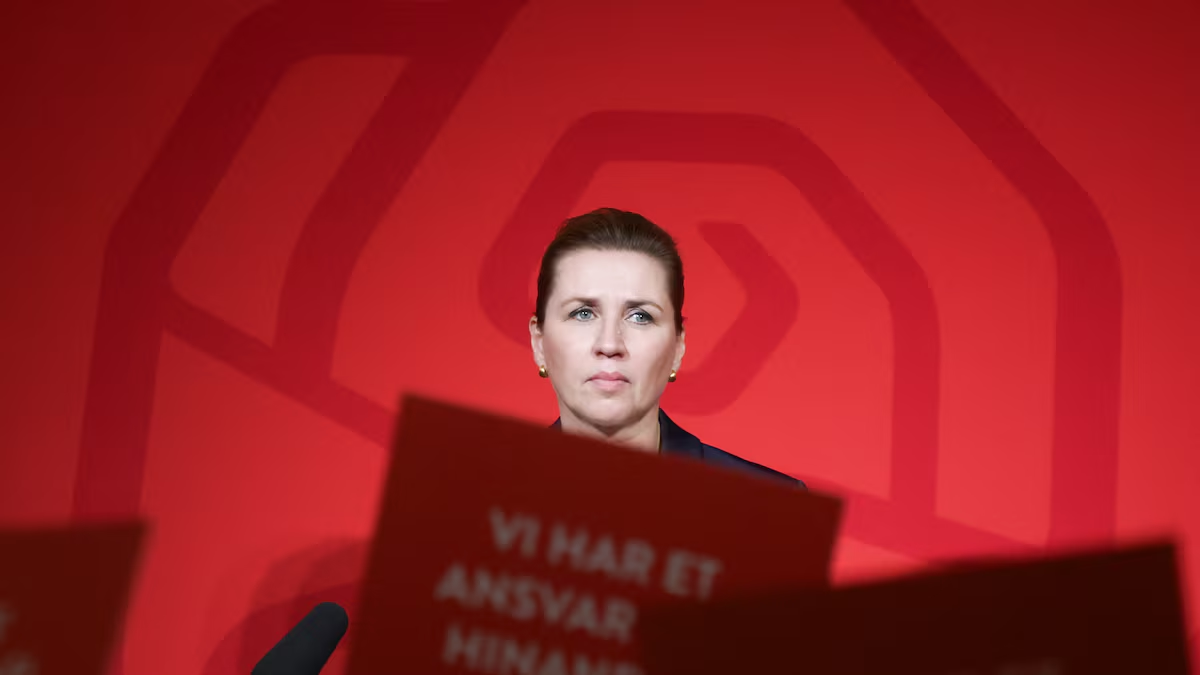
In Copenhagen, Danish Prime Minister Mette Frederiksen was blunt: “Europe won’t be blackmailed.” Her statement, reinforced by a joint declaration from affected countries, framed the dispute as a test of core principles—sovereignty, territorial integrity, and alliance trust.
The Trade Bazooka Comes Into View
Behind closed doors, European leaders also discussed tools rarely aimed at Washington. French President Emmanuel Macron called for readiness to activate the EU’s Anti-Coercion Instrument, informally known as the “trade bazooka.” Adopted in 2023 to counter economic pressure from non-EU states, the mechanism allows for retaliatory tariffs, restrictions on market access, and limits on the use of EU-based financial infrastructure.
While designed with China in mind, its potential use against the United States underscores how far the confrontation has moved from routine trade friction into strategic confrontation.
What Policymakers Should Watch
The Greenland dispute now sits at the intersection of trade, security, and alliance governance. Trump is due to address the World Economic Forum in Davos, where several European leaders and NATO officials will also be present, offering a near-term test of whether dialogue can defuse the standoff.
For European and UN policymakers, the episode carries broader implications. It raises questions about the durability of alliance norms under economic coercion, the governance of the rapidly opening Arctic, and the limits of transactional diplomacy among security partners.
What began as a familiar Trump provocation has evolved into a defining moment for transatlantic cohesion. How Europe responds—economically, diplomatically, and strategically—will signal not just its stance on Greenland, but its readiness to defend sovereignty in an era of contested power.
- Trump Wants Greenland. NATO Is Now the Story.
- Europe Moves as Washington Talks, NATO Troops Join Denmark in Greenland
- Europe Stands Firm on Sovereignty as Greenland Tensions Escalate
- Trump Tariffs Spark Warnings Over U.S. Clean Energy Slowdown
- US Government’s National Security Strategy, Decoded: The Signals Washington Is Sending the World
 Follow SDG News on LinkedIn