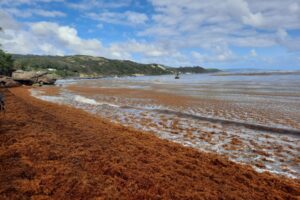
PLAYA DEL CARMEN, Mexico — Record sargassum blooms across the Atlantic are forcing governments to confront a growing challenge at the intersection of environmental resilience, tourism and economic development. Nowhere is that more visible than along Mexico’s Caribbean coastline, where authorities are mounting one of the region’s largest cleanup and offshore interception efforts.
Municipal workers, hotel crews and the Mexican Navy are using tractors, collection vessels and floating barriers to prevent the seaweed from overwhelming beaches that underpin Quintana Roo’s tourism economy. Authorities expect approximately 119,000 metric tons of sargassum to reach the state’s coastline by the end of 2026, surpassing the roughly 96,000 metric tons collected last year. By early August, Mexico had already collected more than 96,000 metric tons, underscoring both the scale and unusually early intensity of this year’s influx.
The response reflects a broader shift in how governments are approaching sargassum. What was once treated primarily as a seasonal beach-maintenance issue is increasingly being viewed as a recurring environmental, economic and public-health challenge—and, potentially, as a new source of renewable energy and circular-economy innovation.
An Atlantic Challenge With Global Implications
This year’s bloom is among the largest observed since systematic satellite monitoring began in 2011.
The University of South Florida’s Optical Oceanography Laboratory reported that the Caribbean recorded its highest sargassum volume for any June on record, while the Gulf of Mexico contained an estimated 5 million metric tons—nearly twice its previous June record. Although total Atlantic biomass remained below the historic peak recorded in 2025, researchers expect 2026 to rank among the largest sargassum years observed.
Since 2011, unusually large blooms have repeatedly affected coastlines across the Caribbean, the Gulf of Mexico, northeastern South America, the southeastern United States and West Africa. While floating sargassum plays an important ecological role in the open ocean by providing habitat for fish, turtles and other marine life, excessive coastal accumulations can reduce oxygen levels, block sunlight from reaching seagrass beds and release hydrogen sulfide as they decompose.
The consequences increasingly extend beyond the environment. An analysis by the Inter-American Development Bank found that hospitals in Martinique and Guadeloupe recorded more than 11,000 cases of acute exposure associated with gases released by decomposing sargassum during a single year, highlighting the broader public-health implications of recurring blooms.
The Economic Stakes Continue to Rise
Beyond the cost of removing seaweed from beaches, sargassum is placing growing pressure on coastal economies.
A working paper published by the Inter-American Development Bank estimated that affected areas of Quintana Roo experienced an approximate 11.6% decline in gross local product, based on economic modeling using nighttime-light data as a proxy for economic activity. The researchers also found evidence that economic impacts could persist after cleanup, suggesting that reputational damage may continue to affect tourism destinations.
Reuters has reported estimates placing the wider economic burden on Quintana Roo at approximately US$2 billion annually, including around US$150 million spent each year by Riviera Maya hotels on containment and cleanup efforts.
Mexico Moves From Cleanup to Prevention
Rather than relying primarily on beach cleanup, Mexico is expanding efforts to intercept sargassum before it reaches the shoreline.
The federal government has committed 2.635 billion Mexican pesos toward specialized collection vessels, floating containment barriers and satellite monitoring designed to identify major offshore accumulations and direct response efforts. By capturing sargassum earlier, authorities aim to reduce damage to beaches and coastal ecosystems while preserving more of the biomass for productive use.
The strategy also reflects an important ecological balance. Offshore collection can reduce shoreline impacts, but floating sargassum supports diverse marine ecosystems that must also be protected.
From Seaweed Crisis to Climate Opportunity
Governments are increasingly recognizing that long-term resilience may depend not only on managing sargassum, but also on creating value from it.
One example is SarGas, a Grenadian climate technology company developing systems that convert sargassum and other organic waste into biogas and organic fertilizer. Earlier this year, the company was named the “Most Investable Opportunity” at the Commonwealth Investment Network Accelerator Showcase in London, reflecting growing investor interest in circular-economy solutions for coastal resilience.
SarGas has already demonstrated its technology at Grenada’s True Blue Bay Resort and is now advancing SarGas ONE, its planned first commercial-scale facility.
“After years of developing and validating the technology, SarGas ONE in Grenada is our first commercial-scale facility,” said Benjamin Nestorovic, CEO of SarGas. “Our ambition is to turn a regional environmental challenge into resilient infrastructure that benefits local communities.”
While still under development, the project illustrates how Caribbean innovators are seeking to transform recurring cleanup costs into renewable energy, economic opportunity and greater climate resilience.
Innovation Alone Will Not Be Enough
SarGas is part of a broader wave of innovation emerging across the Caribbean. Through its Sargassum Innovation Quest, IDB Lab has supported projects exploring agricultural products, biofuels, construction materials and improved collection technologies.
Yet significant obstacles remain. High salt content, heavy metals, seasonal variability and processing costs continue to challenge large-scale commercialization. At the same time, scientists are continuing to study how nutrient runoff, ocean circulation, warming waters and other environmental factors contribute to the expansion of Atlantic blooms, underscoring that no single solution is likely to eliminate the problem.
The Next Chapter in Coastal Resilience
For years, sargassum has largely been treated as an expensive cleanup problem. Today, governments are beginning to approach it differently—not simply as a coastal nuisance, but as a regional resilience challenge requiring better forecasting, stronger international cooperation and new circular-economy industries.
Mexico’s expanded interception strategy and emerging innovations such as SarGas illustrate an important shift in thinking. While none of today’s solutions is likely to solve the problem on its own, together they point toward a future in which one of the Atlantic’s fastest-growing environmental challenges could also become a catalyst for cleaner energy, new industries and more resilient coastal economies.
RELATED STORIES:
 Follow SDG News on LinkedIn