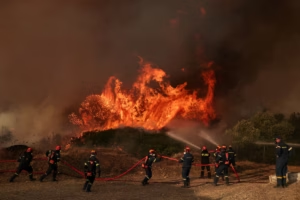
A magnitude 7.1 earthquake in southwestern Japan is providing a real-world test of decades of investment in seismic resilience — demonstrating the value of preparation while exposing vulnerabilities that emerge after the shaking stops.
KUMAMOTO, Japan — When a magnitude 7.1 earthquake struck Kumamoto Prefecture on July 28, Japan’s extensive disaster-preparedness system moved rapidly into action.
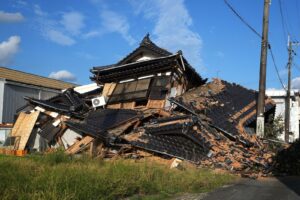
Earthquake warnings were issued, transportation networks halted operations and emergency authorities mobilized across southwestern Japan. The earthquake nevertheless killed at least 38 people, injured more than 100 and damaged more than 11,000 buildings. Days later, tens of thousands of households remained without running water.
The disaster is now providing a stark assessment of what preparedness can, and cannot, accomplish in one of the world’s most earthquake-ready countries.
Reporting by The New York Times has highlighted how Kumamoto’s experience reflects Japan’s deeply embedded culture of earthquake preparation, including reinforced buildings, routine drills, emergency supplies and public awareness developed through generations of living with seismic risk.
But the aftermath is also revealing a broader lesson: surviving the earthquake itself is only one measure of resilience.
A Disaster System Built Through Experience
Japan has spent decades strengthening its response to major earthquakes following disasters including the 1995 Kobe earthquake, the 2011 Tōhoku earthquake and tsunami and the 2016 Kumamoto earthquakes.
Those experiences have influenced building standards, earthquake early-warning systems, evacuation planning and coordination among government agencies, hospitals and local communities.
Japan’s Meteorological Agency recorded the July 28 earthquake at magnitude 7.1 in the Kumamoto region, with the strongest shaking reaching the maximum 7 on Japan’s seismic-intensity scale.
Kumamoto was particularly familiar with the danger. A destructive sequence of earthquakes struck the prefecture in April 2016, prompting extensive reviews of shelter management, emergency supplies, infrastructure and coordination between public authorities and civil society.
A decade of lessons from that disaster helped inform preparations for the next major event.
Preparedness Reduced Risk — but Could Not Eliminate It
Japan’s experience illustrates how sustained investments in stronger buildings, early warning and public preparedness can reduce exposure to earthquake risk. But casualty levels in any individual earthquake also depend on factors including where and when it strikes, the intensity and duration of shaking, building vulnerability and population exposure.
The Kumamoto aftermath has meanwhile exposed risks that building standards alone cannot address.
Associated Press reporting from the disaster zone found that intense summer heat, disrupted water supplies and difficult conditions at some evacuation centers were creating additional risks for survivors. By August 4, more than 46,000 households remained without water and more than 8,500 people were still in shelters. An elderly woman sheltering in a vehicle died from apparent heat stroke.
The convergence of earthquake damage and extreme heat illustrates an increasingly complex challenge for emergency planners. A system capable of moving people away from damaged structures must also provide water, sanitation, cooling, medical services and safe accommodation during prolonged displacement.
Japan’s aging population adds another dimension. Older residents can require accessible shelters, continuity of medication and additional assistance when power, water or transportation systems are disrupted.
The risks are also beginning to overlap. On August 7, Typhoon Dolphin approached southwestern Japan, bringing warnings of heavy rain and strong winds to a region still recovering from the earthquake. Reuters reported that approximately 6,700 earthquake survivors remained in evacuation centers as the storm approached.
Kumamoto is therefore confronting not one isolated emergency, but successive hazards placing pressure on the same communities and response systems.
Resilience Is Becoming a Systems Challenge
The experience illustrates a broader evolution in how governments think about earthquake preparedness.
Historically, seismic resilience has often centered on engineering: strengthening buildings, bridges and infrastructure so they are less likely to collapse.
That remains essential. But resilience increasingly depends on what happens after the initial shock.
Hospitals must remain operational. Water and electricity need to be restored. Communications systems must function. Transportation networks must recover. Shelters need to remain safe if displacement coincides with heat, storms or other hazards.
Earthquake resilience is therefore increasingly understood not simply as protecting structures, but as protecting the systems that allow communities to continue functioning.
Japan’s repeated experience with major earthquakes has produced one of the world’s most developed approaches to seismic preparedness. Governments elsewhere are pursuing different models suited to their own risks.
From Japan to a Global Earthquake-Resilience Push
Across major seismic regions, governments are combining building standards, early-warning technology, infrastructure retrofits and recovery planning to reduce earthquake risk.
In the United States, the U.S. Geological Survey’s ShakeAlert system provides earthquake early warning across California, Oregon and Washington. The technology can give some users seconds of warning before strong shaking arrives, creating time for protective action and automated systems to respond.
Mexico has pioneered public earthquake warning for decades. Its SASMEX network uses seismic sensors to detect potentially damaging earthquakes and transmit warnings to covered cities. The available warning time depends heavily on the location of the earthquake; historically, some events along Mexico’s Pacific coast have provided substantially more warning for Mexico City because of the distance between the epicenter and the capital.
New Zealand is taking a different approach to existing buildings. The government is reforming its earthquake-prone building regime to concentrate requirements more heavily on buildings and regions presenting greater life-safety risks while reducing unnecessary costs in lower-risk areas. The reforms illustrate a challenge common to governments worldwide: how to allocate limited resilience funding where it can reduce the most risk.
In Türkiye, rebuilding continues following the catastrophic February 2023 earthquakes. In June, the World Bank approved an additional €250 million to support resilient rural housing and restoration of essential services, part of a wider reconstruction effort intended not simply to replace destroyed infrastructure but to reduce vulnerability to future disasters.
These approaches differ, but they reflect a common principle: earthquake preparedness cannot depend on any single intervention.
A resilient system requires buildings less likely to collapse, warning technologies capable of buying critical seconds, infrastructure able to withstand disruption, emergency systems capable of protecting vulnerable populations and governments prepared to finance and manage recovery.
When One Disaster Becomes Several
For governments, the lesson from Kumamoto extends well beyond Japan.
The country remains one of the clearest examples of sustained investment in earthquake preparedness, spanning building standards, public awareness, early warning and emergency planning.
But Kumamoto also demonstrates why preparedness cannot be judged solely by what happens during the seconds of severe shaking.
The harder test comes afterward: whether hospitals continue functioning, water returns quickly, transportation networks reopen and displaced residents remain safe when another hazard arrives before recovery is complete.
With intense heat already complicating evacuation and a typhoon now threatening the same region, Kumamoto offers a particularly immediate example of that challenge.
Modern disaster resilience increasingly means preparing not only for individual hazards, but for cascading and overlapping emergencies — and ensuring that the systems designed to protect communities remain functional when one crisis is followed by another.
RELATED STORIES:
 Follow SDG News on LinkedIn