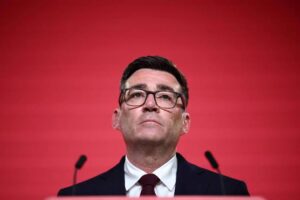
LONDON — Andy Burnham has formally assumed office as Prime Minister of the United Kingdom following Keir Starmer’s resignation, inheriting an economy marked by sluggish growth, persistent cost-of-living pressures, strained public services and an increasingly fragmented political landscape. Within his first days in office, Andy Burnham has unveiled a new cabinet and announced an initial package of economic measures aimed at reducing pressure on households while setting a distinct governing agenda.
A Fast Start Focused on Household Costs
The new government has announced that it will eliminate value-added tax (VAT) on domestic electricity bills beginning October 1, with the measure funded through the cancellation of the previous government’s planned digital identity programme. Officials say the policy is intended to provide immediate relief to households facing continued cost-of-living pressures.
The move is also politically significant. The New York Times reported that the VAT cut is intended to demonstrate an immediate break from the Starmer government’s policy approach, allowing Burnham to establish his own governing priorities early in his premiership.
Whether the measure will materially reduce household costs remains the subject of debate. While the VAT cut will lower electricity bills, analysts note that broader movements in wholesale energy prices are likely to have a greater influence on overall energy costs in the months ahead.
Cabinet Reshuffle Reflects a New Balance of Power
Andy Burnham’s first cabinet appointments represent one of the clearest indications of how Labour’s leadership has shifted following the change in prime minister.
Among the key appointments are John Healey as Chancellor, Ed Miliband as Foreign Secretary, Wes Streeting as Defence Secretary and Louise Haigh as Deputy Prime Minister. Several senior ministers associated with the Starmer government have departed, while Burnham has elevated a number of long-time allies.
Politico Europe characterized the reshuffle as more than a routine change in personnel, arguing that it reflects a significant redistribution of influence within Labour and consolidates Burnham’s authority as he begins shaping the party in his own image.
From Manchester to Downing Street
Burnham’s path to Britain’s highest office differs from that of many recent prime ministers.
After nearly a decade serving as Mayor of Greater Manchester, he built a national profile through regional governance, with particular emphasis on devolution, public transport, housing and economic regeneration outside London. That executive experience is expected to shape many of his domestic policy priorities as prime minister, particularly his emphasis on regional investment and economic opportunity beyond London.
Foreign Policy Challenges Await
While domestic economic issues dominate Burnham’s opening agenda, he assumes office during a period of heightened geopolitical uncertainty.
Britain continues to navigate Russia’s war in Ukraine, escalating tensions in the Middle East, growing strategic competition with China and evolving security cooperation across Europe. Andy Burnham has already begun outreach to international leaders, including U.S. President Donald Trump, while reaffirming Britain’s commitment to NATO and continued support for Ukraine.
For the new government, balancing domestic economic priorities with Britain’s international security commitments will be among its earliest and most consequential tests.
Economic Delivery Will Be Closely Watched
Burnham’s immediate challenge now shifts from announcing priorities to delivering measurable results.
The United Kingdom continues to face sluggish economic growth, constrained public finances and persistent pressure on public services. Early policy decisions have been designed to demonstrate that the new government can respond quickly to household concerns, but longer-term success will depend on whether those initial measures translate into sustained improvements in living standards, productivity and economic growth.
Why It Matters
Britain’s leadership transition carries significance well beyond Westminster.
As Europe’s second-largest economy, a permanent member of the UN Security Council and one of NATO’s leading military powers, the United Kingdom remains a central actor in shaping the international response to today’s most pressing geopolitical and economic challenges. The priorities set by Burnham’s government—from domestic economic policy to regional investment and international engagement—will influence not only Britain’s trajectory but also its role within Europe and the broader international system.
RELATED STORIES:
 Follow SDG News on LinkedIn