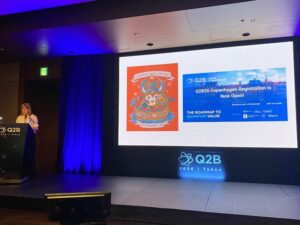
Q2B Copenhagen will bring more than 600 leaders from government, industry, science and investment to Denmark in September as Europe intensifies its push to convert quantum leadership into commercial and strategic value.
COPENHAGEN — The global race for quantum leadership is entering a new phase. After years dominated by research breakthroughs and hardware milestones, governments and companies are increasingly confronting a harder question: where will quantum technology create measurable value?
That question will sit at the center of Q2B Copenhagen, taking place September 9–10 at Øksnehallen. Organized by QC Ware and presented in partnership with a Danish consortium comprising Denmark’s Ministry of Foreign Affairs, the Novo Nordisk Foundation, Novo Holdings and 55 North, the conference is expected to convene more than 600 participants and 80 speakers.
The gathering comes as Denmark and Europe attempt to translate strong scientific capabilities into companies, infrastructure and applications capable of competing globally.
From Quantum Research to Quantum Value
This year’s theme, “The Roadmap to Quantum Value,” captures a broader transition underway across the industry. The Q2B agenda spans quantum computing, sensing and timing, communications and security, quantum AI, error correction and the intersection between quantum and high-performance computing.
Companies and institutions represented on the program include Microsoft Quantum, NVIDIA, Fujitsu, AstraZeneca, Boehringer Ingelheim and NTT Data, alongside quantum startups, researchers and investors. Sessions will examine areas including pharmaceutical and materials discovery, telecommunications, cybersecurity, optimization and machine learning.
The emphasis reflects the next challenge facing the sector: converting scientific progress into commercially useful applications.
Practical, large-scale fault-tolerant quantum computing remains a difficult technical objective even as investment accelerates. IBM, for example, announced plans this year to invest more than $10 billion in quantum computing over five years as it works toward large-scale fault-tolerant systems.
Q2B Copenhagen will bring together many of the constituencies shaping that transition: scientists extending the technology, companies exploring applications, investors deciding where value could emerge and governments determining which capabilities are strategically important.
Why Q2B Copenhagen Matters
The location is significant.
Denmark has been building one of Europe’s most concentrated quantum ecosystems through a combination of government policy, philanthropic funding, research institutions, advanced infrastructure and private capital.
Under the first part of its national quantum strategy, the Danish government allocated approximately $156 million between 2023 and 2027 to quantum research and innovation. The strategy focuses on long-term research, international collaboration and access to research infrastructure, with an explicit objective of translating scientific strength into usable technologies.
The Novo Nordisk Foundation has separately committed approximately $234 million to its Quantum Computing Programme. The 12-year initiative, anchored at the Niels Bohr Institute at the University of Copenhagen, aims to develop a full-scale, generally applicable quantum computer by the end of 2034, with potential applications ranging from drug discovery to climate and green-transition research.
Denmark is also investing in nearer-term computing capacity. The Novo Nordisk Foundation and Denmark’s Export and Investment Fund, EIFO, have committed about $93 million to establish QuNorth, a jointly owned venture that will house the Magne quantum computer. Built using technology from Atom Computing and Microsoft, Magne is expected to be ready for initial use around the turn of 2026–27 and is intended to give Nordic companies and researchers access to an advanced logical-qubit system.
Capital is becoming another pillar of the ecosystem. Novo Holdings and EIFO are cornerstone investors in Copenhagen-based 55 North, which Novo Holdings describes as the world’s largest pure-play quantum venture capital fund. The fund raised approximately $156 million at its first close toward a target of roughly $344 million, with Novo Holdings and EIFO providing the initial capital. 55 North invests across the quantum technology stack globally, with Europe and the Nordics as its anchor region.
Together, those initiatives illustrate what makes Copenhagen increasingly distinctive: government investment, philanthropic capital, venture financing, research and advanced quantum infrastructure are being developed in parallel.
Q2B therefore arrives not simply in a country seeking to participate in the emerging quantum economy, but in one actively attempting to build the ecosystem capable of financing, developing and commercializing it.
Related content: From Breakthroughs to Business: Q2B Tokyo Reveals Quantum’s Commercial Future
Europe Faces the Commercialization Test
Denmark’s ambitions sit within a much larger European challenge.
Europe has long possessed significant strengths in quantum science, but policymakers increasingly recognize that research leadership alone will not guarantee economic leadership.
The European Commission’s Quantum Europe Strategy, adopted in July 2025, is designed to strengthen the continent’s position across research, infrastructure, startup and scale-up financing, supply chains, defense and space applications, and quantum skills. A proposed EU Quantum Act, expected in 2026, is intended to further strengthen industrial capacity and supply-chain resilience.
The underlying strategic question increasingly resembles the challenge Europe faces in semiconductors and artificial intelligence: can scientific leadership be converted into globally competitive companies and industries?
Quantum raises additional stakes because its potential applications span both economic competitiveness and national security — from pharmaceuticals, advanced materials and energy systems to secure communications, sensing and critical infrastructure.
That helps explain why government participation is prominent at Q2B. The conference will open with ambassadors discussing international cooperation and the role of governments in commercialization, scaling, talent, funding and innovation.
Capital Moves Closer to the Technology
Investment will also occupy a prominent place in Copenhagen.
A venture capital panel hosted by Needham & Company’s quantum investment banking team will include investors from 55 North, Deep33, Quantonation, Firgun Ventures and Qbeat Ventures. A startup competition organized by BioInnovation Institute will give early-stage companies an opportunity to present directly to investors, corporations and researchers.
The emphasis is consequential. The next phase of quantum development will require more than research funding. Companies must secure sufficient capital to move technologies from laboratories through engineering, manufacturing and eventually commercial deployment.
That is shifting the competition from a race primarily for scientific breakthroughs into a broader contest for capital, talent, infrastructure, intellectual property and customers.
Denmark’s model offers one potential response: build those pieces together rather than sequentially. Q2B puts many of them in the same room.
The Bigger Signal
Quantum technology is often described as a revolution somewhere over the horizon. Q2B Copenhagen points to a more immediate shift: governments, investors and companies are already building the institutions, infrastructure and markets that could determine who captures the value if that revolution arrives.
For governments, quantum is increasingly becoming an issue of industrial strategy, economic security, research policy and workforce development.
For investors and corporations, the challenge is identifying which technologies can move from technical promise to defensible economic value.
The potential implications extend well beyond computing. Quantum technologies could contribute to drug and materials discovery, energy and industrial optimization, cybersecurity, communications and environmental sensing.
For two days in September, Copenhagen will provide a window into how that emerging quantum economy is beginning to take shape, and whether Europe can turn its scientific strengths into lasting technological and economic advantage.
The Series
Q2B Copenhagen Leaders
Thirteen founders, physicists, investors and policymakers moving quantum computing from the laboratory into industry, profiled by SDG News ahead of Q2B Copenhagen 2026.
9 to 10 September 2026·Øksnehallen, Copenhagen
Explore all thirteen leadersSDG News is an official partner of Q2B Copenhagen 2026, presented by QC Ware.
 Follow SDG News on LinkedIn