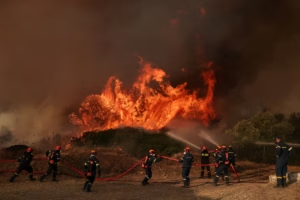
Insurers can absorb this summer’s losses. The larger question is whether rising wildfire risk will force Europe to rethink how governments, insurers and communities share the financial costs of climate disasters.
Europe’s severe wildfire season is exposing a financial vulnerability that extends well beyond the communities in the path of the flames: most of the continent’s losses from natural disasters remain uninsured.
Fires across France, Spain and Greece have already caused billions of dollars in economic damage this summer, while record-breaking outbreaks are testing preparedness in regions where wildfire has historically been considered a less significant insurance threat than in places such as California or Australia.
Reuters reported that the 2026 fires in France alone could produce €10 billion to €15 billion — roughly $12 billion to $18 billion — in economic losses.
For insurers, those losses remain manageable. The more consequential question is what happens if seasons like this become more frequent. Worsening fire conditions, continued development in exposed areas and Europe’s existing insurance protection gap could eventually make coverage significantly more expensive — or harder to obtain — in the places facing the greatest risks.
Europe’s protection gap
Only around one-quarter of losses from extreme events in Europe were insured between 1980 and 2024, according to the European Insurance and Occupational Pensions Authority.
That leaves governments, businesses and households carrying much of the financial burden when disasters strike.
European regulators have warned that rising physical risks could eventually translate into higher premiums, additional exclusions or difficulty obtaining coverage in the most exposed areas. Because mortgage lenders typically require insurance, the issue can extend quickly from disaster recovery into housing markets and financial stability.
Europe is not yet experiencing the widespread insurer retreat seen in some highly exposed U.S. markets. Analysts expect this summer’s wildfire claims to remain absorbable, particularly as long as major fires do not spread deeply into densely developed urban and industrial areas.
But the current season is highlighting how quickly the underlying risk can change.
Wildfires move up the insurance risk map
Moody’s noted that France experienced its most damaging wildfire outbreak in at least half a century this summer, while Spain recorded the largest wildfire in its modern history.
Europe still represents a relatively small share of the global wildfire insurance market, leaving insurers with less historical loss data to model extreme European fires than they have in more established markets.
Globally, however, wildfire has become a far more consequential source of insurance losses.
Swiss Re estimates that so-called secondary perils — including wildfires, severe thunderstorms and floods — accounted for a record 92% of the $107 billion in global natural-catastrophe insured losses in 2025. The Los Angeles fires alone generated approximately $40 billion in insured losses, the largest wildfire loss in the reinsurer’s records.
That shift is changing how insurers assess wildfire exposure, but climate change is only one part of the equation.
Climate risk meets rising exposure
The growth in catastrophe losses cannot be attributed to a changing climate alone.
Swiss Re estimates that expanding exposure — including population growth, urban development, rising property values and greater concentrations of infrastructure in vulnerable areas — explains more than 80% of the long-term global increase in weather-related insured losses since 1970.
At the same time, climate change is altering the hazard itself. Hotter temperatures, prolonged drought and changing precipitation patterns can create conditions more conducive to severe fires.
The financial risk emerges where those trends intersect: more valuable assets are being built in places where the underlying hazard may also be intensifying.
For governments, that makes wildfire resilience an increasingly economic question rather than solely an emergency-response challenge.
Prevention becomes a financial strategy
The European Union is pushing member states to invest more heavily in measures such as forest management, vegetation clearing, ecosystem restoration and wetland protection as wildfire costs rise.
The logic extends beyond reducing the number or severity of fires. Lower physical vulnerability also reduces expected financial losses, helping insurers continue offering coverage at viable prices.
That makes adaptation spending part of the infrastructure that supports functioning insurance and housing markets. Measures that reduce exposure today can help limit future reconstruction costs, preserve mortgage availability and reduce the amount governments are ultimately required to absorb after disasters.
Yet prevention alone may not solve Europe’s widening protection gap.
Who ultimately carries the risk?
European policymakers are also beginning to examine how catastrophe losses should be shared when they exceed the capacity of households, businesses or national insurance systems.
The European Insurance and Occupational Pensions Authority and the European Stability Mechanism have proposed exploring a European system combining a catastrophe insurance pool with a public financial backstop for exceptionally large disasters.
The proposal remains under discussion rather than established EU policy, but it reflects a broader recognition that some climate-related losses can become too large or too correlated to manage efficiently through national insurance markets alone.
For governments, the stakes are significant.
When insurance remains widely available, private capital absorbs part of the economic shock when disaster strikes. As the protection gap grows, more of that burden shifts directly onto homeowners, businesses and public budgets.
This summer’s fires therefore represent more than a test of Europe’s emergency response.
They are also testing whether the continent can adapt its financial systems quickly enough to keep rising climate risks insurable.
Insurers appear capable of absorbing today’s losses. The longer-term challenge is ensuring that prevention, adaptation and risk-sharing evolve fast enough that tomorrow’s losses do not increasingly become a public liability.
RELATED STORIES:
 Follow SDG News on LinkedIn