The former Colombian energy minister and IMF climate-policy leader has been selected to lead the Global Environment Facility as the institution begins a critical four-year financing cycle running through 2030.
Diego Mesa Puyo has spent much of his career at the intersection of energy, economics and environmental policy. Now, he is preparing to bring that experience to one of the world’s most important multilateral environmental financing institutions.
The Global Environment Facility announced on August 5 that its Council had selected Mesa as the organization’s next CEO and Chairperson. He is expected to take office at the beginning of October for an initial four-year term.
The timing gives the appointment particular significance.
Diego Mesa Puyo will take the helm as the GEF begins its ninth replenishment cycle, GEF-9, which runs from July 2026 through June 2030. Donor countries have pledged an initial $3.9 billion to the GEF Trust Fund for the four-year period, aligning the cycle with the final years before many international climate, biodiversity and sustainable-development targets come due.
The GEF serves as a financial mechanism for six international environmental agreements, spanning climate change, biodiversity, land degradation, chemicals and waste, mercury pollution and biodiversity beyond national jurisdiction.
For Mesa, the new role brings together two defining strands of his career: building policies intended to transform energy systems and examining the economic realities that determine whether those transformations can succeed.
Building Colombia’s Energy Transition
Diego Mesa Puyo served first as Colombia’s Vice Minister of Energy and later as Minister of Mines and Energy during the administration of President Iván Duque, with his period in government spanning 2018 to 2022.
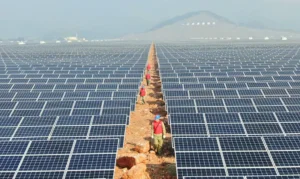
His tenure coincided with major efforts to expand Colombia’s non-conventional renewable-energy sector, including renewable-energy auctions, new regulatory frameworks and national strategies covering hydrogen and offshore wind.
Colombia entered this period with a power system dominated by hydropower and with solar and wind representing only a very small share of generation. Government reforms sought to create the market conditions for large-scale investment in technologies that previously had little presence in the country’s electricity system.
The GEF, in announcing Mesa’s appointment, said the market reforms pursued during his period in government mobilized more than $3 billion in private investment and helped accelerate the deployment of variable renewable energy.
The experience also placed Diego Mesa Puyo directly inside one of the central dilemmas facing emerging and fossil-fuel-producing economies: how to pursue decarbonization while managing energy affordability, government revenues, investment, employment and economic growth.
It is a challenge he would later examine from a different vantage point at the IMF.
From Energy Policy to Climate Economics
Mesa is an economist by training and a CFA charterholder whose career has moved between government, consulting and multilateral finance.
Before entering Colombia’s government, he worked at PwC and the International Monetary Fund, where his work included fiscal policy related to energy and extractive industries. After leaving government, he returned to the IMF and became Deputy Chief of its Climate Policy Division.
His research there has addressed the economic consequences of the global energy transition, particularly for fossil-fuel-exporting countries.
An IMF Staff Climate Note co-authored by Mesa warned that the transition could create significant fiscal risks for hydrocarbon-producing economies as revenues, exports and investment patterns change. The research argues that governments will need to manage those risks while diversifying their economies, reducing domestic emissions and protecting vulnerable populations.
That background places Mesa within a broader evolution in global environmental policy: climate and nature are increasingly becoming questions of fiscal and economic policy, not simply environmental policy.
Governments must determine not only what environmental objectives they want to achieve, but how to finance them, attract investment, manage transition risks and integrate them into national development strategies.
The Next Challenge: Turning Public Finance Into Scale
Those questions will follow Mesa to the GEF.
The institution’s resources are substantial, but they remain small relative to the overall financing needed to address climate change, biodiversity loss, land degradation and pollution globally.
That makes the ability to use public and concessional finance strategically increasingly important — including through projects and policies capable of attracting additional public and private investment.
Diego Mesa Puyo’s experience in Colombia offers one example of that approach. Government reforms established new rules, incentives and market structures intended to make renewable-energy investment commercially viable; private companies supplied much of the capital needed to build the resulting projects.
At the GEF, the challenge will be considerably broader.
It will involve helping countries translate environmental priorities into programs capable of delivering measurable results while ensuring financing reaches developing economies and vulnerable communities where purely commercial capital may be insufficient.
A Critical Four Years
Diego Mesa Puyo assumes the GEF leadership at an important moment for the international environmental system.
GEF-9 runs through June 2030 — placing his first term almost exactly across the remaining period before a series of internationally agreed 2030 targets are assessed.
The coming years will therefore test whether governments and multilateral institutions can turn decades of commitments into implementation at significantly greater scale.
Mesa’s appointment places an economist who has worked across government, energy markets and international financial institutions at the helm of an organization tasked with financing that implementation.
He helped shape the policy architecture behind Colombia’s expansion of renewable energy. At the GEF, the mandate is global: helping turn environmental ambition into finance, investment and measurable results.
RELATED STORIES:
- Christina Markus Lassen: The Danish Diplomat Giving Principle a Stronger Voice at the United Nations
- Winnie Byanyima Is Fighting to Keep the End of AIDS Within Reach
- Volker Türk — Defending Human Rights in an Era of Global Division
- Damilola Ogunbiyi – Working to Ensure the Global Energy Transition Reaches Everyone
 Follow SDG News on LinkedIn