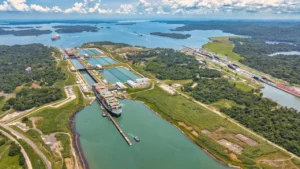
A ship reportedly paid nearly $4 million to jump the Panama Canal queue as Middle East conflict disrupts major maritime routes just as falling water levels threaten capacity at one of the world’s most important trade arteries.
PANAMA CITY — The Panama Canal is emerging as a critical pressure point in the global trading system as two disruptions converge: the Iran war is reshaping shipping through the Middle East, while an intensifying El Niño threatens to constrain the canal’s ability to accommodate growing demand.
The pressure became particularly visible this week when the Seaspan Benefactor, a container ship capable of carrying roughly 10,100 twenty-foot equivalent units, reportedly paid nearly $4 million for a priority transit slot, according to Bloomberg reporting cited by The Guardian. The winning auction bid was more than twice the average over the preceding seven days.
Ships without reservations are facing waits of around 10 days on some routes, the longest backlog since May. The extraordinary auction price illustrates how valuable access to the 82-kilometer waterway has become as disruption elsewhere reshapes maritime trade.
Middle East conflict reshapes shipping
Traffic through the Strait of Hormuz, one of the world’s most important energy corridors, has fallen to a fraction of normal levels amid the Iran war.
Only eight vessels were tracked crossing Hormuz on Tuesday, according to Kpler data reported by Reuters, compared with roughly 130 to 140 vessels per day before the war. The 10-day average has fallen to about 12 vessels a day.
The Bab el-Mandeb Strait, connecting the Red Sea with the Gulf of Aden, remains more active. Thirty vessels crossed on Tuesday, above its recent 10-day average of 25. But renewed attacks on commercial shipping have heightened security risks and complicated efforts to normalize traffic through the Red Sea.
That disruption has consequences further west. Reduced confidence in the Red Sea route weakens the attractiveness of the Suez Canal, the shortest maritime connection between Asia and Europe, and pushes more operators toward longer alternatives.
For some trade flows, that increases the strategic importance of other major corridors — including Panama.
Panama faces a constraint of its own
But greater demand is arriving just as the canal faces mounting pressure from water scarcity.
The Panama Canal relies on freshwater stored primarily in Gatun Lake to operate its lock system. With El Niño expected to reduce rainfall, the Panama Canal Authority is preparing for additional pressure on reservoir levels.
The authority has announced that the maximum authorized draft through the Neopanamax locks will fall to 48 feet on August 26. Lower draft limits can force large vessels to carry less cargo, reducing the amount of freight that can move through the canal even when ships continue to transit.
Panama has experienced the consequences before. A severe drought in 2023 forced authorities to sharply restrict daily canal crossings, producing long queues and prompting some shipping companies to reroute vessels.
The canal has since strengthened water-management measures and adjusted its reservation system to manage capacity more efficiently as conditions fluctuate.
The world’s shipping alternatives are narrowing
The Panama squeeze is more significant because the world’s major maritime routes are not fully interchangeable.
When Red Sea security deteriorates, vessels can sail around Africa’s Cape of Good Hope. But that alternative adds substantial distance, fuel use and time at sea, tying up vessels for longer and tightening capacity across the global fleet.
UN Trade and Development has previously found that rerouting away from the Red Sea and Panama increased global vessel demand by about 3% and container-ship demand by 12% by mid-2024, illustrating how longer routes can strain the system even without any reduction in the number of ships available.
The current configuration is therefore unusually challenging: Hormuz is severely restricted; Red Sea and Suez routes remain exposed to conflict; the Cape of Good Hope is available but costly; and Panama itself is confronting water-related capacity constraints.
The issue is not that global shipping has run out of routes. It is that the alternatives increasingly come with their own limitations.
A stress test for global trade
Maritime transport carries more than 80% of international merchandise trade by volume, making the resilience of these chokepoints critical to the global economy.
UNCTAD has repeatedly warned that simultaneous disruption across major waterways can increase sailing distances, freight rates, insurance and fuel costs while putting additional pressure on vulnerable supply chains.
The connection between the Iran war and Panama should not be overstated: not every additional Panama transit can be attributed directly to the conflict, and vessels continue to navigate both Hormuz and Bab el-Mandeb.
But the overlapping disruptions reveal a deeper vulnerability. When one maritime corridor becomes less viable, pressure shifts toward alternatives. When several corridors come under strain at the same time, the global trading system has less redundancy with which to absorb the shock.
For Panama, that creates an unusual combination of opportunity and vulnerability. Demand for its canal is rising precisely as water constraints threaten its ability to accommodate that demand.
A nearly $4 million bid to move one container ship ahead of the queue is an extreme example. More importantly, it captures the broader challenge confronting global trade: the world still has alternative shipping routes, but increasingly, each one comes with its own constraint.
RELATED STORIES:
 Follow SDG News on LinkedIn